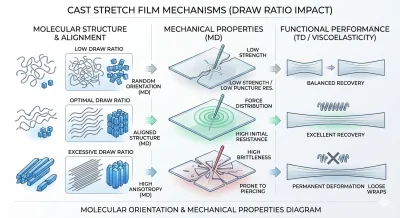
The mechanical draw ratio of a stretch film making machine directly determines the finished film's puncture resistance and elastic recovery. This parameter controls polymer chain alignment during extrusion, separating standard wraps from high-performance packaging. Optimizing the draw ratio allows production equipment to maximize load containment while reducing material thickness.
The Molecular Mechanism: Chains and Crystallinity
The draw ratio is the mathematical relationship between extruded film thickness and final thickness. It dictates molecular alignment along the machine direction (MD):
- Low Draw Ratios: Polymer chains remain randomly oriented, creating balanced but low-strength properties.
- Optimal Draw Ratios: Molecules align forcefully, boosting tensile strength and initial puncture resistance.
- Excessive Draw Ratios: High anisotropy occurs, causing transverse direction (TD) tear strength to plummet.
Impact on Puncture Resistance
A controlled draw ratio increases the film's resistance to sharp objects by modifying its microcrystalline structure.
- Energy Absorption: Proper stretching enables the film to distribute localized impact forces.
- Thickness Reduction: Precise machine control ensures uniform down-gauging without creating weak spots.
- Brittleness Risk: Over-stretching locks the crystalline structure, making the film brittle and prone to piercing.
Impact on Elastic Recovery
Elastic recovery defines the film's ability to snap back after deformation, which is crucial for pallet stability.
- Plastic Deformation: Excessively high draw ratios induce permanent structural elongation.
- Loss of Recovery: Over-stretched polymer networks cannot relax, leading to loose wraps.
- Tension Control: Modern lines utilize adaptive speed rollers to preserve the film's viscoelastic memory.
Machine Configurations and Layer Optimization
Different equipment setups alter how the draw ratio influences the final film properties:
2-3-Layer Stretch Film Machines
A 2-3-layer stretch film machine utilizes co-extrusion to split mechanical duties. A stiff core layer carries the main tensile load, while softer skin layers provide cling. Setting a moderate draw ratio (typically 5:1 to 7:1) orients the core molecules to maximize puncture resistance without destroying the skin’s recovery force.
5-Layer Stretch Film Machines
A 5-layer stretch film machine offers advanced layer distribution for complex recipes, including recycled content. Precise draw ratio management matches the distinct viscoelastic responses of all five layers, ensuring uniform elongation and high puncture thresholds.
Semi-Automatic and Fully Automatic Lines
Integrated automation allows real-time adjustments of the stretch profile. These systems stabilize the draw ratio despite batch-to-batch resin viscosity variations, ensuring consistent performance.
Intelligent Evolution: IoT-Driven Stretch Profiles
Next-generation extrusion lines feature intelligent draw ratio systems integrated with IoT sensors. These machines dynamically adjust roller speeds based on real-time melt temperature and viscosity measurements. Adaptive draw control transitions stretch film production from static mechanical inputs to autonomous, performance-driven outputs.