Multi-layer Stretch Film Extrusion Machine: 300% Stretch Cuts Costs
2026-05-25
Traditional monolayer stretch films often require thick gauges to achieve necessary load retention, leading to high resin consumption, frequent film breaks, and increased per-pallet packaging costs. The next generation of multi-layer stretch film extrusion machine technology resolves these efficiency challenges. Engineered to achieve up to 300% pre-stretch capability, these advanced co-extrusion lines utilize precision die designs and balanced structures to deliver superior cling, puncture resistance, and elongation without compromising load stability.
Core Technical Advantages of Multi-layer Co-extrusion
Modern co-extrusion technology allows for the strategic placement of different polymers across multiple functional layers. By combining flexible core layers with high-modulus skin layers, a multi-layer stretch film extrusion machine optimizes the physical properties of LLDPE formulations.
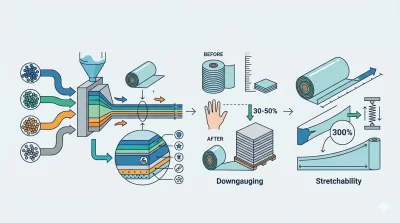
- Advanced Material Downgauging: Enables a 30% to 50% reduction in film thickness while maintaining the mechanical strength required for heavy pallet stabilization.
- 300% High Elongation Rate: High-precision extrusion control ensures the film stretches up to three times its original length without tearing, significantly increasing the yield per roll.
- Optimized Layer Formulation: Independent control over each layer allows for the precise segregation of resins, tackifiers, antiblock agents, and UV stabilizers to maximize film performance.
Machine Classifications and Structural Configurations
Depending on production requirements and layer architecture, multi-layer extrusion lines are configured into specific models to target precise film characteristics.
5-Layer Stretch Film Machine
The 5-layer stretch film machine represents the peak of material engineering, providing two additional functional layers compared to standard lines. This structure allows for extreme downgauging, exceptional puncture resistance, and precise segregation of additives, making it ideal for high-performance, ultra-thin high-stretch film production.
3-Layer Stretch Film Machine
Serving as the industry workhorse, the 3-layer stretch film machine delivers optimal gauge uniformity and precise cling control. It provides a balanced layout (typically A/B/C or A/B/A structures) suitable for a wide range of general-purpose and high-yield industrial wrapping applications.
2-Layer Stretch Film Machine
The 2-layer stretch film machine offers a reliable co-extrusion alternative for basic bundling applications. It provides consistent layer distribution and essential tear resistance for standard wrapping requirements where capital complexity is minimized.
Automation and Process Control Options
To ensure repeatable performance across continuous shifts, the integration of automation systems is critical to eliminating film neck-in and reducing edge waste.
- Fully Automatic Stretch Film Machine: Engineered for continuous, high-volume output. This configuration integrates servo-driven winders, automatic tension control, and real-time thickness monitoring systems to maintain a strict ±1-micron gauge consistency.
- Semi-Automatic Stretch Film Machine: Designed for medium-volume converters. This setup allows for quick recipe changeovers between different multi-layer structures, maintaining film quality with a flexible operational framework.
Quantifiable Cost Reduction and Efficiency
The operational impact of migrating to a high-stretch multi-layer system is directly reflected in material savings. Transitioning from a traditional 20-micron monolayer film to a 12-micron film produced on a multi-layer stretch film extrusion machine cuts overall resin consumption per pallet.
With a stable 300% stretch ratio, the same volume of raw material covers significantly more pallets. This precise gauge control and high elongation efficiency effectively reduce total packaging spend by 15% to 25%, delivering a decisive technical advantage in material-efficient cargo containment.