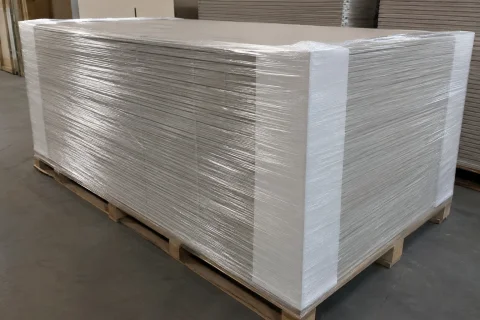
The transportation of gypsum board, also known as plasterboard or drywall, requires reliable packaging solutions that can withstand heavy loads, vibration, and changing environmental conditions. Due to its large surface area, rigid structure, and sensitivity to moisture, gypsum board can be vulnerable to edge damage, shifting loads, and humidity exposure during storage and long-distance transportation.
For manufacturers, distributors, and construction material suppliers, maintaining product quality throughout the logistics process is essential. Traditional packaging methods may not provide sufficient load stability for heavy gypsum board pallets, especially when products are transported over long distances or handled by automated wrapping systems.
A modern stretch film manufacturing machine provides an efficient solution by producing high-performance stretch films with controlled thickness, excellent tensile strength, and consistent wrapping performance. Through advanced extrusion technology and multi-layer film structures, manufacturers can develop packaging materials specifically designed for demanding construction logistics applications.
Challenges of Packaging Gypsum Board for Industrial Transportation
Gypsum board pallets usually contain multiple stacked panels with considerable weight. During transportation, these loads are exposed to various mechanical forces, including acceleration, braking, vibration, and sudden direction changes.
When low-quality stretch film is used, insufficient holding force may allow individual boards to move within the pallet. This movement can create friction between panels, causing edge wear, surface damage, and instability during handling.
Another major challenge is the sharp edge structure of gypsum boards. Unlike soft packaging products, rigid construction panels can create concentrated stress points against the wrapping film. If the film lacks proper puncture resistance and elongation properties, tearing may occur during wrapping or transportation.
Moisture protection is also an important consideration. Gypsum board contains a paper surface layer and a gypsum core that can be affected by excessive humidity or direct water exposure. Effective stretch wrapping helps reduce exposure to environmental moisture during warehouse storage and transportation.
Multi-Layer Film Structures Improve Load Stability
A key advantage of using a stretch film manufacturing machine is the ability to produce multi-layer stretch films with customized performance characteristics.
Compared with traditional single-layer films, multi-layer co-extrusion technology allows manufacturers to assign different functions to different layers of the film structure. For example, a 3-layer or 5-layer stretch film can combine strength, flexibility, puncture resistance, and cling performance within a single material.
The middle layer is typically designed to provide mechanical strength and resistance against tearing forces. The outer layers can be optimized for surface protection, controlled adhesion, and stable wrapping performance.
For gypsum board transportation, this layered structure helps the film maintain integrity when exposed to sharp edges, pallet pressure, and continuous vibration during logistics operations.
Modern stretch film production lines achieve this performance through precise extrusion control, stable melt distribution, and accurate layer ratio adjustment. These technologies allow manufacturers to produce films that match different load requirements and packaging conditions.
High Pre-Stretch Performance Reduces Material Consumption
For heavy construction materials, maintaining consistent wrapping force is critical. A stretch film with insufficient elasticity may require more material to stabilize the pallet, while excessive stretching can reduce film strength.
Advanced stretch film manufacturing machines are equipped with precision-designed stretching systems that can provide high pre-stretch ratios according to production requirements. During the manufacturing process, controlled stretching aligns polymer chains and improves the film’s tensile properties and recovery performance.
When used with automatic pallet wrapping equipment, properly produced stretch film can apply consistent containment force around gypsum board stacks. This helps reduce pallet movement, improves load stability, and supports efficient transportation.
The actual pre-stretch ratio depends on factors such as raw material formulation, film thickness, machine configuration, and end-user packaging requirements. Therefore, film manufacturers can adjust production parameters to achieve the required balance between strength and material efficiency.
Moisture Resistance Through Advanced Film Materials
Gypsum board protection requires packaging materials that can perform reliably under changing environmental conditions. Stretch film produced by modern extrusion equipment can incorporate different polyethylene materials to improve barrier performance.
Linear low-density polyethylene (LLDPE) is commonly used in stretch film production because of its combination of flexibility, toughness, and puncture resistance. Metallocene polyethylene (mLLDPE) can also be added to improve mechanical properties and film consistency.
Through multi-layer co-extrusion technology, manufacturers can optimize the film structure for specific applications. Certain layers can focus on strength, while others provide improved sealing performance and surface characteristics.
For construction materials stored in warehouses, transportation yards, or outdoor environments, additional additives such as UV stabilizers may be considered to improve film durability during extended exposure to sunlight.
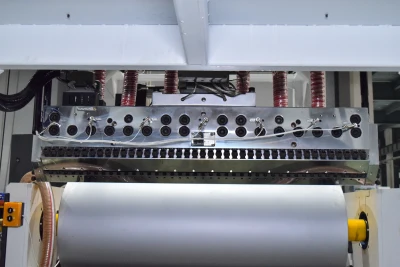
Machine Design Considerations for Heavy Industrial Production
Stretch film production environments often require equipment capable of long-term continuous operation. Factors such as dust, temperature variation, and production intensity can influence machine reliability.
Our industrial stretch film manufacturing machines are designed with durable components, stable drive systems, and efficient cooling structures to support continuous production.
Important equipment features include:
- Precision extrusion systems for stable polymer melting
- Automatic temperature control for consistent processing conditions
- Reliable winding systems for uniform film rolls
- PLC-based control systems for easier operation and parameter management
- Optimized mechanical structures for long-term operation
Producing Reliable Stretch Film for Construction Material Logistics
The transportation of gypsum board requires packaging materials that combine strength, flexibility, and consistent performance. A suitable stretch film solution depends not only on the film formulation but also on the accuracy and stability of the production equipment.
A high-quality stretch film manufacturing machine enables manufacturers to produce customized stretch films with controlled thickness, stable mechanical properties, and reliable wrapping performance for heavy industrial applications.
Our 3-layer and 5-layer stretch film manufacturing machines are designed for manufacturers who require efficient production, precise extrusion control, and consistent film quality. With advanced automation systems, optimized extrusion technology, and reliable mechanical design, our equipment helps customers develop stretch film solutions suitable for construction materials, logistics, and other demanding packaging applications. Contact our technical team to discuss your production requirements and explore the right extrusion solution for your business.