The Circular Economy Challenge: Maintaining Stretch Film Performance with 30% Recycled Content
2026-05-20
The push toward circular economy targets compels manufacturers to incorporate post-consumer recycled (PCR) and post-industrial recycled (PIR) resins into stretch film production. However, introducing 30% recycled content from reclaimed LLDPE or LDPE disrupts molecular weight distribution and melt flow consistency. Recycled resins often carry degraded polymer chains and contaminants, compromising melt stability, causing gel defects, and reducing puncture resistance. Advanced co-extrusion technology provides the critical solution to these material limitations.
Co-Extrusion Solutions for Recycled Feedstocks
3-Layer and 5-Layer Stretch Film Machines
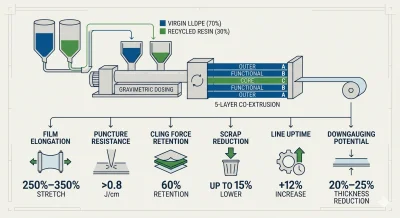
- Core Layer Isolation: A 3-layer stretch film machine or 5-layer stretch film machine enables precise co-extrusion architecture.
- Performance Safeguards: These systems isolate the 30% recycled content within a central core layer, sandwiched between premium virgin outer skins.
- Surface Cling: This structural design preserves surface cling, tack, and optics while exposing the recycled core to lower shear stress.
2-Layer Stretch Film Machines
- Economic Entry: A 2-layer stretch film machine offers an accessible entry point for blending up to 30% recycled materials.
- Specialized Hardware: Equipped with barrier screws and custom screw designs, it ensures adequate melt homogenization.
- Application Target: This setup is highly effective for applications requiring pre-stretch ratios under 200%.
Automation and Process Control
Fully Automatic Stretch Film Machines
- Gauge Control: A fully automatic stretch film machine incorporates closed-loop gauge control to counter melt flow fluctuations inherent in PCR/PIR feedstocks.
- Real-Time Adjustments: Adaptive temperature profiling across all heating zones automatically regulates extruder RPM, melt temperature, and die gaps.
- Thickness Uniformity: The system maintains film thickness uniformity within ±2 microns, completely eliminating film breaks during high-speed continuous runs.
Semi-Automatic Stretch Film Machines
- R&D Flexibility: A semi-automatic stretch film machine provides excellent process flexibility for pilot lines and small-batch production.
- Parameter Optimization: Operators can precisely tune screw speeds and cooling roller temperatures.
- Mechanical Integrity: This precise control optimizes the recrystallization rate of the recycled resin, improving film elongation without sacrificing tear strength.
Technical Specifications and Performance Metrics
When utilizing advanced extrusion platforms with controlled blending logic—dosing 30% recycled content by weight and 70% virgin LLDPE via gravimetric feeders—the output meets rigorous industrial standards:
- Film Elongation: Achieves 250% to 350% stretch capacity.
- Puncture Resistance: Exceeds 0.8 J/cm to prevent tearing.
- Cling Force Retention: Maintains a consistent 60% retention rate.
- Scrap Reduction: Lowers production scrap rates by up to 15%.
- Line Uptime: Increases continuous production uptime by 12%.
- Downgauging Potential: 5-layer co-extrusion allows a 20% to 25% thickness reduction without losing load containment.
- Through precise thermal management and multi-layer isolation, modern stretch film extrusion lines ensure that incorporating 30% recycled resins no longer compromises mechanical performance or load stability.