How Stretch Film Extrusion Machine Improves Film Stretch Strength
2026-09-02
Stretch film is widely used to secure pallets, cartons, industrial components, food products, and other goods during storage and transportation. While material selection plays an important role in stretch film performance, the quality of the finished stretch film also depends heavily on the extrusion process. Melt uniformity, stretch film thickness, cooling conditions, layer structure, and winding tension can all influence the mechanical properties of stretch film.
For manufacturers looking to produce stretch film with stable tensile strength, elongation, puncture resistance, and load-holding performance, selecting the right stretch film extrusion machine is therefore an important production decision. A well-designed extrusion line provides better control over the key processing conditions that determine stretch film consistency and performance.
Why Stretch Film Strength Depends on the Extrusion Process
Stretch film needs to withstand repeated mechanical stress during wrapping, handling, transportation, and storage. Stretch film with inconsistent thickness or unstable molecular orientation may perform differently from one area to another, even when the same polymer formulation is used.
Several production factors can influence this performance. Uneven melting can affect the consistency of the polymer melt, while unstable die conditions may create thickness variations across the stretch film width. Cooling conditions can also influence stretch film formation and mechanical behavior. During winding, excessive or unstable tension may introduce unnecessary deformation before the finished stretch film roll reaches the packaging line.
For this reason, improving stretch film strength is not simply a matter of adding more raw material. A more effective approach is to establish stable control over the complete stretch film extrusion process.
Common Production Limitations That Affect Stretch Film Performance
Simple extrusion configurations can have limited flexibility when manufacturers need to balance different stretch film properties. In a single-layer structure, the same material must generally provide several functions at the same time, including strength, flexibility, cling, and processability.
Temperature control is another important consideration. If processing temperatures fluctuate significantly, polymer plasticization and melt flow can become less consistent. This may contribute to variations in the finished stretch film and make it more difficult to maintain stable mechanical performance.
Stretch film thickness is equally important. Localized thin areas can become weaker points when the stretch film is stretched or subjected to impact. Maintaining a consistent stretch film thickness distribution therefore helps manufacturers produce stretch film with more predictable performance.
Cooling and winding also require attention. Inadequate or unstable cooling can affect stretch film formation, while inconsistent winding tension can cause unwanted stretching during the production of the finished stretch film roll.
How a Stretch Film Extrusion Machine Supports Higher Stretch Film Strength
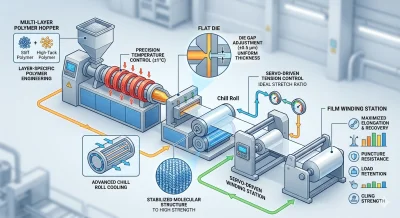
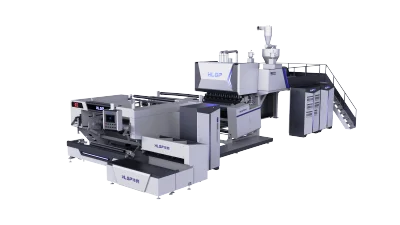
A modern stretch film extrusion machine is designed to control these production variables more precisely. Instead of relying on a single adjustment point, the extrusion line combines temperature control, melt processing, die adjustment, cooling, and winding systems to create more stable stretch film production conditions.
Independent Temperature Control and Uniform Melting
Different polymer materials may require different processing conditions. An extrusion system with independent temperature control provides better control over the heating and plasticizing process of each extrusion unit.
Stable melt processing helps reduce variations caused by temperature fluctuations and supports more consistent stretch film formation. For manufacturers using materials such as LLDPE, HDPE, and LDPE in different layers, accurate temperature management is particularly important because each material may behave differently during extrusion.
The use of 38CrMoAlA nitrided screws also provides a durable screw configuration for continuous polymer processing. Proper screw design and processing conditions work together to support stable plasticization and melt delivery.
Automatic Die Gap Adjustment for Consistent Stretch Film Thickness
Stretch film thickness consistency has a direct relationship with the usable mechanical performance of stretch film. If the stretch film contains significant thickness variations, some areas may carry more load while thinner areas can become more vulnerable during stretching.
An automatic die-gap adjustment system helps maintain a more consistent thickness distribution across the stretch film width. The machine can be designed to control stretch film thickness variation within ±3% under specified production conditions, providing manufacturers with a practical target for thickness uniformity.
This type of control is particularly useful when producing thinner stretch film, where even relatively small thickness variations can have a greater influence on the overall consistency of the finished stretch film product.
Controlled Cooling for Stable Stretch Film Formation
After the polymer exits the die, cooling plays an important role in determining the final condition of the stretch film. A circulating water cooling system provides a controlled environment for stretch film formation and helps maintain stable processing conditions during continuous production.
Consistent cooling can support more uniform stretch film formation and help reduce variations caused by unstable thermal conditions. Combined with controlled extrusion and thickness adjustment, it contributes to more predictable stretch film properties throughout the production run.
For manufacturers producing stretch film for demanding packaging applications, stable cooling is especially valuable because the objective is not only to achieve high output but also to maintain consistent stretch film performance from roll to roll.
Servo-Driven Winding Tension Control
Winding is the final stage of stretch film production, but it can also affect the condition of the finished stretch film. Excessive winding tension may introduce unnecessary stretching, while unstable tension can lead to inconsistent stretch film roll formation.
Servo-driven winding systems provide more precise control of winding tension and help maintain stable stretch film handling throughout the winding process. By controlling tension more accurately, manufacturers can reduce unnecessary deformation and maintain more consistent stretch film roll quality.
This is particularly important for stretch film because the material is expected to stretch during the packaging process rather than being excessively deformed during production.
Why Strong Stretch Film Matters in Different Industries
Heavy industrial equipment and machinery components often have sharp edges and high package weight. In these applications, stable stretch film thickness and mechanical strength can help reduce the risk of localized stretch film damage during wrapping and transportation.
Cold-chain food packaging presents another challenge. Temperature changes can influence the flexibility and impact behavior of polymer stretch film. A well-controlled extrusion process can help manufacturers produce stretch film with consistent thickness and balanced elasticity for demanding transportation conditions.
Building materials, profiles, and other long products also require reliable load holding during transportation. Stable stretching and recovery characteristics help stretch film maintain effective wrapping tension around the packaged goods, reducing the possibility of package loosening caused by handling and vibration.
Our Stretch Film Extrusion Machine Solution
Our stretch film extrusion machines are developed around the key production factors that influence stretch film consistency and mechanical performance. The available three-layer and five-layer configurations support flexible multilayer stretch film production using materials such as LLDPE, HDPE, and LDPE.
With independent temperature control, 38CrMoAlA nitrided screws, automatic die-gap adjustment, a circulating water cooling system, and servo-driven winding tension control, the equipment is designed to provide manufacturers with greater control over melting, stretch film thickness, cooling, and winding conditions.
For producers seeking a reliable stretch film extrusion machine for consistent stretch film quality and flexible multilayer production, our equipment provides a practical combination of process control, material flexibility, and production stability for a wide range of packaging applications.