
Precision Instrument Storage Requires Advanced Packaging Solutions
In the storage and transportation of precision instruments, calibration equipment, optical sensors, and industrial testing devices, packaging performance directly affects product reliability and service life. Unlike ordinary industrial goods, precision equipment often contains sensitive optical components, electronic circuits, metal contacts, and finely machined surfaces that require protection from dust, moisture, oxidation, and mechanical impact.
During long-term storage or international logistics, even minor environmental changes can influence instrument accuracy. Humidity may accelerate corrosion on metal components, airborne particles can contaminate optical surfaces, and unstable packaging structures may cause movement damage during transportation. Therefore, manufacturers and logistics providers increasingly require high-performance protective films with excellent barrier properties, clean surface contact, and stable wrapping force.
Challenges of Traditional Packaging for Precision Instruments
Precision instruments require packaging solutions that provide both environmental protection and mechanical stability. However, traditional packaging methods often face limitations when applied to high-value equipment.
One major challenge is contamination control. Precision measuring instruments, optical sensors, and calibration devices are highly sensitive to dust particles, oil residues, and moisture exposure. Conventional packaging materials may not provide sufficient sealing performance, allowing external contaminants to enter during storage. For optical components and electronic sensors, surface contamination can reduce measurement accuracy and increase maintenance requirements.
Another challenge is chemical cleanliness. Many precision instruments include protective coatings, optical lenses, and sensitive electronic assemblies that can be affected by material migration. Some low-quality plastic films may release small amounts of additives or low-molecular-weight substances over extended storage periods. These residues can attach to surfaces and require additional cleaning procedures, which may increase handling costs or create risks for delicate components.
Mechanical protection is also a key concern. Precision instruments often include irregular structures such as cables, probes, connectors, and detachable accessories. During transportation, insufficient wrapping force can allow internal movement, causing friction between components or damage caused by vibration. Traditional packaging films with unstable thickness distribution may lose elasticity over time, resulting in loose packaging and reduced protection performance.
To overcome these challenges, packaging film manufacturers need production equipment capable of creating clean, consistent, and highly controllable stretch films.
The Role of Stretch Film in Precision Instrument Protection
High-quality stretch film plays an important role in creating a controlled protection environment for precision instruments. With excellent transparency, elasticity, and self-adhesive performance, stretch film can provide secure wrapping without directly applying adhesives to sensitive surfaces.
One of the primary functions of stretch film is creating a dust and moisture barrier. When the film is tightly wrapped around equipment, multiple layers form a continuous protective shield that reduces exposure to external environmental factors. This helps maintain cleaner storage conditions for optical devices, laboratory equipment, electronic testing instruments, and industrial measurement tools.
Another important advantage is clean surface protection. Unlike tapes or adhesive packaging materials, stretch film relies on controlled cling performance between film layers rather than chemical bonding with the product surface. This feature allows operators to remove the packaging without leaving adhesive marks or requiring additional cleaning processes.
Stretch film also improves transportation stability. The elastic recovery force generated by stretched film helps secure components and reduce movement inside the package. For precision equipment with complex structures, stable holding force can minimize vibration and friction damage during handling, loading, and international shipment.
Different instrument storage environments may also require different film characteristics. For example, optical equipment may require high transparency and low residue performance, while industrial sensors may require stronger puncture resistance and higher tensile strength. Flexible stretch film production technology allows manufacturers to develop customized films according to specific application requirements.
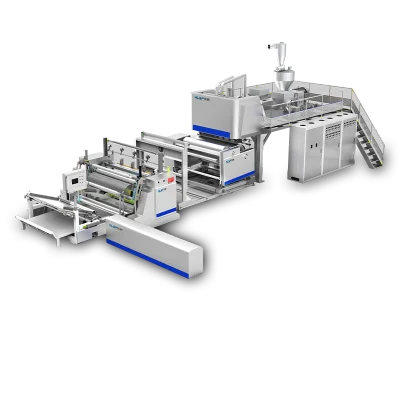
How Stretch Film Manufacturing Machine Improves Film Performance
The production quality of protective stretch film depends heavily on the capability of the manufacturing equipment. A modern stretch film manufacturing machine integrates advanced extrusion, cooling, stretching, and winding technologies to ensure stable film performance for demanding applications.
Multi-layer co-extrusion technology is one of the most important features for producing specialized stretch films. By using 2-layer, 3-layer, or 5-layer configurations, manufacturers can design different functional layers within a single film structure. The outer layer can provide wear resistance and protection, the middle layer can improve tensile strength and elasticity, while the inner layer can optimize cling performance for stable wrapping.
This flexible layer design enables packaging film producers to manufacture films suitable for precision instrument storage, where balanced mechanical strength and surface protection are essential. Advanced resin combinations, including LLDPE and metallocene-based materials, can be accurately processed to improve stretchability, puncture resistance, and film consistency.
Precise material control is another key advantage of advanced stretch film production equipment. Equipped with gravimetric dosing systems, the stretch film manufacturing machine can accurately measure and mix different raw materials during extrusion. This improves production stability, reduces material variation, and helps maintain consistent film properties throughout large-scale manufacturing.
For high-value equipment packaging, film cleanliness is particularly important. Precise extrusion control helps minimize defects caused by unstable processing conditions and supports the production of films with reliable self-adhesive performance. The result is a protective material that securely wraps instruments while reducing the risk of unwanted surface contamination.
Automatic thickness control technology further enhances film reliability. Modern machines can integrate Automatic Gauge Control (AGC) systems and online thickness measurement sensors to monitor film thickness during production. Maintaining uniform thickness distribution ensures balanced tensile strength and prevents weak points that could lead to tearing during wrapping.
For precision instrument applications, consistent thickness is especially important because packaging performance depends on stable holding force. A film that is too thin may fail during transportation, while excessive thickness may increase material consumption and packaging costs. Intelligent thickness control allows manufacturers to achieve an optimal balance between protection performance and production efficiency.
The stretching and winding system of the machine also influences the final film quality. Advanced cast film processing technology provides controlled stretching performance, allowing the produced film to maintain elasticity and recovery force after application. High-precision winding systems ensure smooth rolls with consistent tension, improving efficiency for downstream packaging operations.
Supporting High-Value Industrial Packaging Through Advanced Film Production
The demand for reliable precision instrument packaging continues to grow as industries such as electronics manufacturing, aerospace inspection, medical technology, and industrial automation expand globally. These sectors require packaging materials that can protect expensive equipment throughout storage, export transportation, and supply chain operations.
A high-performance stretch film manufacturing machine enables film producers to respond to these market requirements by delivering customized protective film solutions with stable quality, efficient production, and flexible configurations. From multi-layer extrusion technology to intelligent thickness control systems, advanced equipment provides the foundation for manufacturing stretch films that meet the strict requirements of precision equipment protection.
For packaging material manufacturers, investing in reliable stretch film production technology means improving product competitiveness while expanding opportunities in high-value industrial packaging markets. With accurate processing capabilities, energy-efficient operation, and consistent film output, modern stretch film manufacturing machines help create protective solutions that support the safe storage and transportation of precision instruments worldwide.