Semi-Automatic Stretch Film Extrusion Machine: Performance & Industrial Applications

2026-09-11

Packaging operations of every size face the same tension: production lines need consistent stretch film quality without the capital outlay of a fully automated system. A semi-automatic stretch film extrusion machine fills that gap. It produces high-performance LLDPE stretch film with strong tensile strength, reliable puncture resistance, and the clarity modern supply chains expect, while keeping entry cost and operating complexity within reach of small and mid-sized manufacturers.

Where Traditional Stretch Film Lines Fall Short

Older or lower-spec extrusion setups tend to share the same weaknesses. Single-screw systems with a shallow length-to-diameter ratio struggle to plasticize resin evenly, which shows up later as gel spots, streaking, or uneven clarity in the finished roll. Thickness control is another recurring problem: without a properly engineered die and gauge system, output drifts outside a workable tolerance, forcing operators to overbuild the film or accept a higher scrap rate. Width flexibility is often limited too, so one line cannot easily move between manual rolls, machine-grade rolls, and wider industrial-format stretch film without significant downtime. Formula, color, and width changeovers tend to be slow and labor-intensive as well, adding hidden cost each time a run changes. For manufacturers serving more than one market segment, these limitations compound quickly.

The Role of Stretch Film Across Industrial Sectors

Stretch film is a small part of the packaging chain, but its performance has an outsized effect on how goods move through logistics and storage. In pallet wrapping for warehousing and freight, film holds a load together through repeated handling and long-distance transit, so any weak point in gauge consistency becomes the point where a wrap fails. In electronics and precision instrument packaging, stretch film is often the last barrier against dust, moisture, and surface scratching, so uneven thickness or micro-defects are protection failures, not just cosmetic ones. Construction and heavy-material packaging, such as bundling aluminum profiles or ceramic tile, pushes stretch film toward its puncture-resistance limits, and film from inconsistent equipment tears more easily under sharp edges and heavy loads. Food and beverage distribution relies on stretch film as a secondary barrier against moisture during shipping, where clarity and seal integrity both affect how the product looks on arrival. Across these sectors, inconsistent film quality traces back to inconsistent extrusion performance upstream.

Extrusion Technology Built for Consistent Melt Quality

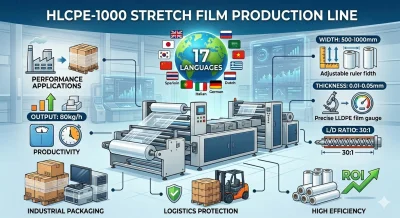
A properly engineered co-extrusion system addresses the plasticization problem at its source. Multi-screw configurations with a length-to-diameter ratio around 30:1 melt the resin thoroughly and evenly, producing a homogeneous melt free of the gels and impurities that undermine strength and clarity. For pallet wrapping and heavy-material bundling, this uniform melt means the film resists puncture and tearing under real handling conditions, not just in lab tests. For electronics packaging, the same melt consistency keeps the film's protective barrier intact across the full roll width, without thin spots where contamination or moisture could get through.

3-5-Layer Stretch Film Making Machine

Gauge Precision and Die Technology That Match the Application

Thickness control is where load-bearing performance and material cost meet. A stable output range between 0.01mm and 0.05mm, supported by a high-precision T-die, lets operators dial in film thickness to match the actual load instead of defaulting to a heavier gauge out of caution. A pallet of lightweight cartons can run on a thinner, more economical film, while aluminum profiles or ceramic tile can run on a thicker specification built for higher puncture resistance, all on the same line. This gauge precision cuts raw material consumption without compromising load-bearing integrity, a direct cost advantage for manufacturers serving both light-duty and heavy-duty segments.

Width Flexibility for Multiple Roll Formats

An adjustable output width from 500mm to 1000mm turns a single production line into a multi-format operation. Manual rolls, machine-grade rolls for automated wrapping equipment, and large-format industrial stretch film can all come off the same line, with no need for separate equipment per format. This matters for manufacturers serving logistics, food and beverage distribution, and construction material packaging at once, since each sector tends to favor a different roll width. Rather than running multiple narrow-purpose machines, a manufacturer can consolidate production and respond to shifting order mixes without adding capital equipment.

Operational Efficiency and Lower Capital Requirements

A semi-automatic design keeps output high while managing power consumption and maintenance costs more efficiently than a fully automated line typically allows. For small and mid-sized manufacturers, this efficiency matters as much as raw output, since it keeps running costs proportional to production volume. The lower capital expenditure also gives manufacturers a realistic entry point into stretch film production without compromising film quality, closing the gap between what a fully automated system can produce and what a smaller operation can afford to run.

Manufacturing Agility Across Formulas and Specifications

Beyond raw output, the ability to switch formulas, tints such as black or blue, and width specifications without extended downtime lets a single line serve multiple industries at once. A manufacturer might run a batch of UV-stabilized black film for outdoor storage one day and a fully transparent film for retail-facing food packaging the next. Fast changeovers turn that demand variability into a scheduling question rather than a production bottleneck, one of the clearest advantages a semi-automatic line holds over rigid, single-purpose setups.

Stretch Film Performance That Drives Down Cost Per Pallet

High pre-stretch capability is where film quality and economics converge. Film that stretches further before reaching its load-bearing limit covers more pallets per kilogram of raw material, lowering the effective cost per pallet even when the upfront film price is comparable to lower-performance alternatives. Combined with the gauge precision and melt consistency described above, this pre-stretch performance lets a semi-automatic stretch film extrusion machine compete on long-term return on investment rather than price per roll alone.

We design and build semi-automatic stretch film extrusion machines around these priorities: a co-extrusion system engineered for consistent melt quality, precision gauge control across a 0.01mm to 0.05mm thickness range, adjustable output widths from 500mm to 1000mm, and an operational footprint that keeps power consumption and maintenance costs manageable for growing manufacturers. If your line needs to serve multiple industries, switch formulas quickly, and deliver stretch film that holds up under real transit and storage conditions, our engineering team can help you match the right configuration to your output and application needs.

Blog Cover

GET IN TOUCH NOW

*We respect your privacy. When you submit your contact information, we agree to only contact you in accordance with our Privacy Policy.