In industrial pallet wrapping, stretch ratio defines how much a film can be elongated before application. It directly affects wrapping performance, material usage, and load containment behavior.
The stretch ratio of a film is determined by the structure created in the stretch film making machine, particularly its co-extrusion system. The number of layers influences how materials are distributed and how the film responds under stress.
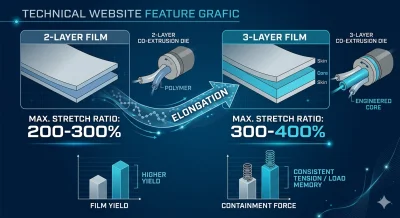
A 2-layer stretch film making machine produces film with a simpler structure. The materials are combined into two functional layers without a distinct internal separation of roles. This structure typically results in a maximum stretch ratio in the range of 200% to 300%. The elasticity and force distribution are relatively uniform across the film.
A 3-layer stretch film making machine, in contrast, produces film with three distinct layers. These usually include two outer layers and one core layer. Each layer can be formulated with different material properties. The core layer is often designed to handle stress and deformation, while the outer layers focus on surface performance such as cling and strength.
Because of this layered structure, the film produced by a 3-layer system typically achieves a higher maximum stretch ratio, generally between 300% and 400%. The difference comes from how stress is distributed across the layers and how the internal structure responds during elongation.
The key distinction is structural rather than simply numerical. In 2-layer films, performance is based on a combined material response. In 3-layer films, performance is defined by the interaction between independently designed layers. This leads to different stretching behaviors, load retention characteristics, and application performance.
These differences in structure and stretch ratio define how each type of film performs under various packaging conditions, without relying on changes in thickness or overall material volume.