Workflow of a Fully Automatic Stretch Film Extrusion Machine: A Complete Guide

2026-08-14

The packaging industry is continuously moving toward higher efficiency, better material utilization, and more consistent film performance. Traditional stretch film production methods often face challenges such as unstable thickness control, high dependence on manual operation, production interruptions during roll changes, and limited flexibility in material formulation.

A fully automatic stretch film extrusion machine provides an advanced solution by combining multi-layer co-extrusion technology, precise extrusion control, automatic winding systems, and intelligent process management. These technologies allow manufacturers to produce high-quality stretch film with stable mechanical properties, excellent transparency, and improved production efficiency. Modern stretch film production lines commonly use multiple extruders to process materials such as LLDPE, mLLDPE, and recycled materials in different layer structures, allowing each layer to perform a specific function.

For companies producing pallet wrapping film, industrial packaging film, or high-performance machine-grade stretch film, understanding the complete workflow of a stretch film extrusion machine is essential for selecting the right equipment and optimizing production performance.

Challenges in Traditional Stretch Film Production

Difficulties in Maintaining Film Thickness Uniformity

Film thickness consistency is one of the most important factors affecting stretch film quality. Uneven thickness can lead to inconsistent stretching performance, reduced load stability, and higher risks of film breakage during packaging operations.

In traditional production systems, fluctuations in melt pressure, temperature changes, or unstable material feeding can influence the final film quality. A modern stretch film extrusion machine addresses these issues through precise temperature control, stable extrusion systems, and optional online thickness monitoring technology.

By maintaining a stable melt flow before the material enters the T-die, the production line can improve thickness uniformity and ensure more consistent film performance throughout the entire roll.

Production Interruptions Caused by Manual Roll Changes

In conventional stretch film production, operators may need to manually replace finished rolls and restart the winding process. This operation increases labor requirements and may reduce overall production efficiency.

Fully automatic winding systems are designed to minimize manual intervention. When the film roll reaches the preset diameter or length, the automatic winding unit can complete roll change procedures, including cutting, transferring the film, and starting a new winding cycle. This improves production continuity and helps manufacturers achieve more stable output.

Material Waste and Production Cost Pressure

Material efficiency has become an important concern for film manufacturers. During stretch film production, edge trimming and process adjustments may create material waste if no recycling system is available.

Modern stretch film production lines can integrate edge trimming and recycling equipment to collect suitable waste materials and return them into the production process according to the required formulation. This approach helps reduce raw material consumption and improves overall production economics.

Limited Flexibility for Different Film Formulations

Different industries require different stretch film properties. Logistics companies may require high stretchability and load retention, while industrial packaging applications may focus more on puncture resistance and durability.

Single-layer production methods have limitations when manufacturers need to balance multiple performance requirements. Multi-layer co-extrusion technology allows different materials to be assigned to different layers, creating more flexible film structures. Three-layer and five-layer configurations are widely used because they allow manufacturers to optimize surface performance, core strength, and material costs.

The Importance of High-Performance Stretch Film in Modern Packaging

Improving Packaging Efficiency Through High Stretch Performance

Stretch film plays an important role in logistics, warehousing, and industrial transportation because it secures products during storage and shipment. High-performance stretch film can provide strong load retention while using less material compared with conventional packaging methods.

The final stretching performance depends on multiple factors, including resin selection, layer structure, extrusion stability, and winding control. A properly configured stretch film extrusion machine helps manufacturers produce films with excellent elasticity and reliable wrapping performance.

Multi-Layer Structure for Customized Film Properties

One of the main advantages of modern extrusion technology is the ability to produce multi-layer films with different functional layers.

The outer layers can be optimized for surface properties such as cling performance, abrasion resistance, and smooth unwinding. The middle layer can focus on strength, toughness, and material optimization. By combining materials such as LLDPE and mLLDPE, manufacturers can achieve improved puncture resistance and stretching characteristics while controlling production costs.

This layered design provides greater flexibility for producing hand stretch film, machine stretch film, and specialized packaging films.

Better Transparency for Product Identification

Transparency is another important property of stretch film, especially in logistics and warehouse applications where labels, barcodes, and product information need to remain visible.

The cast extrusion process used in stretch film production relies on controlled melt flow and rapid cooling through a chill roll system. Proper cooling conditions help improve film appearance, surface quality, and optical clarity.

Heating System of Stretch Film Making Machine.png

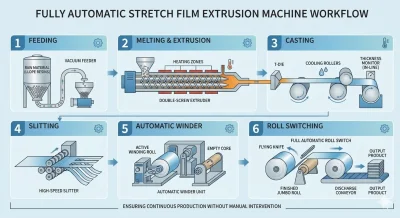
Complete Workflow of a Fully Automatic Stretch Film Extrusion Machine

Multi-Layer Co-Extrusion System: Creating Advanced Film Structures

The production process begins with the preparation and feeding of polymer materials into independent extruders. Each extruder melts and plasticizes the material under controlled conditions before delivering the melt to the feed block and T-die.

A fully automatic stretch film extrusion machine can be configured with different layer structures, such as ABA, ABC, or more advanced multi-layer designs. Each layer can use different material combinations depending on the required film performance.

For example, mLLDPE may be introduced into specific layers to improve toughness and puncture resistance, while standard LLDPE can help optimize cost efficiency. This flexible structure enables manufacturers to develop films for different market applications.

Precision Temperature Control and Cast Film Forming

After extrusion, the molten polymer passes through the flat T-die to form a continuous film sheet. Precise temperature control throughout the extrusion system ensures stable melt conditions and reduces fluctuations during production.

The cast film then contacts the cooling roll, where controlled cooling solidifies the film and improves surface quality. A well-designed cooling system helps maintain film flatness, transparency, and dimensional stability during high-speed operation. Industrial stretch film cast lines commonly combine multi-layer extrusion with precision cooling and automatic winding systems to achieve consistent production results.

Online Monitoring and Automatic Process Adjustment

To improve production consistency, advanced stretch film extrusion machines can be equipped with online inspection systems, including thickness measurement devices.

These systems continuously monitor film thickness and provide feedback information for process adjustment. By detecting changes during production, manufacturers can maintain more stable film quality and reduce the possibility of producing off-spec materials.

Automation also extends to other areas, including extrusion speed control, tension management, and winding parameter adjustment.

Automatic Winding and Roll Change System

The winding section is a key part of a fully automatic stretch film production line. After cooling and trimming, the finished film enters the winding unit under controlled tension.

The automatic winding system manages roll formation, tension stability, and roll replacement. When the preset roll size is reached, the system completes the changeover process with minimal operator involvement.

This continuous operation capability is especially valuable for large-scale production environments where stable output and reduced downtime are important.

Edge Recycling System for Improved Material Utilization

During film production, edge trimming is necessary to achieve accurate film width. The trimmed material can be collected through an edge recycling system.

After processing, suitable recycled material may be reused in designated layers depending on product requirements and quality standards. This improves material utilization and supports more sustainable production practices.

Production Advantages of Our Fully Automatic Stretch Film Extrusion Machine

A fully automatic stretch film extrusion machine represents more than an upgrade in production equipment. It provides manufacturers with improved process control, higher production stability, and greater flexibility in developing different film products.

Through multi-layer co-extrusion technology, precise extrusion management, automatic winding systems, and efficient material handling, modern stretch film production lines help companies produce high-quality packaging films while reducing operational challenges.

For manufacturers looking to expand production capacity, improve film consistency, and optimize long-term production costs, selecting the right stretch film extrusion machine configuration is an important step toward building a more efficient and competitive packaging film operation.

Blog Cover

GET IN TOUCH NOW

*We respect your privacy. When you submit your contact information, we agree to only contact you in accordance with our Privacy Policy.