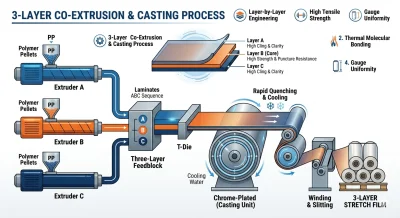
In high-performance packaging, the internal structure of a film determines its operational reliability. A modern stretch film making machine utilizes advanced co-extrusion technology to overcome the limitations of conventional single-layer materials. By producing a 3-layer cast stretch film, manufacturers can engineer specific functional properties into each layer, ensuring maximum durability and material efficiency.
1. The Co-Extrusion Process: Layer-by-Layer Engineering
The production of high-quality 3-layer film relies on three independent extruders. This system allows for precise metering of polymer melts, creating a composite structure with specialized functional zones:
- Outer Layers (A & C): These surface layers are engineered for high cling and optical clarity. They ensure the film adheres firmly to itself without leaving residue on the palletized goods, while maintaining transparency for scanning.
- Core Layer (B): Positioned between the outer layers, the core acts as the structural backbone. It is formulated for high tensile strength and superior puncture resistance.
2. Precision Lamination: The Feedblock and ABC Sequence
The technological core of the stretch film making machine is the three-layer distributor (feedblock). This precision manifold performs critical structural functions:
- ABC Configuration: It laminates three separate molten streams into a single, unified composite flow in a precise ABC sequence.
- Thermal Molecular Bonding: Because the layers merge while in a molten state, they achieve a permanent thermal bond, preventing delamination even under extreme tension.
- Gauge Uniformity: The feedblock ensures an even distribution of polymer across the entire width, which is vital for consistent film performance.
3. Formation and Cooling: T-Die and Casting Unit
Once the layers are sequenced, the melt is extruded through a high-precision T-die. This flat-die system is essential for maintaining strict thickness (gauge) tolerances across the entire film profile.
The molten "curtain" then contacts a high-speed chill roll (casting unit). This rapid quenching process is decisive for the film's final properties:
- Molecular Locking: It freezes the polymer structure instantly to enhance mechanical strength.
- Crystal Clarity: Rapid cooling prevents large crystal formation, resulting in the high transparency required for product identification.
- High Elongation: The casting process optimizes the film's ability to stretch up to 300% or more without breaking.
4. Technical Advantages of 3-Layer Cast Structures
Utilizing a stretch film making machine for 3-layer production delivers significant technical performance gains over monolithic films.
The reinforced core layer provides up to 50% higher puncture resistance, which is critical for securing sharp-edged industrial loads. This enhanced strength also allows for downgauging—using thinner films to achieve the same containment force—thereby reducing material consumption by 20-30%. Furthermore, the specialized outer layers provide optimized cling force and high elastic memory, ensuring that pallet loads remain stable and secure throughout long-distance logistics cycles.
Conclusion
The 3-layer cast stretch film is the result of sophisticated mechanical coordination and thermal management. By leveraging independent extrusion and precision casting, a stretch film making machine produces a high-performance material that minimizes waste and maximizes load security in the global supply chain