Stretch Film Extrusion Machine: Applications and Performance Overview
2026-08-27
In global logistics and manufacturing, packaging efficiency has become a critical driver of operational success, and the equipment behind that packaging matters just as much as the materials it uses. A modern stretch film extrusion machine represents the practical intersection of those two priorities, designed to deliver high-performance wrapping solutions that maximize load stability while minimizing material waste. As packaging requirements continue to evolve, stretch film extrusion technology is also moving toward greater process stability, tighter film consistency, and more efficient material use across different packaging applications.
The Limits of Single-Layer Extrusion
Older single-layer extrusion methods were never designed to do more than one job well, and that limitation shows up constantly on the production floor. A film optimized for cling adhesion typically lacks the structural strength to hold heavy or irregular loads, while a film reinforced for strength often loses the puncture resistance that sensitive goods need during transit, forcing operators to choose which weakness they can live with. Downgauging capability is another persistent gap: without high-performance resin processing, traditional machines can only reduce film thickness so far before strength drops below a usable threshold, which means facilities end up consuming more raw material than the load actually requires just to stay safe. Add in the absence of precision melt pumps, calibrated dies, and efficient cooling systems, and thickness consistency becomes unpredictable from batch to batch. Many older lines also still depend heavily on manual operation, which limits both production speed and repeatability, and leaves stretch film quality more dependent on operator skill than on the equipment itself.
Limitations of Single-Layer Stretch Film in Different Applications
These shortcomings surface differently depending on where the stretch film is put to work. On automated pallet wrapping lines, high-speed robotic wrappers demand film with high elongation and consistent stretch behavior, and traditional film that lacks sufficient extensibility tends to tear mid-cycle, forcing line stops that ripple through an entire shift. In heavy-duty bundling applications, such as securing construction materials, metal stock, or bulky industrial components, insufficient tensile strength in conventional film means loads shift or loosen in transit, creating both safety risks and liability exposure. For sensitive goods that require high clarity along with dust and moisture protection, single-layer films with limited barrier properties often fail to hold up over longer shipping distances, leaving products vulnerable exactly when protection matters most. In each case, the underlying issue traces back to the same limitation: a single extruded layer being asked to perform multiple, sometimes conflicting, functions at once.
Multi-Layer Co-Extrusion Built for Real Production Demands
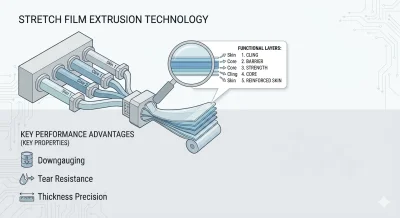
A properly engineered stretch film extrusion machine solves this by separating those functions into dedicated layers rather than compromising across a single one. Precision multi-layer co-extrusion technology integrates distinct polymer streams into a composite structure, with a cling layer engineered specifically for secure pallet adhesion, a high-strength core that provides the tensile integrity heavy loads require, and a durable skin layer that improves puncture resistance and shields against environmental exposure. This layered approach is what allows the same roll of film to hold a shifting pallet load and resist a sharp corner without either property canceling the other out.
That structural precision translates directly into measurable performance gains. High-performance resin formulations processed through this system enable significant downgauging, producing thinner film without sacrificing strength and cutting raw material consumption in the process, a benefit that compounds quickly across high-volume operations. Material properties are optimized specifically for superior elongation at break, high tear resistance, and strong puncture strength, which is exactly the combination that automated wrapping lines and heavy-duty bundling applications depend on. Robust melt pumps, precision dies, and high-efficiency cooling systems keep film thickness uniform batch after batch, removing the inconsistency that undermines confidence in older production lines. Full automation across the control system minimizes human error and supports stable, high-output production suited to continuous industrial use rather than start-stop manual operation.

Applications Across Industrial Packaging
This combination of layered engineering and process control is what makes a single stretch film extrusion machine capable of serving genuinely different end markets without redesigning the process each time. For automated pallet wrapping, high-stretch film produced on this equipment is built to keep pace with high-speed robotic wrappers, holding tension and adhesion through rapid, continuous wrap cycles. For heavy-duty bundling, reinforced film with elevated tensile strength secures construction materials, metal components, and bulky industrial goods that would overwhelm standard-grade wrap. For product protection applications, high-clarity film provides a dependable barrier against dust, moisture, and transit damage while still allowing visual inspection of the wrapped goods, a detail that matters for quality control throughout the supply chain.
The Strategic Case for In-House Production
Investing in this level of extrusion technology is ultimately a strategic move toward supply chain resilience rather than just an equipment upgrade. Producing high-performance stretch film in-house gives facilities direct control over a mission-critical packaging supply that no longer depends on external vendor lead times or price volatility. The material savings that come from reliable downgauging reduce total cost of ownership over the life of the equipment, while consistent, high-strength film significantly lowers the risk of product damage during long-haul transit, a cost that is easy to underestimate until it shows up in claims and customer complaints. Facilities running diverse packaging operations, from automated wrapping to heavy industrial bundling to sensitive product protection, benefit most from a single platform that can be configured to meet each of these demands without compromising performance in any one area.
Engineered for Where Your Production Is Headed
Choosing the right stretch film extrusion machine comes down to matching layered film engineering, automation, and material efficiency to the specific demands of your production floor, whether that means high-speed automated wrapping, heavy-duty industrial bundling, or high-clarity protective packaging for sensitive goods. Our stretch film extrusion machines are built around precision multi-layer co-extrusion, high-efficiency cooling and melt control systems, and full automation designed for continuous industrial operation, giving manufacturers a dependable platform for producing consistent, high-performance stretch film at scale. Reach out to our team to discuss which configuration best fits the applications driving your production line.