3-Layer Co-Extrusion Equipment of Stretch Film Making Machine

2026-09-08

Single-layer stretch film exhibits inherent material trade-offs; the formulation characteristics that optimize cling and pre-stretch elongation are rarely the same mechanisms that make it resist puncture under heavy load. Our stretch film line resolves that compromise through a precise three-layer A/B/C structure, optimizing load retention and mechanical performance for pallet stabilization.

The Core Architecture Behind the Improvement

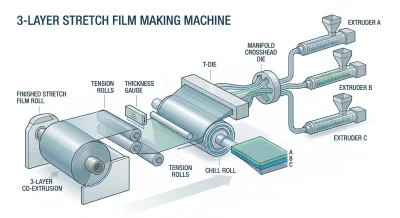
The performance gains our stretch film line delivers come from machine architecture, not solely the resin formulation. Three independent single-screw extruders run simultaneously, each processing a distinct formulation: an adhesive-rich Layer A for cling, a high-tenacity Layer B core for structural strength, and a slip-enhanced Layer C for a smooth outer surface. These three molten streams converge inside a precision A/B/C multi-manifold die, where internal flow channels stack the polymers into clean, distinct strata before the material ever exits the die, eliminating the disordered mixing that undermines simpler extrusion setups. Multi-stage thermal sensors and automatic thermal bolts throughout the die system hold melt viscosity constant across the entire web width, which is what keeps layer ratios consistent across the transverse direction (TD). On single-layer equipment, a shift in melt temperature or throughput induces gauge defects, whereas three-layer closed-loop architectures dynamically absorb process fluctuations prior to web solidification.

This structural control directly dictates key mechanical metrics, establishing clear performance advantages over conventional single-layer stretch film in demanding load-wrapping applications.

3-Layer Stretch Film Making Machine

Where the Improvement Shows Up

Automotive Parts Export

Engine components, stamped metal parts, and mold fittings represent high-stress loads that challenge stretch film integrity. These loads are heavy and feature sharp geometry. Export shipments typically involve long ocean or overland routes with multiple handling and transfer points. On conventional single-layer stretch film, puncture failures frequently occur. Once a wrap tears, the load suffers structural destabilization.

The reinforced core layer mitigates these failure modes. Because Layer B is formulated specifically for high yield strength and puncture resistance, rather than balancing cling and surface performance, the stretch film absorbs sustained contact from sharp metal edges without propagating tears. Consequently, cargo wrapped with three-layer stretch film maintains enclosure integrity during transit, significantly reducing transit-related rejection rates.

The three-layer structure also improves elastic recovery, resisting the gradual loosening that occurs over multi-week transit cycles. Pallets wrapped with conventional stretch film often experience decay in retention force, with parts that have shifted just enough to knock against each other during transit. Loads wrapped with optimized three-layer stretch film sustain load retention force from initial wrapping through final delivery, preventing load shifting during export transport.

Solar Panel and Precision Electronics Export

Solar panels and precision instruments impose distinct packaging constraints. Surface cleanliness is as critical as structural protection, and these products often encounter environmental extremes such as high humidity and intense UV exposure. Conventional single-layer stretch film struggles here for a different reason: a formulation tuned for high cling tends to cause what the industry calls blocking, where the stretch film's outer surface sticks to itself or to handling equipment during unwrapping, complicating unwrapping operations and risking surface contamination.

The slip-enhanced Layer C resolves blocking issues. Because the outer layer is engineered independently from the inner cling layer, the surface exhibits a low coefficient of friction (COF) without sacrificing the grip that Layer A provides against the load. Warehouse teams unwrapping solar panel or electronics pallets notice this immediately: no sticking, no dragging, and no dust or debris trapped against the product surface, which keeps panels and instruments free of the scuffs and residue that conventional stretch film sometimes leaves behind.

The layer-specific additive placement optimizes environmental resistance. Rather than dosing UV stabilizers or anti-static agents across the entire stretch film thickness, our stretch film line allows these additives to be concentrated in the specific layer where they are most effective, protecting against embrittlement without unnecessary additive consumption in core layers. For exporters shipping to high-UV or high-humidity regions, this ensures the stretch film retains flexibility and mechanical strength, preventing brittle failure under sustained UV exposure.

Material Efficiency: A Gain Customers See on Every Roll

In addition to puncture resistance, elastic recovery, and surface performance, the three-layer structure our stretch film line produces opens up meaningful downgauging. Because the high-tenacity core carries more of the structural load, customers can run thinner stretch film while holding the same containment force a thicker single-layer stretch film would need, meaningfully reducing raw resin material consumption. For high-volume packaging operations, this yield optimization delivers substantial raw material cost reductions without compromising structural load stability or transport safety.

What This Means for Your Production Line

Every one of these improvements traces back to the same underlying design principle: giving each layer of the stretch film a dedicated job instead of forcing one material to compromise across every function at once. By optimizing layer ratios and resin architectures—isolating tack to skin layers, maximizing tenacity within the core, and controlling surface friction on outer faces—three-layer co-extrusion yields superior load retention, lower transit failure rates, and enhanced material economy. Tailoring layer distribution to specific load demands ensures precise mechanical compliance across industrial packaging applications.

3-Layer Co-Extrusion Equipment of Stretch Film Making Machine

GET IN TOUCH NOW

*We respect your privacy. When you submit your contact information, we agree to only contact you in accordance with our Privacy Policy.