Key Energy-Saving Technologies in Stretch Film Extrusion Machine
2026-08-19
Energy efficiency has become an increasingly important consideration in modern stretch film production. As manufacturers face rising electricity costs, higher raw material prices, and growing demand for thinner and higher-performance films, production efficiency can no longer depend on speed alone. A modern stretch film extrusion machine must balance output, film quality, material utilization, and energy consumption.
Traditional extrusion equipment may experience unnecessary energy losses from inefficient motors, heating systems, unstable extrusion conditions, and excessive material consumption. In high-volume production, these inefficiencies can increase the cost of every kilogram of finished film. Advanced extrusion technology provides a practical way to address these challenges while maintaining stable production performance.
Why Energy Efficiency Matters in Stretch Film Production
Stretch film is widely used for pallet wrapping, warehouse packaging, logistics, export packaging, and industrial transportation. Its high tensile strength, controlled elasticity, and strong load-holding capability allow manufacturers to secure products while using relatively small amounts of material.
However, producing consistent thin-gauge stretch film requires precise control of extrusion, cooling, stretching, and winding. When thickness is inconsistent, manufacturers may compensate by producing film slightly thicker than the target specification. This increases polymer consumption and also wastes the energy already used to process the additional material.
For this reason, energy efficiency should be evaluated together with material efficiency and production stability. A well-designed stretch film extrusion machine can reduce unnecessary energy consumption while improving thickness consistency and overall production efficiency.
High-Efficiency Drive Systems for Lower Power Consumption
The extrusion drive system is one of the key energy-consuming sections of a production line. Conventional asynchronous motors can operate reliably, but modern permanent magnet synchronous motors can provide higher efficiency and more precise speed control in suitable applications.
A properly sized permanent magnet drive system can reduce motor-related energy consumption compared with conventional systems, with savings of around 20% possible under comparable operating conditions. Actual results depend on motor capacity, production speed, load conditions, inverter efficiency, and the overall machine configuration.
Beyond energy savings, stable motor torque is important for extrusion consistency. Precise screw-speed control helps maintain steady polymer output and melt pressure, supporting uniform film thickness during continuous production.
For manufacturers operating a stretch film extrusion machine for long production cycles, improving drive efficiency can therefore contribute to both lower electricity consumption and more stable operation.
Advanced Heating and Thermal Management
Heating is another major source of energy consumption in extrusion. The barrel and die must maintain appropriate temperatures to melt polymer materials and provide stable melt flow. Conventional heating systems can lose energy through thermal radiation and inefficient heat transfer.
Advanced heating technologies can improve thermal efficiency by delivering heat more directly to the required components. Depending on the machine configuration, technologies such as induction heating can reduce unnecessary heat loss and shorten machine warm-up time.
Temperature stability is equally important. In a multilayer stretch film production line, each extrusion zone must operate within an appropriate temperature range to maintain consistent polymer viscosity and melt flow. Excessive temperature fluctuations can affect pressure stability and film thickness.
Modern temperature-control systems continuously monitor heating zones and adjust heating output according to actual operating conditions. This helps prevent unnecessary heating while maintaining stable processing temperatures.
Heat recovery can provide another energy-saving opportunity. Where the factory layout and equipment configuration allow it, waste heat from the extrusion process can be recovered and used for applications such as raw material preheating. The actual saving depends on production conditions, but integrating thermal management into the overall production system can further improve energy efficiency.
Intelligent Thickness Control Reduces Material Waste
Energy efficiency is closely connected to material utilization. Every additional kilogram of polymer used in production also requires additional energy for melting, extrusion, cooling, stretching, and winding.
For this reason, precise thickness control is an important feature of an advanced stretch film extrusion machine. Online thickness measurement systems can continuously monitor film thickness and provide feedback to the control system.
The PLC can then coordinate extrusion output, line speed, and other relevant parameters to maintain the target thickness. With stable raw materials and properly calibrated equipment, modern systems can achieve thickness variation within a few microns for suitable film specifications.
The purpose of online thickness control is not simply to achieve a smaller tolerance. Its greater value is reducing unnecessary over-gauge production. If the finished film consistently meets its required thickness and performance specifications, manufacturers can use material more efficiently without compromising packaging strength.
For high-volume stretch film production, even a small reduction in unnecessary material consumption can generate significant long-term savings.
PLC Automation Improves Production Efficiency
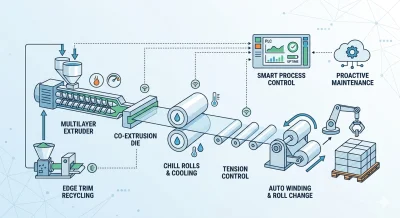
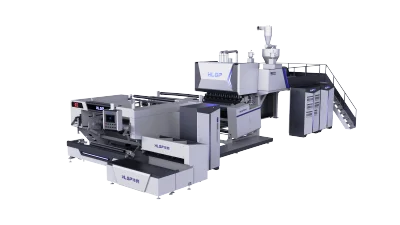
A modern stretch film extrusion machine requires coordinated operation between extrusion, cooling, stretching, traction, and winding systems. Manual adjustment becomes increasingly difficult as production speeds increase.
A centralized PLC control system can synchronize major production parameters in real time, including screw speed, motor load, temperature, line speed, tension, and winding conditions.
This automation helps maintain stable production when operating at high speeds. Depending on film structure, thickness, raw materials, and machine configuration, advanced stretch film lines can operate at production speeds of approximately 300–400 m/min.
Recipe management is another useful function. Operators can store process parameters for different film specifications and recall them when changing production orders. This can reduce setup time and improve repeatability between production runs.
HMI monitoring and automatic alarms also help operators identify abnormal temperature, pressure, speed, or tension conditions before they develop into larger production problems.
Optimized Multilayer Extrusion Flow Channels
Multilayer co-extrusion allows manufacturers to combine different polymers and functional layers within a single stretch film. Two-layer, three-layer, and five-layer configurations can be selected according to product requirements, material combinations, and production targets.
However, multilayer extrusion also creates greater demands on melt distribution. Poorly designed feedblocks and die channels may cause unnecessary pressure loss, uneven flow, or unstable layer distribution.
Optimized feedblock and die-flow designs create smoother and more balanced melt paths. Reducing unnecessary resistance can help lower extrusion pressure requirements and reduce the load placed on the drive system.
At the same time, stable melt distribution improves film uniformity and supports consistent mechanical properties across the film width.
The actual energy-saving effect depends on the complete extrusion system rather than a single component. Screw design, motor efficiency, die configuration, raw materials, output rate, and temperature settings all influence final energy consumption.
A More Efficient Approach to Stretch Film Manufacturing
Energy-saving technology should not be viewed as a single feature. The best results come from optimizing the entire production line.
High-efficiency motors reduce electrical losses, advanced heating systems improve thermal management, optimized flow channels reduce unnecessary extrusion resistance, and online thickness control minimizes material waste. PLC automation then coordinates these systems to maintain stable production conditions.
This integrated approach can help manufacturers reduce energy and material consumption without sacrificing film quality or production efficiency. It is particularly valuable for high-output plants producing thin-gauge stretch film, where small improvements in energy efficiency and material utilization can have a significant effect on total operating costs.
Choose Our Advanced Stretch Film Extrusion Machine for Efficient Production
For manufacturers planning to upgrade an existing production line or build a new stretch film facility, our advanced stretch film extrusion machine is designed to deliver a practical balance of high productivity, energy efficiency, and stable film quality. With high-efficiency drive systems, precise temperature control, intelligent PLC automation, accurate thickness control, and optimized multilayer extrusion technology, our machines are engineered to support demanding stretch film production requirements.
Our stretch film extrusion machine combines reliable extrusion performance with intelligent process control to help manufacturers reduce unnecessary energy consumption, minimize material waste, and maintain consistent film quality during continuous production. Whether you require a two-layer, three-layer, or five-layer configuration, the production line can be configured according to your film specifications, output requirements, and manufacturing goals.
If you are looking for a reliable and energy-efficient solution for modern stretch film production, our stretch film extrusion machine provides the technology and flexibility needed for long-term production efficiency. Contact our team to discuss your requirements and get a customized stretch film production line solution for your business.