Advantages of 3-Layer Stretch Film Extrusion Machine
2026-09-07
Producing stretch film that combines reliable load stability with efficient material use requires more than simply adjusting film thickness. A single-layer structure has to balance strength, elasticity, cling, and other performance requirements within one material formulation, which can limit how precisely each property is optimized. A 3-layer stretch film extrusion machine provides a more flexible approach by allowing different material formulations to be distributed across separate layers. This layered structure gives manufacturers greater control over film performance and creates more opportunities to balance mechanical strength, stretchability, cling, and material efficiency within the same roll.
The Structural Limits of Single-Layer Film
A monolayer film's core weakness is that it has no way to specialize. Strength, elasticity, and cling all have to come from the same formulation, so improving one property usually means trading off against another rather than gaining ground on all three. When strength falls short, the only practical fix on a standard line is to increase overall thickness, which raises resin consumption and cost without guaranteeing that elasticity or cling improve alongside it. Wrap stability suffers as a result — thicker film doesn't automatically mean better-performing film, just more material spent trying to get there. This gap becomes most obvious when film meets a sharp edge or an irregular, heavy load: monolayer structures tend to fail right at the point of contact, and once that point gives way, the wrap around the entire load loses its integrity.
This single-formulation constraint also limits how much control an operation actually has over its own packaging costs. Because a monolayer line can only adjust one variable — overall film thickness — to compensate for any performance shortfall, there's no way to selectively reinforce just the property that's failing. An operation dealing with puncture failures ends up paying for more thickness everywhere on the roll, not just at the points of contact where extra strength would actually help. Over a full production run, that inefficiency compounds into resin spend that isn't buying the film any real improvement in the failure mode it was meant to solve.
Applications That Demand More From Stretch Film
These structural limitations don't play out the same way across every application — they show up hardest in packaging jobs where load shape, fragility, or shipping economics leave no room for a weak wrap.
Automotive and machinery parts palletizing routinely involves sharp edges and substantial weight, and monolayer film's limited puncture resistance at points of contact leads to a higher rate of damage in transit, right where the film is under the most stress.
Glass products and ceramic building materials packaging demands both fragility protection and consistent wrap stability, and when a single-layer film's elasticity and cling aren't well balanced, the load can shift or loosen inside the wrap, leaving seals inconsistent and protection unreliable.
Furniture and wood product export packaging deals with bulky, irregular shapes that push monolayer film toward extra thickness just to reach adequate baseline strength — a compromise that increases shipping cost while still leaving the wrap prone to loosening from insufficient elasticity.

How a 3-Layer ABC Co-Extrusion Structure Solves the Trade-Off
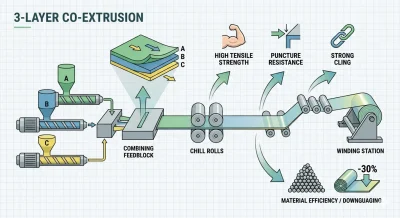
A 3-layer stretch film extrusion machine addresses this limitation directly through advanced ABC co-extrusion technology, which extrudes three distinct polymer layers simultaneously into a single film structure. Rather than asking one formulation to cover every function, each layer is engineered for a specific job, and the result is a film that performs closer to what each individual property actually requires.
The core layer is formulated for high tensile strength and puncture resistance, giving the film the capacity to withstand heavy loads and sharp edges without failing at the point of contact. That's a direct answer to the damage pattern seen in automotive and machinery parts packaging, where punctures at sharp edges are the most common failure mode on monolayer film. The outer layers, by contrast, are formulated with cling additives and elasticity modifiers, delivering strong adhesion and stretch performance that keeps the wrap sealed and stable through handling and transport. This is the piece that resolves the load-shifting and inconsistent sealing problem in glass and ceramic building materials packaging — a wrap that clings evenly and stretches predictably holds its shape around a fragile, irregular load instead of loosening in transit.
Compared with single-layer film, this three-layer structure delivers measurably improved mechanical properties across the board, including higher strength, better elongation, and enhanced puncture resistance — without requiring the added thickness that monolayer film relies on to reach the same baseline performance. That distinction matters directly for furniture and wood product export packaging, where bulky, irregular loads previously forced a thickness compromise just to hold basic strength; with strength and elasticity engineered into dedicated layers, the same load can be secured with less material and less added shipping weight. The structural design as a whole allows for reduced film thickness while maintaining full performance, which is what makes material optimization possible without sacrificing the load stability an application depends on.
None of this works without precision at the extrusion stage itself. A 3-layer stretch film extrusion machine has to ensure precise layer distribution, stable extrusion, and consistent film quality across every meter of output, since even small variation in how the three layers combine would undermine the functional separation the structure is built around. If the core layer runs thin in one section of the web, the strength gain it's meant to provide disappears exactly where a load is most likely to test it; if an outer layer runs uneven, cling performance drifts from one part of the roll to the next. Controlled production at this level also supports high-speed operation while minimizing defects, which keeps output consistent across the high-volume runs that automotive parts distributors, building materials suppliers, and furniture exporters all depend on to keep pallets moving through their production and shipping schedules without interruption.
This consistency matters as much for the operation running the line as it does for the film's final performance. A production process that holds its layer ratios and extrusion parameters steady at speed means fewer rejected rolls, less time spent recalibrating between runs, and a more predictable relationship between the resin going into the machine and the finished film coming off it — which is ultimately what makes the cost savings from thinner, better-performing film reliable rather than occasional.
Purpose-Built Layers, Purpose-Built Performance
The advantage of a 3-layer ABC structure isn't that it adds complexity for its own sake — it's that separating strength, elasticity, and cling into dedicated layers lets each one actually do its job instead of compromising to cover for the others. With optimized material allocation and enhanced performance, this structure enables the production of high-quality stretch film for logistics, industrial packaging, and heavy-duty applications where monolayer film has historically fallen short. For operations wrapping sharp-edged machinery parts, fragile glass and ceramic materials, or bulky furniture and wood products, the difference shows up directly in fewer transit failures and less material spent compensating for a structure that was never built to hold up under those conditions. If your current line is still relying on single-layer film and thicker gauges to get by, a 3-layer stretch film extrusion machine is built to deliver that same load protection with far less material and far more consistency.