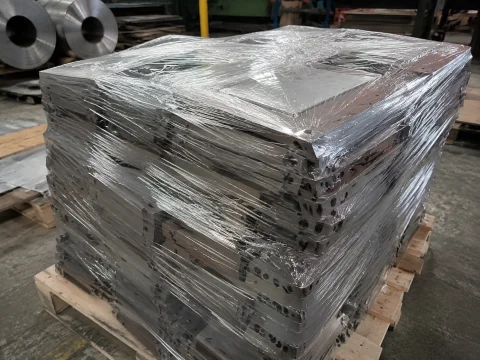
In modern industrial logistics, packaging performance directly affects cargo safety, transportation efficiency, and supply chain reliability. Heavy-duty products such as metal components, construction materials, glass products, and recycling materials often feature sharp edges, irregular surfaces, or high-density structures that create significant challenges for conventional wrapping materials. When standard stretch film encounters concentrated impact or excessive tension, punctures and tears may occur, resulting in unstable loads, product damage, and increased packaging costs.
A stretch film manufacturing machine designed for puncture-resistant film production provides manufacturers with the ability to develop advanced packaging materials specifically for high-stress applications. By combining multi-layer co-extrusion technology, precise thickness control, and optimized processing systems, these machines enable the production of stretch films with enhanced puncture resistance, tear strength, and load containment performance.
Packaging Challenges in High-Stress Industrial Applications
Industrial packaging environments are significantly different from general pallet wrapping applications. Many industries handle products with sharp corners, uneven surfaces, and heavy weights, which place additional mechanical stress on stretch film during wrapping, storage, and transportation.
For example, steel coils, metal sheets, fabricated components, and construction materials may contain sharp edges capable of cutting through ordinary stretch film. Similarly, recycled materials such as scrap metal and crushed glass create unpredictable contact points that can easily damage low-performance films. During long-distance transportation, repeated vibration and sudden movement further increase the possibility of film failure.
Traditional stretch films often rely on increased thickness to improve strength. Although thicker film can provide better resistance against puncture, it also increases material consumption and reduces packaging efficiency. For manufacturers and end users, the challenge is not simply producing thicker film but developing a balanced structure that provides high mechanical performance while maintaining flexibility and cost efficiency.
Another common issue is inconsistent film thickness. During stretching, areas with insufficient gauge become weak points where punctures and tears are more likely to occur. Without accurate extrusion control, even a film with suitable raw materials may fail to deliver stable performance in demanding applications.
The Role of Puncture-Resistant Stretch Film in Heavy-Duty Packaging
Puncture-resistant stretch film is developed to provide a stronger protective barrier between products and external forces. Unlike conventional films, high-performance stretch film utilizes advanced polymer structures and multi-layer designs to distribute stress more effectively.
The outer layer of puncture-resistant stretch film is typically designed to provide improved surface durability and resistance against external impact. This protective layer helps prevent sharp objects from directly penetrating the film surface during handling and transportation.
The core layer plays an important role in absorbing impact energy. By incorporating high-performance materials such as metallocene linear low-density polyethylene (mLLDPE), manufacturers can improve film toughness and resistance to crack propagation. When a small puncture occurs, the optimized molecular structure helps prevent the damage from expanding into a larger tear.
The combination of strength and elasticity also improves load stability. During pallet wrapping, the film needs to stretch while maintaining sufficient holding force to secure products. High-quality puncture-resistant stretch film can maintain tension around irregular loads, reducing shifting risks during transportation.
This performance makes puncture-resistant stretch film suitable for demanding industries including metal processing, construction materials, furniture manufacturing, chemical packaging, recycling, and export logistics. These sectors require packaging materials that can withstand challenging environments while maintaining consistent protection.
How Stretch Film Manufacturing Machine Enables High-Performance Film Production
The performance of puncture-resistant stretch film depends not only on raw materials but also on the precision and capability of the production equipment. A professional stretch film manufacturing machine provides the technical foundation required to produce reliable industrial-grade films.
Multi-layer co-extrusion technology is one of the most important features for manufacturing puncture-resistant stretch film. Compared with single-layer production, multi-layer extrusion allows manufacturers to assign different functions to each layer. Two-layer, three-layer, and five-layer configurations can be selected according to product requirements.
A three-layer structure can combine a strong outer layer, a functional middle layer, and a high-performance inner layer with optimized cling properties. Five-layer systems provide greater flexibility by allowing more precise distribution of materials and performance characteristics. Layer combinations such as A-B-C or A-B-C-B-A structures enable manufacturers to balance puncture resistance, stretchability, transparency, and adhesion.
Material compatibility is another important factor. Advanced stretch film production lines are designed to process commonly used polyethylene materials including LLDPE, mLLDPE, and customized polymer blends. The ability to combine different resin characteristics allows manufacturers to develop films for specific applications rather than relying on one universal formulation.
Precision Extrusion Control for Consistent Film Quality
Producing durable stretch film requires accurate control throughout the extrusion process. The extrusion system, T-die, cooling unit, and winding system all influence the final mechanical properties of the film.
A precision T-die ensures uniform melt distribution across the entire film width. Stable material flow helps reduce thickness variations and prevents weak areas that may cause failure during stretching. Consistent gauge control is especially important for thin industrial films, where small thickness differences can significantly affect puncture performance.
The cooling system also plays an important role in film strength. Controlled cooling conditions influence polymer crystallization and directly affect properties such as tensile strength, elasticity, and tear resistance. Optimized cooling technology allows manufacturers to achieve stable film performance while maintaining high production efficiency.
The winding system further ensures that finished rolls maintain proper tension and flatness. A stable winding process prevents deformation and helps preserve the quality of the stretch film during storage and transportation.
Supporting High-Performance Industrial Film Applications
A modern stretch film manufacturing machine is not only a production device but also a solution for developing specialized packaging materials. By adjusting layer ratios, processing parameters, and material combinations, manufacturers can produce films that meet different market requirements.
For heavy industrial applications, the machine can support the production of films with enhanced puncture resistance and high holding force. For automated packaging operations, consistent thickness and stable stretching performance help improve wrapping efficiency. For export packaging, durable film structures provide additional protection during extended transportation cycles.
The flexibility of multi-layer production also allows manufacturers to respond to changing market demands. As industries continue to require lighter, stronger, and more sustainable packaging solutions, advanced film production technology provides opportunities to develop products with improved performance and reduced material usage.
Reliable Stretch Film Manufacturing Machine for Advanced Packaging Solutions
The demand for stronger and more reliable packaging materials continues to grow as industries handle heavier, more complex, and higher-value products. Puncture-resistant stretch film provides an effective solution for protecting challenging loads, but achieving consistent quality requires advanced manufacturing technology.
With multi-layer co-extrusion capability, precise extrusion control, and compatibility with high-performance polyethylene materials, our stretch film manufacturing machine helps producers manufacture durable films designed for demanding industrial applications. From metal products and construction materials to recycling and export logistics, these production lines provide the foundation for creating high-strength stretch films that improve packaging safety, efficiency, and market competitiveness.