Features of 2-Layer Stretch Film Extrusion Machine

2026-08-26

Producing premium LLDPE stretch film at scale requires more than a functional extrusion line. It requires equipment engineered to hold tight tolerances, resist wear over years of continuous operation, and deliver film that performs consistently under real-world load conditions. A modern stretch film extrusion machine has to do all of this at once, which is exactly where many older single-layer systems fall short.

The Trade-Offs of Single-Layer Extrusion

Single-layer stretch film extrusion machines force a compromise that shows up directly in the finished roll. Because only one polymer structure is available, manufacturers cannot optimize clarity and load-holding strength at the same time, so one property is typically sacrificed to achieve the other. Film often ends up either clear but weak, or strong but visually hazy, neither of which fully satisfies modern packaging requirements.

Core components add another layer of risk. Standard screw and barrel assemblies, without specialized surface treatment, wear down faster under constant exposure to abrasive polymer melts. That wear gradually affects melt pressure and dimensional accuracy, which means film thickness and quality can drift over the life of the equipment rather than staying consistent from the first roll to the ten-thousandth. Cooling is frequently the weakest link of all. Without a precision cycle water cooling system, temperature control during the cooling phase is inconsistent, which limits film crystallinity, reduces clarity, and produces uneven tensile strength across the web. On top of the quality issues, these limitations compound into higher maintenance frequency and more downtime, since a machine that wears faster and cools less precisely simply cannot sustain the high-speed, continuous output that modern production schedules demand. A stretch film extrusion machine without these engineering solutions increasingly struggles to keep pace with industries that need both performance and reliability at scale.

How These Limitations Play Out by Industry

In the building materials sector, stretch film is used to bundle tile, board, and other products with sharp edges and significant weight. Film produced on a standard extrusion machine often lacks the puncture resistance to survive those sharp edges intact, and inconsistent core component wear over time leads to uneven film thickness and localized weak points exactly where strength matters most.

In beverage and bottled water packaging, stretch film secures full pallet loads of cased product for transport. Low-clarity film from a single-layer machine makes it harder for warehouse staff to visually verify product count and label orientation without unwrapping a pallet, and an imbalance between cling and strength in a single-layer structure increases the risk of load shift or pallet collapse during long-haul transport.

In chemical and fertilizer packaging, stretch film provides moisture protection and load stability for bagged product. Imprecise cooling control on standard machines leads to inconsistent film crystallinity and unpredictable tear resistance, which makes it difficult to meet the sealing and moisture-barrier standards this sector often requires.

Stretch Film Extrusion Machine

How Our Stretch Film Extrusion Machine Solves These Problems

Dual-Layer Co-Extrusion for Clarity and Strength

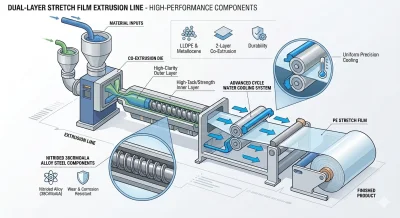
Rather than forcing a single-layer compromise, this stretch film extrusion machine uses a specialized co-extrusion process to strategically combine two polymer layers within one film structure. A high-clarity exterior layer improves visual appeal and product visibility, while a high-tack, high-strength interior layer delivers superior pallet stability. For beverage and bottled water producers, this means warehouse teams can visually verify pallet contents without unwrapping, while the high-strength interior layer keeps heavy cased loads secure through long transport routes.

Nitrided Alloy Steel for Long-Term Wear Resistance

At the core of the extrusion line, the screw and barrel assembly is crafted from 38CrMoAlA alloy steel and undergoes a specialized nitriding treatment that creates an ultra-hard, low-friction surface. This treatment provides exceptional resistance to corrosion and the abrasive wear caused by continuous polymer melt exposure, keeping melt pressure and dimensional accuracy stable even during high-speed, continuous operation. For building materials producers running heavy, high-volume production, this translates directly into consistent film thickness and strength across every roll, along with a longer service life and reduced maintenance frequency compared to standard steel components.

Precision Cooling for Consistent Film Properties

To lock in film quality after extrusion, this stretch film extrusion machine integrates a high-efficiency cycle water cooling system. Precise temperature control during the cooling phase maximizes film crystallinity and clarity, while uniform cooling directly improves tensile strength and tear resistance in the finished film. The closed-loop design maintains thermal equilibrium throughout production, preventing the film defects that inconsistent cooling would otherwise cause. For chemical and fertilizer packaging applications, this level of cooling precision delivers the consistent tear resistance and sealing reliability that moisture-sensitive bagged products require.

Overall Technical Performance

Beyond these three core systems, our stretch film extrusion machine is optimized for high-grade LLDPE and metallocene resins, giving producers flexibility to fine-tune formulations for different performance and cost targets. The 2-layer co-extrusion structure enhances overall mechanical properties compared to single-layer film, while the nitrided alloy steel components extend service life and reduce maintenance demands over the equipment's operating lifetime. Together, these systems support high-throughput production with consistent thickness control and reliable transparency, roll after roll.

From dual-layer co-extrusion to nitrided alloy steel components and precision water cooling, every part of our stretch film extrusion machine is designed to eliminate the compromises that limit standard single-layer equipment. Whether the application calls for the visual clarity and load stability needed in beverage packaging, the puncture resistance required for building materials, or the sealing consistency demanded by chemical and fertilizer packaging, this stretch film extrusion machine delivers the durability, precision, and production efficiency modern packaging operations rely on.

Blog Cover

GET IN TOUCH NOW

*We respect your privacy. When you submit your contact information, we agree to only contact you in accordance with our Privacy Policy.