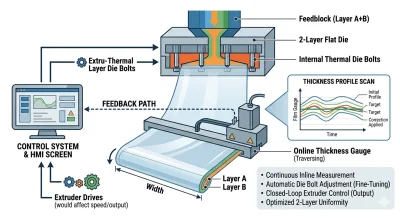
Achieving micron-level accuracy in 2-layer stretch film production requires more than just high-quality resin; it demands a sophisticated integration of real-time sensing and automated mechanical adjustment. For modern cast film lines, precise thickness control is the defining factor in optimizing film performance and reducing operational waste.
1. The Role of Gauge Consistency in 2-Layer Structures
A high-performance 2-layer stretch film relies on the perfect balance between its functional layers—typically a clinging layer and a high-tenacity structural layer. Any gauge variation can compromise the film’s puncture resistance or lead to uneven roll winding. Precision control ensures each layer meets its design specifications across the entire web width.
2. High-Precision Online Thickness Gauging
The foundation of a stable production line is the Online Thickness Gauge. This scanning system, usually equipped with X-ray or Beta-ray sensors, continuously monitors the film as it exits the chill roll.
- Transverse Scanning: The gauge moves back and forth, capturing thousands of data points.
- Instant Visualization: It provides operators with a high-resolution "thickness map," identifying even the slightest deviations in real-time.
- 3. The Core Feedback Mechanism
- Our machine features an online thickness gauge for real-time monitoring. This advanced feedback system automatically adjusts thermal die bolts and extruder output, ensuring superior film uniformity. By maintaining precise closed-loop control, it minimizes gauge variation and optimizes material usage for high-quality 2-layer stretch film production.
- 4. Automatic T-Die and Thermal Bolt Actuation
- The execution of thickness correction happens at the T-Die via Thermal Die Bolts. This is where digital data becomes physical adjustment:
- Active Regulation: When the system detects a thick spot, it increases the heating power to the corresponding thermal bolt.
- Thermal Expansion: The bolt expands under heat, precisely narrowing the die lip to reduce material flow in that specific zone.
- Dynamic Tuning: This process repeats hundreds of times per hour, maintaining a flat profile without manual intervention.
- 5. Longitudinal Stability (MD Control)
- While the T-die manages the width-wise (TD) uniformity, the machine also regulates Machine Direction (MD) thickness through:
- Extruder Output Sync: Synchronizing the screw speeds of both extruders to maintain the exact 2-layer ratio.
- Take-up Speed Precision: Using high-frequency drives to ensure the chill roll and winding speed remain perfectly constant, preventing stretching fluctuations.
Conclusion
Superior thickness control in 2-layer stretch film machines is a synergy of high-speed sensors and automated die technology. By implementing a feedback-driven closed-loop system, manufacturers can guarantee a high-performance product that meets the rigorous demands of the global logistics industry while significantly lowering resin consumption.