Understanding Strain Hardening Phenomenon in Stretch Film Production
2026-08-20
Producing high-quality stretch film at high production speeds requires a careful balance between output, film uniformity, mechanical strength, and material efficiency. As manufacturers increasingly move toward thinner films and higher pre-stretch ratios, the rheological behavior of polyethylene becomes an important factor in maintaining stable extrusion. One of the key phenomena involved is strain hardening, which describes the increase in resistance of a polymer melt when it undergoes extensional deformation. Understanding this behavior can help manufacturers optimize resin selection and extrusion conditions while making better use of modern multilayer stretch film production technology.
Challenges in High-Speed Stretch Film Extrusion
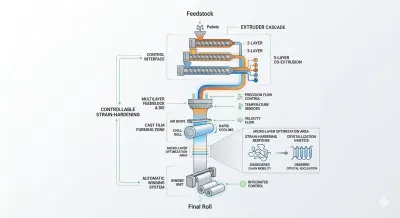
Stretch film is generally manufactured through cast extrusion, where molten polyethylene passes through a flat T-die and is rapidly cooled on a chill roll before being trimmed and wound. During this process, the polymer melt experiences both shear and extensional deformation. As production speed increases, the melt is subjected to greater drawdown, making melt strength and extensional stability increasingly important.
LLDPE is widely used for stretch film because it provides a useful combination of flexibility, tensile strength, elongation, and puncture resistance. However, different LLDPE grades can have significantly different rheological characteristics. A resin with insufficient resistance to extensional deformation may become unstable under aggressive processing conditions, increasing the risk of thickness variation, edge instability, web breaks, and inconsistent winding.
These problems become more important when producing thinner stretch film. Down-gauging can reduce resin consumption and packaging costs, but the finished film must still maintain sufficient holding force, tear resistance, puncture resistance, and elongation. Poor thickness control or unstable extrusion can therefore reduce the practical benefits of using a thinner gauge.
What Is Strain Hardening?
Strain hardening occurs when a polymer melt becomes increasingly resistant to extensional deformation as it is stretched. During extension, polymer chains become oriented in the direction of deformation, and molecular entanglements can contribute to a significant increase in extensional viscosity.
This behavior is different from simple shear flow and is particularly relevant to cast film production because the polymer melt is continuously drawn between the T-die and cooling system. When the material has favorable strain-hardening characteristics, it can better resist excessive thinning during drawdown. This can contribute to more stable melt behavior and more consistent film formation.
The strength of strain hardening depends on polymer molecular structure, including molecular weight, molecular weight distribution, chain entanglement, branching characteristics, and resin formulation. Certain high-performance polyethylene grades can provide more favorable extensional behavior than conventional grades. Therefore, strain hardening should not be considered a function of the machine alone. The resin and processing system must work together.
For stretch film manufacturers, this means that achieving reliable production depends on more than selecting a high-output extruder. Resin properties, layer structure, extrusion temperature, cooling conditions, drawdown, film thickness, and winding tension all influence the final result.
How Strain Hardening Supports Film Performance
One important benefit of suitable strain-hardening behavior is improved resistance to excessive melt thinning. This can be valuable when a stretch film extrusion machine operates at relatively high output or produces thinner film gauges. More stable melt behavior can help maintain a controlled film profile and reduce the risk of localized weak areas.
Thickness uniformity is directly related to material efficiency. If some areas of the film are unnecessarily thick, material consumption increases. If other areas become too thin, puncture or tear performance may be compromised. Stable extrusion and accurate die control can therefore help manufacturers achieve a better balance between film performance and resin consumption.
Strain hardening may also support the production of films designed for high elongation and pre-stretch applications. However, it is important to recognize that strain hardening alone does not determine final film performance. Puncture resistance, tensile strength, elongation, cling, and holding force are influenced by the complete material formulation and processing conditions.
This is why an advanced stretch film extrusion machine should focus on process stability rather than simply pursuing maximum line speed.
The Advantages of Multilayer Stretch Film Production
Multilayer coextrusion gives manufacturers greater flexibility when designing stretch film. Different layers can be formulated for specific functions instead of requiring one material to provide every required property.
A three-layer stretch film structure can provide a practical balance between strength, cling, and overall film performance. Depending on the formulation, the outer layers can be optimized for surface characteristics, while the core layer can contribute to tensile performance and material efficiency.
Five-layer coextrusion provides additional flexibility for more demanding applications. Multiple functional layers can be designed around specific requirements such as puncture resistance, tensile strength, cling performance, and cost control. This approach can be particularly useful when manufacturers want to reduce film thickness while maintaining the required packaging performance.
A well-designed stretch film extrusion machine must therefore provide accurate layer distribution, stable melt delivery, reliable temperature control, and consistent T-die performance. Precise control of each layer helps manufacturers make better use of different resin grades and develop film structures suited to specific packaging requirements.
Precise Process Control for Stable Production
Temperature control is essential for maintaining consistent polymer flow. The extrusion system must provide stable heating across the barrel, adapter, and T-die while avoiding unnecessary thermal stress. Consistent melt temperature helps maintain predictable viscosity and supports stable film formation.
Cooling is equally important in cast stretch film production. After leaving the T-die, the molten film must be cooled quickly and uniformly. Chill roll temperature, cooling capacity, contact conditions, and production speed can all influence crystallization and the final mechanical properties of the film.
Modern automation can further improve production consistency. A stretch film extrusion machine can integrate PLC control, automatic temperature regulation, synchronized drives, extrusion monitoring, and precision winding control. Depending on the configuration, online thickness measurement and automatic adjustment can also help reduce variations during continuous production.
These systems do not replace proper resin selection or process expertise, but they provide manufacturers with better control over the variables that influence film quality. Stable automation is particularly valuable during long production runs, where small process deviations can result in significant material waste.
Advanced Stretch Film Extrusion Technology for Stable Film Production
Strain hardening is an important aspect of polymer extensional rheology and can contribute to more stable melt behavior during high-speed stretch film production. However, consistent film quality depends on the complete production system rather than a single material property. Resin selection, multilayer structure, screw design, motor efficiency, extrusion temperature, T-die performance, cooling capacity, thickness control, and winding stability must work together to achieve reliable results.
Our stretch film extrusion machine solutions are designed for manufacturers seeking stable cast film production and flexible multilayer configurations, with equipment options that can be adapted to different film structures, widths, thickness ranges, output targets, and material combinations. By integrating controlled extrusion, accurate temperature management, efficient cooling, multilayer coextrusion, and automated process control, the production line provides a practical foundation for producing stretch film with consistent thickness and dependable mechanical performance. This approach can also support manufacturers pursuing down-gauging and improved material efficiency while maintaining the performance required for pallet wrapping, logistics packaging, industrial packaging, and other demanding applications. With the right stretch film extrusion machine configuration, manufacturers can build a more efficient and flexible production line that responds to specific production goals while supporting long-term film quality and operational stability.