Maximizing Output: Analyzing the 250m/min High-Speed Stretch Film Extrusion Machine
2026-09-04
The growing demand for efficient logistics and automated packaging has increased the requirements for stretch film production. Manufacturers supplying pallet wrapping, industrial packaging, and automated wrapping systems need film with consistent thickness, reliable mechanical properties, and stable roll quality.
A production speed of 250 m/min can provide high output for a suitable stretch film extrusion machine, but speed alone does not determine actual productivity. Higher line speeds place greater demands on extrusion stability, temperature control, cooling, thickness uniformity, traction, and winding. These systems must work together to maintain consistent production conditions.
Challenges of High-Speed Stretch Film Production
Increasing extrusion speed can change melt temperature, pressure, and material flow. If the screw design and processing conditions are not properly matched to the polymer and output requirements, fluctuations in melt stability may affect film quality.
Thickness control is another important consideration. Die conditions, melt distribution, cooling, and traction speed can influence film gauge across the web. Consistent thickness is particularly important for thin stretch film because variations can affect material utilization and mechanical performance.
Cooling capacity also needs to match production output. At higher speeds, more molten polymer must be cooled within a limited time. An appropriately configured cooling system helps stabilize the film before it reaches the traction and winding sections.
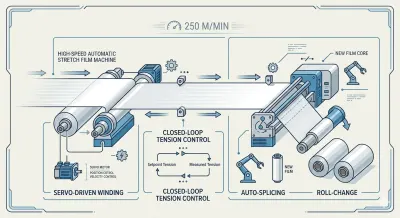
Winding presents another challenge. Changes in tension can affect roll formation, while excessive or insufficient tension may contribute to wrinkles, loose winding, or other roll-quality problems. Stable traction and tension control are therefore important parts of high-speed production.
Stretch Film Applications in Modern Logistics
Stretch film is widely used to secure palletized goods during storage and transportation. By applying controlled tension around a load, it helps hold products together and reduce movement during handling.
Different applications require different film characteristics. Heavy or irregular loads may require stronger puncture resistance, while other applications may prioritize stretchability, holding force, transparency, or material efficiency.
Automated wrapping systems place additional demands on film quality. The film must feed and stretch consistently during high-speed wrapping. Variations in thickness, roll tension, or winding quality can affect downstream packaging performance.
Pre-stretch film is also widely used in automated and semi-automatic wrapping applications. Its performance depends on the relationship between film thickness, formulation, stretching characteristics, and production conditions. Stable extrusion is therefore important for maintaining consistent film behavior.
Multilayer Extrusion for Different Film Requirements
Multilayer extrusion gives manufacturers greater flexibility when developing stretch film structures. Three-layer and five-layer configurations can distribute different materials across the film according to the required properties.
Different layers can contribute to stretch performance, puncture resistance, surface characteristics, or other product requirements. The appropriate structure depends on polymer type, formulation, target thickness, and application.
A multilayer stretch film extrusion machine must therefore be matched to the materials being processed. Screw configuration, extrusion capacity, melt distribution, temperature control, and die design all influence the stability of the multilayer structure.
For industrial and logistics packaging, multilayer technology can help manufacturers balance film performance and material utilization. Final mechanical properties should be confirmed through production trials and application testing rather than relying only on equipment specifications.
Extrusion and Temperature Control at 250 m/min
The extrusion system is central to high-speed stretch film production. Screw geometry should be selected according to the characteristics of the polymers being processed and the required output.
A suitable screw design can support consistent plasticization and melt transport, while multi-zone temperature control allows different sections of the extrusion system to operate within appropriate processing conditions.
At higher production speeds, temperature stability becomes increasingly important. Excessive fluctuations can influence melt viscosity and flow behavior, potentially affecting film thickness and appearance.
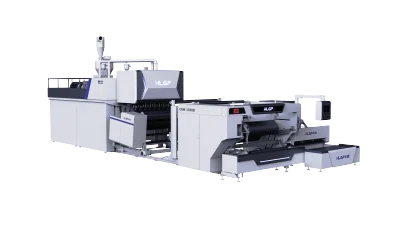
For this reason, a 250 m/min stretch film extrusion machine should be evaluated as a complete system rather than by screw speed alone. Extrusion capacity, temperature control, die performance, cooling, and downstream handling all influence practical production results.
Die, Cooling, and Thickness Control
The die plays an important role in distributing molten polymer across the film width. Proper die configuration and temperature management can support more consistent transverse thickness.
An inline thickness monitoring system can provide production data for detecting gauge changes and supporting process adjustments. This can help manufacturers maintain more consistent film specifications during continuous production.
Cooling must also be matched to film width, thickness, material, and extrusion output. Stable cooling conditions help the film reach a suitable state before traction and winding.
Together, extrusion, die, cooling, and traction systems determine how consistently the film is produced at high speed.
Servo Winding and Tension Management
Finished roll quality is important for both film manufacturers and downstream packaging operations. Servo-driven winding systems can provide controlled winding speed, while tension management helps maintain stable roll formation.
The appropriate winding conditions depend on film thickness, web width, roll diameter, and product requirements. Stable winding can help reduce issues such as wrinkles, loose areas, and uneven roll formation.
For customers using automatic wrapping equipment, consistent rolls can also support smoother film feeding and stretching during packaging.
Evaluating the Value of 250 m/min
A maximum speed of 250 m/min should not be considered separately from actual production requirements. Practical output depends on film width, thickness, polymer type, layer structure, startup time, changeovers, winding efficiency, and machine operating time.
Operating costs should also be evaluated through energy consumption, material waste, labor, maintenance, and downtime. These factors provide a more realistic basis for calculating production costs than maximum line speed alone.
A High-Speed Solution for Your Production Requirements
A 250 m/min production speed can provide high output when supported by a properly matched extrusion and downstream system. Stable extrusion, temperature control, cooling, thickness management, traction, and winding all contribute to reliable high-speed stretch film production.
Our stretch film extrusion machine solutions can be configured according to different film widths, thicknesses, material structures, and production targets. Depending on customer requirements, the production line can incorporate multilayer extrusion, precise temperature control, suitable die systems, cooling equipment, traction units, servo winding, and automation functions.
By providing your target film specifications, raw materials, required output, and application, you can work with our technical team to select a suitable stretch film extrusion machine configuration for efficient and consistent production.