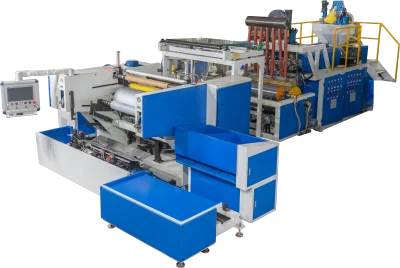
Key Advantages of 2-Layer Co-Extrusion Stretch Film Machines

2026-09-07

Producing stretch film on a monolayer extrusion line often means balancing several performance requirements within the same material layer. Increasing thickness can improve puncture resistance and tensile strength, but it may also increase material consumption without addressing every performance requirement. On the other hand, optimizing the film for cling and flexibility can make it more difficult to achieve the desired tear resistance and load stability. These limitations are not necessarily caused by the resin itself, but by having to achieve different properties within a single layer. This is where 2-layer co-extrusion offers a more flexible approach. Our 2-layer stretch film extrusion machines are designed to distribute material functions between layers, giving manufacturers greater control over film performance while reducing the need to rely on thickness alone.

Where Single-Layer Film Structures Start to Break Down

The core issue with a monolayer approach is that one resin formulation is being asked to do two jobs at once — hold the load and stick to itself — and neither job gets done particularly well as a result. On older stretch film extrusion machines, extrusion control also tends to lack the precision needed to distribute material evenly across the web, so even when a formulation is tuned reasonably well, thickness variation across the roll undermines it. The practical response on most legacy lines has been to simply run thicker film to compensate for uneven strength distribution, which solves the immediate breakage problem but drives resin consumption — and cost — well above what the application actually needs. Add in the tension spikes that come with high-speed wrapping, and monolayer film frequently fails at exactly the point where a load is heaviest or most irregular, which defeats the purpose of wrapping it in the first place.

The Real-World Cost of a Single-Layer Compromise

These limitations aren't abstract — they show up differently depending on how and where the film gets used.

In high-frequency e-commerce fulfillment operations, packages move through wrapping stations continuously, and any inconsistency in cling or strength compounds fast across thousands of daily cycles. Monolayer film run at speed on older equipment tends to produce uneven wrap tension, which raises the rate of loose or broken packages that need to be rewrapped before they can ship.

In outdoor agricultural silage bale wrapping, film is exposed to sustained UV radiation and wide temperature swings for weeks at a time. A single-layer structure without a formulation built specifically for that exposure becomes brittle and prone to cracking well before the silage inside has finished fermenting, letting in oxygen and spoiling feed that a farm has already invested in.

In industrial pallet wrapping involving irregular or heavy loads — machinery parts, stacked crates, uneven dimensional freight — the sharp edges and corners typical of these loads concentrate stress on whatever film touches them first. Traditional film without a dedicated strength layer punctures at these contact points, and once one puncture propagates, the entire wrap loses its holding force.

Stretch Film Samples

How an AB Layer Structure Solves the Trade-Off

Our 2-layer co-extrusion stretch film machines address this by giving each function its own dedicated layer instead of asking a single resin blend to cover both. Layer A is formulated as the strength core, engineered for maximum puncture resistance and tensile strength so it can absorb the stress concentrated at sharp corners and irregular load edges. Layer B is engineered as the cling surface, built for high-tack self-adhesion that keeps the wrap sealed and intact through handling and transport without relying on external tape or adhesives. Because these two layers are extruded simultaneously and brought together through a precision T-die, the finished film achieves strong interfacial bonding between layers rather than the delamination risk that comes with laminating two separately produced films after the fact.

This structural separation is what actually breaks the traditional thickness-versus-strength trade-off, rather than just shifting it. The AB structure delivers noticeably better tear resistance under the kind of tension spikes that occur during high-speed wrapping, which directly addresses the loose-package problem in fast-moving e-commerce fulfillment settings — the film holds its wrap integrity through the cycle instead of failing partway through. The same structural logic protects agricultural silage wrap: a strength-oriented A layer resists the abrasion and puncture risk of bale surfaces, while the film formulation as a whole is built to withstand prolonged UV and temperature exposure without becoming brittle, keeping the silage sealed for its full storage period.

Because the two functions are separated at the layer level, our stretch film extrusion machines can also run precise gauge control that produces thinner film without sacrificing the strength the application needs. In practical terms, this typically reduces resin consumption by 15% to 25% compared to traditional single-layer methods, since the machine is no longer compensating for weak spots by adding bulk everywhere. That reduction matters most in industrial pallet wrapping of irregular or heavy freight, where operations have historically over-specified film thickness simply to guarantee it survives contact with sharp corners — with a dedicated strength layer doing that job instead, the same load can be secured with meaningfully less material per pallet.

Consistency at high output is the other half of this equation. Our machines pair the AB co-extrusion process with advanced melt plastication and thermal management, so film quality holds steady across long, high-speed production runs rather than drifting as the line heats up or as throughput increases. For operations running continuous shifts — whether that's a fulfillment center wrapping pallets around the clock or an industrial packaging line running multiple shifts of heavy freight — this stability translates directly into fewer rejected rolls and less line downtime spent adjusting for inconsistent output.

Built for Reliability Across Applications

For manufacturers considering a new stretch film extrusion machine, the advantage of a 2-layer co-extrusion system lies in having greater control over how the finished film performs. By assigning different functions to the two layers, manufacturers can optimize strength, puncture resistance, cling, and flexibility without relying on additional thickness to compensate for limitations in a single-layer structure. Our 2-layer co-extrusion machines are designed around this principle, combining precise layer control with stable extrusion and an integrated production process.

This makes the platform suitable for manufacturers supplying e-commerce and logistics, agriculture, industrial packaging, and other applications with different film performance requirements. Instead of building production around one fixed film specification, our machines give producers more flexibility to develop and manufacture films for multiple markets on the same extrusion platform. For operations looking to improve material efficiency while maintaining consistent film performance, 2-layer co-extrusion provides a practical way to achieve that balance.

Blog Cover

GET IN TOUCH NOW

*We respect your privacy. When you submit your contact information, we agree to only contact you in accordance with our Privacy Policy.