How to Reduce Thickness Variation in Multi-Layer Stretch Films
2026-09-02
Thickness uniformity is a key factor in multi-layer stretch film production. As packaging manufacturers increasingly use thinner films, higher production speeds, and automated wrapping systems, controlling thickness variation becomes essential for maintaining stable film performance and reducing material waste.
For manufacturers operating a stretch film extrusion machine, thickness consistency depends on more than the nominal film gauge. Melt temperature, polymer viscosity, layer flow ratio, die gap, cooling conditions, and haul-off speed can all affect the final film thickness. A well-designed extrusion system must therefore control these factors together to maintain stable production.
Common Challenges in Stretch Film Thickness Control
Traditional stretch film production equipment may rely heavily on manual die adjustment and periodic quality inspection. While this approach can work under stable conditions, it becomes less responsive when production parameters change.
Manual die adjustment requires operators to identify a thickness deviation before making a correction. Changes in melt temperature or polymer viscosity may therefore affect the film before the adjustment is completed. Without continuous monitoring, some thickness variations may only be discovered during sampling or finished-roll inspection.
Multi-layer film production also requires accurate control of material distribution between extrusion layers. In an A-B-A three-layer structure or an A-B-C-B-A five-layer structure, fluctuations in individual extruder output can change the layer ratio and affect the consistency of the finished film.
Cooling and haul-off stability are also important. Uneven cooling or changes in drawing speed can contribute to cross-web thickness variation, particularly when the line is operating at higher speeds.
What Causes Thickness Variation in Multi-Layer Stretch Film?
Several process factors can influence the thickness uniformity of stretch film.
Melt temperature and viscosity directly affect polymer flow through the die. If processing temperatures fluctuate, melt viscosity can change and influence the distribution of material across the film width.
Extrusion output is another important factor. Each layer must maintain its intended flow rate to preserve the designed film structure. Stable independent screw speed control helps maintain the required proportion between the different layers.
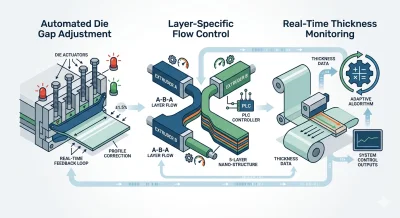
Die gap distribution also has a direct effect on cross-web thickness. If the gap is uneven, some areas may receive more polymer than others. Adjustable die zones provide a way to correct these differences and improve thickness distribution.
Finally, cooling and haul-off conditions need to remain stable. Changes in these parameters can affect film drawing and final gauge, making them important parts of the overall thickness-control process.
Why Thickness Uniformity Matters in Packaging
Thickness consistency is particularly important in applications where stretch film is subjected to high tension or continuous automatic wrapping.
In beverage and bottled-water pallet packaging, locally thin areas can become weak points when the film is stretched around a heavy load. Better thickness consistency can help reduce localized film failure and support more stable pallet containment.
For building materials, profiles, and other long products, uneven film thickness may contribute to differences in stretching behavior across the package. More consistent film distribution can help maintain more balanced wrapping tension and reduce the risk of packaging becoming loose during transportation.
In e-commerce warehouses, automatic wrapping machines often operate continuously at high speed. Localized weak points can increase the risk of film breaks and unnecessary production interruptions. Consistent film thickness helps provide more predictable film behavior during automated wrapping.
How Our Stretch Film Extrusion Machine Improves Thickness Uniformity
A modern stretch film extrusion machine should combine stable extrusion, layer control, die adjustment, cooling, and monitoring rather than relying on a single control point. Our equipment is designed with this integrated approach.
Multi-Zone Die with Adjustable Die Gap
A multi-zone die allows adjustments to be made across different sections of the film width. This helps compensate for variations in melt distribution and improve cross-web thickness uniformity.
Under appropriate raw material, process, and operating conditions, our equipment can achieve cross-web thickness variation of around ±3%. Actual results depend on factors such as polymer grade, target film thickness, production speed, temperature settings, and machine configuration.
The adjustable die system gives operators a more precise method of correcting thickness distribution compared with relying entirely on manual fixed-gap settings.

Independent Screw Speed Control
Our three-layer and five-layer configurations provide independent control of the extrusion output for different layers. This helps maintain stable material distribution within structures such as A-B-A and A-B-C-B-A.
Stable layer ratios are important when different polymers are used to achieve specific combinations of stretchability, puncture resistance, tensile strength, and cling performance. By controlling each extrusion layer separately, manufacturers can better maintain the intended structure throughout production.
Online Thickness Monitoring
Online thickness monitoring provides continuous information about film gauge during production. Instead of waiting for periodic sampling to identify a deviation, operators can monitor thickness changes while the line is running.
When integrated with the appropriate control system, measurement feedback can support adjustments to relevant production parameters. This helps operators respond to process changes earlier and maintain more consistent film quality during long production runs.
From Thickness Control to Production Efficiency
Better thickness uniformity is not only a quality issue. It can also influence material utilization and downstream packaging performance.
Excessively thick areas consume additional polymer, while excessively thin areas may create weak points during stretching. A properly controlled extrusion process aims to distribute material more consistently while maintaining the required film gauge.
For pallet wrapping, this can support stable load containment. For long building materials, it can contribute to more consistent wrapping behavior. For automated e-commerce packaging, stable film quality can help reduce interruptions caused by localized film weakness.
Choosing the Right Stretch Film Extrusion Machine
When selecting equipment for multi-layer stretch film production, manufacturers should look beyond maximum output. Screw configuration, independent layer control, die adjustment, temperature management, cooling, haul-off stability, and thickness monitoring all contribute to final film quality.
Three-layer and five-layer configurations can serve different production requirements. The appropriate structure depends on the required film properties, polymer combination, target thickness, and packaging application.
Our stretch film extrusion machine integrates multi-layer extrusion technology with independent screw control, adjustable die technology, stable cooling and haul-off systems, and online thickness monitoring. With three-layer and five-layer options, our machines are designed to help stretch film manufacturers improve thickness consistency, material utilization, and production stability for demanding packaging applications.