
In cast stretch film production, line speed and extrusion output are two closely related parameters that directly affect film gauge, production stability, and winding quality. Increasing line speed does not necessarily mean higher production efficiency, because the extrusion output must be adjusted accordingly to maintain the target film gauge and material distribution. For manufacturers using stretch film making machines, achieving stable production depends on coordinating the extruder, T-die, cooling system, traction unit, and winding system as one integrated process.
For a stretch film line operating at around 150–200 m/min, the relationship between extrusion output and line speed becomes particularly important when changing film gauge, width, or resin formulation. A change in one parameter without a corresponding adjustment to the others can affect film gauge, melt stability, cooling performance, and winding tension. The goal is therefore not simply to maximize line speed, but to maintain a practical operating balance that delivers consistent film quality and repeatable throughput.
Understanding the Relationship Between Line Speed and Extrusion Output
Extrusion output refers to the amount of polymer melt delivered by the extrusion system over a given period, usually expressed in kg/h. It is influenced by factors such as screw diameter, screw speed, screw design, resin properties, and melt temperature.
Line speed refers to the speed at which the cast film moves through the forming, cooling, traction, and winding sections of the production line. When extrusion output and effective film width remain stable, increasing line speed generally reduces the amount of material deposited per unit area, resulting in a thinner gauge. Conversely, increasing extrusion output while maintaining the same line speed tends to increase film thickness.
A simplified production relationship can therefore be expressed as:
Film gauge is proportional to extrusion output ÷ (film width × line speed)
This is only a basic engineering relationship. Actual film thickness is also affected by edge trim, layer distribution, resin density, die characteristics, cooling conditions, and process stability. For this reason, operators should not rely on line speed alone when adjusting film gauge.
This relationship becomes especially important when producing thin stretch film. A small change in extrusion output or line speed can have a noticeable effect on the final gauge. Modern stretch film making machines therefore need coordinated extrusion, drive, cooling, and winding systems rather than isolated speed controls.
Common Production Challenges When Parameters Are Poorly Matched
One of the most common problems in stretch film production is unstable film gauge. If the line speed changes without a corresponding adjustment in extrusion output, the film may become thinner or thicker than the target specification. Gauge variation can also occur across the film width when melt distribution through the T-die is not sufficiently uniform.
Melt pressure is another important factor. Changes in screw speed, feeding conditions, resin characteristics, or melt temperature can affect pressure stability before the die. Excessive fluctuations may make consistent film gauge more difficult to maintain. For this reason, professional extrusion systems commonly monitor key process parameters such as extruder temperature, die temperature, melt pressure, drive speed, and winding speed. Integrated control systems can coordinate these parameters and improve process visibility.
Cooling capacity also becomes increasingly important as throughput rises. Cast stretch film passes from the T-die onto a chill roller, where rapid and uniform cooling helps stabilize the newly formed film. If the cooling system is not appropriately matched to the production rate, the process can become more difficult to control, particularly when producing thin films at higher speeds.
Winding is equally important. Even when the extrusion and cooling sections are operating correctly, unstable winding tension can result in telescoping, wrinkles, loose rolls, or inconsistent roll hardness. A suitable winding system must therefore dynamically track the actual line speed rather than simply following a fixed mechanical speed.
How Stretch Film Making Machines Coordinate Extrusion and Line Speed
Our stretch film making machines are designed around the principle that extrusion, casting, traction, and winding should operate as an integrated production system.
The PLC and HMI control architecture can coordinate the main operating parameters of the line, including extruder speed, temperature settings, traction speed, and winding operation. Depending on the configuration, process monitoring can also be used for parameters such as melt pressure and other critical process variables.
This type of integrated control reduces the need for operators to make frequent independent adjustments to individual subsystems. Instead, production parameters can be managed as part of a coordinated process. Recipe-based settings can also help operators reproduce established process parameters when changing between different film specifications.
For manufacturers producing different grades of stretch film, this flexibility is important. A production line may need to handle different film gauges, widths, resin formulations, or layer structures during its operating life. The correct machine configuration should therefore be based on the intended production range rather than a single headline speed rating.
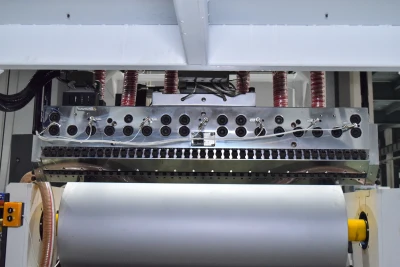
Multi-Layer Co-Extrusion for Flexible Film Production
Multi-layer co-extrusion provides manufacturers with greater flexibility in material distribution. Depending on the machine configuration, stretch film making machines can be designed with 2-layer, 3-layer, 5-layer, or other multilayer structures.
The purpose of multilayer construction is not simply to increase the number of layers. Different layers can be assigned different functions according to the formulation and target film properties. For example, selected materials can be concentrated in the outer layers for surface or cling characteristics, while core layers can be formulated to optimize strength and material cost.
The practical benefit is greater control over how materials are distributed throughout the film structure. Commercial stretch film lines commonly use multilayer configurations together with feedblocks, T-dies, chill rollers, gauge measurement systems, and automatic or semi-automatic winding systems.
For this reason, selecting a stretch film making machine should involves more than comparing the number of layers. The extruder configuration, die design, material compatibility, cooling system, control architecture, and winding system must be evaluated holistically.
T-Die, Cooling and Winding: The Key to Stable Production
The T-die is one of the most important components in a cast film extrusion line because it distributes the polymer melt across the required film width. Stable melt distribution and appropriate die design are essential for achieving consistent film gauge across the web.
Cooling performance is equally important. The chill roller must provide sufficient and uniform heat transfer for the selected resin, film gauge, and production rate. Different machine designs use different cooling arrangements, and the appropriate configuration depends on the intended application and output requirements.
The winding system then converts the continuous film web into finished rolls. Automatic tension control maintains consistent winding conditions as roll diameter changes. Advanced systems may also include automatic roll handling and changeover functions to reduce manual intervention. These features are standard across commercial cast stretch film lines.
Ultimately, high-speed production is a complete system requirement. A faster extruder does not automatically create a more productive stretch film line if the die, cooling, traction, or winder cannot maintain stable operation at the same production rate.
Optimize Your Stretch Film Production with the Right Machine Configuration
When evaluating stretch film lines, manufacturers should consider the complete production objective rather than focusing on one specification. Important factors include finished film width, target gauge, required output, number of layers, resin formulation, desired line speed, cooling requirements, winding configuration, automation level, and facility infrastructure.
Our stretch film lines are developed for cast film production with tailored layouts for diverse operational needs. By coordinating extrusion, multilayer distribution, T-die forming, cooling, drive control, and winding, the production line can be configured around the actual film specifications instead of relying on a one-size-fits-all approach.
If you are planning a new stretch film production line or upgrading an existing extrusion system, choosing the right balance between extrusion output and line speed is an important starting point. Contact our technical team with your target film width, gauge, material formulation, layer structure, and required production capacity, and our engineering team will tailor a system to your operational targets.
