The Impact of Extrusion Speed on Stretch Film Quality: A Comprehensive Guide
2026-09-02
Increasing line speed is one of the most direct ways manufacturers try to boost output from a stretch film extrusion machine, but higher speed does not automatically mean higher productivity. Increasing screw speed too aggressively without adequate process control can raise the risk of melt fracture, changes in molecular orientation, and thickness variation, affecting the consistency and performance of the finished stretch film. Understanding how extrusion speed affects film quality — and how machine design and process control help maintain a stable balance — is essential for manufacturers looking to increase output while maintaining consistent production quality.
Why Speed and Quality Often Work Against Each Other
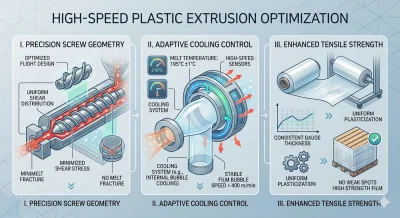
At the core of the problem is shear stress. As screw speed increases, the polymer melt experiences higher shear forces as it moves through the barrel and die. On a stretch film extrusion machine with an underdeveloped screw geometry, this added stress doesn't distribute evenly — it concentrates in ways that disrupt the melt flow, leading to fracture patterns on the film surface and inconsistent molecular alignment. The film may still come off the line, but its tensile strength, elongation, and tear resistance are compromised in ways that aren't always obvious until the roll is put under real load.
Cooling adds a second layer of difficulty. As output speed rises, the melt has less time to reach a stable temperature before it's drawn down and wound. Without a cooling system capable of keeping pace, plasticization becomes uneven across the width of the stretch film, creating thin spots and weak zones that show up as breakage points during pallet wrapping or transport. This is a common failure mode on older or lower-spec equipment: the line can technically run fast, but the stretch film it produces can't reliably hold up under tension.
Multi-layer co-extrusion introduces its own version of this challenge. When two, three, or five melt streams need to come together into a single structure, each layer has to be processed under conditions that keep it synchronized with the others. If pressure or viscosity between layers isn't well matched, manufacturers see neck-in, wrinkling, or poor interlayer bonding — problems that tend to get worse, not better, as speed increases.
How High-Speed Extrusion Affects Stretch Film Performance
These quality issues aren't abstract — they surface differently depending on how the stretch film is actually used. In pallet wrapping for heavy or irregularly shaped loads, stretch film needs enough elongation and tear resistance to conform tightly around the load without failing mid-wrap; a batch produced with inconsistent molecular orientation is far more likely to snap under tension at exactly the wrong moment. In food and beverage packaging, where clarity and cling are just as important as strength, uneven cooling or poor layer bonding can leave the film hazy or inconsistently tacky, which affects both product presentation and how well it holds during automated wrapping.
In both cases, the underlying issue traces back to the same root cause: equipment that wasn't designed to maintain process stability as speed increases. This is exactly the gap that better extrusion design is meant to close.
How Our Stretch Film Extrusion Machines Are Built to Close That Gap
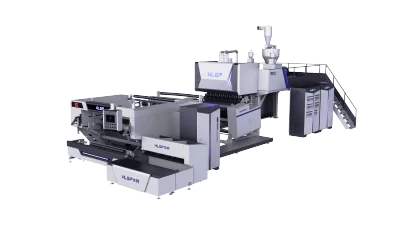
Our stretch film extrusion machines are engineered around the idea that throughput and stretch film integrity shouldn't be a trade-off. Rather than simply pushing screw speed higher, we focus on screw geometry that manages shear stress more evenly, paired with a cooling system designed to keep plasticization consistent even as output increases — the combination that determines whether a fast-running line actually produces usable stretch film or just a faster path to scrap.
Our two-layer stretch film extrusion machines are built for manufacturers who need dependable, consistent output for standard pallet wrapping applications. The screw and cooling design work together to reduce shear-related defects and maintain even thickness across the roll, giving operators confidence that higher line speeds won't come at the cost of tear resistance or weak spots during high-speed wrapping.
For applications that demand better clarity, barrier properties, and cling — common in food, beverage, and retail distribution packaging — our three-layer stretch film extrusion machines use an A/B/A co-extrusion structure with a dedicated metering section to stabilize melt pressure across all three extruders. This keeps the core layer contributing stiffness while the outer layers preserve the cling and clarity these applications depend on, without the pressure imbalances that typically cause die drool or inconsistent crystallinity at higher speeds.
At the top of the range, our five-layer stretch film extrusion machines are built for the most demanding, highest-value applications — heavy industrial loads, irregular shapes, and situations where load security simply cannot fail. Distributing the melt across five independent streams reduces internal tension, neck-in, and wrinkling far more effectively than a simpler structure can. Inner and outer layers are processed under different shear conditions by design, so inner layers can be optimized for strength and cocrystallization while outer layers retain the softness needed for cling — all while maintaining thickness tolerances within roughly ±3%, a standard we hold across our co-extrusion lines using nitrided alloy steel screw and barrel components for long-term wear resistance and thermal stability.
Across all three configurations, real-time monitoring and closed-loop gauge control work continuously to keep the process within tolerance, rather than relying on operators to catch drift after it's already affected the roll. This is what allows line speed to increase without quietly eroding the tear resistance, elongation, or visual quality that stretch film performance depends on.
Turning Higher Extrusion Speed Into Reliable Output
The real lesson behind the relationship between extrusion speed and stretch film quality is that faster output and reliable performance don't have to be opposing goals — they just require equipment engineered to keep pace with both. Whether a manufacturer needs a straightforward two-layer line for consistent pallet wrapping, a three-layer system for cling and clarity, or a five-layer machine built for high-stakes load security, the underlying priority stays the same: stable, well-controlled extrusion that protects stretch film quality at every speed the line is capable of running. For manufacturers looking to scale output without inheriting a new set of quality problems, that kind of engineering discipline is what makes the difference.