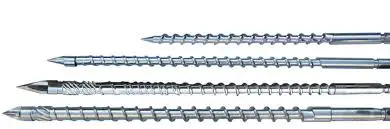
In the high-stakes arena of plastic film production, every component must be purpose-engineered for performance, not mere presence. At the heart of both stretch and shrink film lines lies the extrusion screw—the undisputed mechanical heart of the operation. Its diameter is far more than a dimensional metric; it is a strategic design parameter that directly dictates your machine’s output quality, throughput, and ultimately, your profitability. Mastering the functional nuance of screw diameter between bubble (shrink) and cast (stretch) film processes is the key to making an informed, high-return investment.
For Stretch Film Machines: Diameter as the Engine of Volume & Layer Precision
In high-speed cast stretch film lines—engineered for relentless pallet wrap demand—screw diameter is fundamentally about volumetric throughput and precision multi-layer control. These lines require screws capable of moving massive volumes of LLDPE resin per hour. A larger diameter delivers the necessary flight depth for this unyielding volume. Yet the sophistication runs deeper: modern premium stretch films are multi-layered marvels. To achieve this, co-extrusion lines strategically orchestrate different screw diameters—large-diameter master screws efficiently pump the core layer, while smaller, precision screws meter the thin skin layers. This diameter orchestration enables exact control over layer ratios, directly enhancing film strength, cling, and stretch performance. Paired with high L/D ratios, these larger screws ensure perfect melt homogenization—eliminating defects like fish-eyes that sabotage clarity and stretch consistency on your customers’ lines.
For Air Bubble Film) Machines: Diameter as the Guardian of Pressure & Thermal Stability
In blown film shrink lines, the primary function of screw diameter shifts to generating and sustaining stable, high pressure—critical for inflating and maintaining a flawless bubble of POF, PE, or PVC. Here, the screw must be sized to deliver robust, unwavering backpressure; fluctuations directly threaten bubble stability and film gauge uniformity. Diameter selection becomes a precision balancing act. It must be substantial enough to drive the high melt flow required for wide, industrial-grade shrink wraps, yet meticulously calibrated to manage shear heat. Shrink materials are often heat-sensitive; an oversized diameter at high RPM can generate excessive frictional heat, degrading polymer integrity and compromising the shrink properties your end-users depend on. The optimal diameter ensures a steady, gentle melt flow that supports a massive bubble through the cooling tower without collapse or thermal damage.
Strategic Investment: Beyond the Screw, to Competitive Dominance
This technical divergence proves that a “one-size-fits-all” screw design is a costly compromise in efficiency and quality. Specifying the correct screw diameter philosophy for your target film—volume-driven stretch or stability-critical shrink—is the first step toward securing a machine engineered not just to produce, but to excel. It translates directly to higher output rates, superior film properties, reduced defect waste, and a stronger value proposition for your customers. The question is not merely about having a screw, but about investing in the precise mechanical heart that powers your competitive edge.