Advantages of 5-Layer Stretch Film Extrusion Machine

2026-08-13

The rapid growth of global logistics, e-commerce distribution, and industrial transportation has increased the demand for stronger, thinner, and more reliable packaging materials. Stretch film plays an essential role in pallet stabilization, warehouse protection, and long-distance transportation because it helps secure products while reducing the risk of movement, damage, and contamination. However, modern packaging manufacturers are facing higher requirements for film quality, production efficiency, and material cost control. Traditional single-layer or basic film production methods often struggle to achieve the ideal balance between transparency, strength, stretchability, and cost efficiency.

A 5-layer stretch film extrusion machine provides an advanced solution by using multi-layer cast co-extrusion technology to optimize the performance of each film layer. Through precise material distribution, intelligent thickness control, and automated production systems, manufacturers can produce high-performance stretch film with excellent mechanical properties while improving raw material utilization and production stability. The five-layer structure allows different polymer materials to perform specific functions within the film, creating a more efficient packaging material compared with conventional single-layer production methods.

Bottlenecks in Traditional Stretch Film Manufacturing

In many traditional stretch film production processes, achieving both high strength and excellent appearance quality remains a major challenge. Single-layer films require the entire structure to rely on one material formulation, which limits the ability to optimize different performance requirements. Increasing film thickness may improve strength, but it also increases resin consumption and packaging costs. On the other hand, reducing thickness without improving the material structure may affect puncture resistance, load retention, and overall wrapping performance.

Transportation environments create additional challenges for packaging manufacturers. Heavy pallets, irregular-shaped products, and long-distance shipments require stretch film with stable holding force and strong resistance against tearing and puncture. If the film lacks sufficient elasticity and structural strength, packages may become loose during handling, resulting in product damage or additional packaging costs.

Material waste is another important issue in conventional production systems. Without advanced thickness monitoring, automatic process adjustment, and efficient recycling systems, small variations in film thickness or production conditions can lead to unnecessary material consumption. For large-scale stretch film manufacturers, even minor production losses can significantly affect operating costs over time.

Production efficiency is also a key factor in modern packaging manufacturing. Older equipment with limited automation may require more manual adjustments during operation, while frequent machine stops for roll changes can reduce overall production capacity. As customers increasingly demand faster delivery and customized packaging solutions, manufacturers need production equipment that can provide continuous operation and consistent film quality.

The Role of High-Performance Stretch Film in Modern Logistics

High-quality stretch film has become an important component of modern supply chains because it provides both product protection and operational convenience. In warehouse and transportation applications, transparent stretch film allows operators to quickly identify packaged products, inspect pallet conditions, and scan labels without removing the packaging material. This improves efficiency in inventory management and logistics handling.

For heavy-duty applications, stretch film performance directly affects load stability. Films produced with optimized multi-layer structures can provide better elasticity, recovery force, and wrapping strength, helping maintain package integrity during transportation. The combination of strong tensile performance and controlled cling properties allows manufacturers to produce films suitable for different applications, including pallet wrapping, industrial packaging, export packaging, and automated wrapping systems.

The development of advanced stretch film extrusion technology has enabled manufacturers to create thinner films without sacrificing essential mechanical properties. By placing premium resins only in specific functional layers, five-layer co-extrusion technology allows more efficient use of materials while maintaining the required strength and durability for demanding packaging environments.

3-5-Layer Automatic Stretch Film Making Machine.png

Advantages of 5-Layer Stretch Film Extrusion Machine

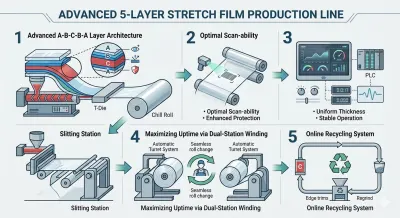
The main advantage of a 5-layer stretch film extrusion machine is its ability to combine different materials and functions within a single film structure. The commonly used A-B-C-B-A configuration separates the film into functional layers, allowing each layer to contribute specific performance characteristics.

The outer A layers are designed to improve film surface performance, transparency, and external protection. These layers can be optimized for smooth unwinding, stable appearance, and suitable surface properties required for different packaging applications. By controlling the outer layers independently, manufacturers can achieve consistent film quality while reducing unnecessary use of expensive materials.

The B layers work as intermediate bonding and transition layers between the outer surfaces and the core layer. Their main function is to improve structural stability and ensure strong adhesion between different polymer materials. This layered design helps create a more balanced film structure compared with traditional single-material production.

The central C layer serves as the main performance layer, providing enhanced mechanical strength, elasticity, and resistance against puncture and tearing. By concentrating high-performance resin materials in the core section, manufacturers can improve overall film performance while maintaining cost efficiency. This structure is especially valuable for producing thin-gauge stretch films that require reliable load retention and durability.

A key feature of advanced stretch film extrusion machine systems is precision thickness control. Modern production lines can integrate PLC-based control systems with online monitoring technology to continuously track film thickness and automatically adjust operating parameters. This helps reduce thickness variation, improve product consistency, and minimize material waste during continuous production.

The extrusion system, temperature control units, and precision T-die work together to ensure stable melt distribution and uniform film formation. Proper temperature management is essential because even small fluctuations can affect film transparency, mechanical strength, and surface performance. A well-designed extrusion system helps manufacturers maintain stable output during long production cycles.

Another important advantage is the automatic double-station winding system. Traditional winding processes may require production interruptions when replacing finished rolls, reducing equipment utilization. An automatic roll-changing system controlled by PLC can minimize downtime and support continuous production, making it suitable for high-volume stretch film manufacturing environments.

The integration of an online edge trim recycling system further improves production efficiency. During film production, edge materials generated during trimming can be collected and reused according to production requirements. This reduces raw material waste and helps manufacturers improve resource efficiency while maintaining stable production performance.

A complete stretch film extrusion machine can also support flexible material combinations, including LLDPE, mLLDPE, and other performance-enhancing polymer formulations. This flexibility enables manufacturers to develop different film grades for various industries, from general pallet wrapping to high-performance industrial packaging applications.

How a 5-Layer Stretch Film Extrusion Machine Future-Proofs Your Production

Investing in a 5-layer stretch film extrusion machine is not only an equipment upgrade but also a strategic improvement for manufacturers seeking higher product value and stronger market competitiveness. Compared with simpler film production systems, five-layer co-extrusion technology provides greater flexibility in material design, better control over film performance, and improved opportunities for reducing material consumption.

For manufacturers producing stretch film for demanding applications, equipment reliability and process stability are equally important as film performance. A professionally engineered production line combines precision extrusion technology, intelligent automation, and efficient winding systems to support long-term industrial production.

As packaging markets continue to develop toward lightweight materials, higher efficiency, and sustainable manufacturing, advanced multi-layer extrusion technology will become increasingly important. A 5-layer stretch film extrusion machine helps manufacturers respond to changing market requirements by producing high-quality stretch film with consistent performance, optimized material usage, and reliable production efficiency.

If you are planning to upgrade your stretch film production capacity or looking for a customized manufacturing solution, contact our professional technical team to discuss your application requirements and receive a suitable stretch film extrusion machine solution designed for your production goals.

Blog Cover

GET IN TOUCH NOW

*We respect your privacy. When you submit your contact information, we agree to only contact you in accordance with our Privacy Policy.