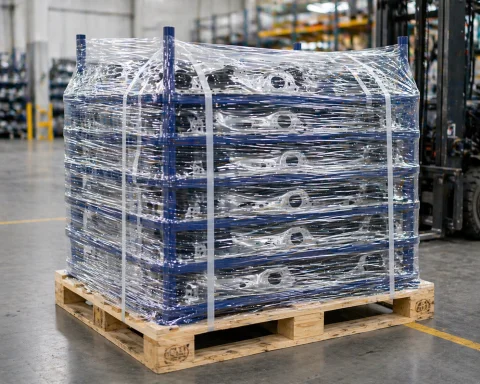
Industrial parts—such as automotive components and precision machinery—are highly prone to tearing, shifting, or surface damage during long-distance transit due to their irregular shapes, sharp edges, and heavy weight. Traditional single-layer stretch films lack the versatile performance needed to endure these complex logistics environments. Consequently, the 5-layer co-extrusion stretch film machine has emerged as a critical piece of equipment; it enables customized multi-layer structures that balance superior puncture resistance with high holding force, ultimately securing cargo safety while optimizing material costs.
Why Parts Transportation Requires Multi-Layer Stretch Film
Industrial components have different packaging requirements compared with ordinary palletized goods. Many mechanical parts contain sharp corners, metal edges, or uneven surfaces that can concentrate stress on the packaging material. When conventional film is stretched around these products, local pressure points may cause punctures or tearing, reducing the stability of the entire package.
A 5-layer stretch film structure solves these challenges by combining multiple functional layers into one film. Each layer can be designed for a specific purpose, allowing the final film to achieve better overall performance. The inner layer can provide strong cling force to secure components, the middle layers can improve tensile strength and puncture resistance, while the outer layer can offer smoother handling characteristics.
For industries such as automotive manufacturing, machinery production, aerospace components, and industrial equipment supply chains, this multi-functional structure provides better protection during transportation. Instead of increasing film thickness to improve strength, manufacturers can use advanced layer distribution technology to achieve stronger performance with optimized material consumption.
Protective Advantages of 5-Layer Stretch Film in Parts Transportation
The main advantage of 5-layer stretch film is its ability to combine different material properties within one packaging solution. Through advanced co-extrusion technology, manufacturers can adjust polymer formulations and layer ratios according to specific application requirements.
The inner layer of high-performance stretch film is typically designed with enhanced cling properties. This layer directly contacts the wrapped product and helps keep components securely positioned during transportation. For irregular parts such as valve bodies, stamped metal components, or machine accessories, strong cling reduces micro-movement between products and minimizes surface friction during handling.
The middle layers provide structural strength for demanding transportation environments. By optimizing resin selection and layer thickness distribution, 5-layer stretch film can achieve improved tensile strength, elongation performance, and tear resistance. This is particularly important for heavy industrial components where packaging must maintain stable containment force throughout the logistics process.
The outer layer is designed to improve operational convenience. A controlled friction surface allows wrapped pallets to be moved more efficiently in warehouses and distribution centers. The balance between slip performance and load stability helps reduce difficulties during storage, transportation, and automated handling.
Improved Puncture Resistance for Complex Industrial Components
One of the biggest challenges in parts transportation is protecting packaging integrity when products contain sharp edges or irregular structures. A damaged stretch film can quickly reduce load stability, especially when pallets are transported over long distances by road, rail, or sea.
The multi-layer structure produced by a stretch film manufacturing machine improves resistance against localized impact. Different layers work together to distribute stress, allowing the film to absorb external forces more effectively. This helps reduce the possibility of sudden tearing caused by sharp corners or heavy contact points.
For precision components, packaging protection is not only about preventing physical damage but also maintaining product appearance and quality. A properly engineered stretch film can provide cushioning support while reducing direct contact between products and external contaminants. This makes it suitable for applications where cleanliness, surface protection, and transportation reliability are important.
In addition, high-quality stretch film provides protection against dust and moisture exposure during storage and logistics operations. Although stretch film is not a replacement for specialized barrier packaging, its continuous wrapping structure helps reduce environmental contamination and supports cleaner supply chain management.
The Role of Stretch Film Manufacturing Machine in Producing High-Performance Packaging Film
The performance of 5-layer stretch film depends not only on material selection but also on the precision of the production equipment. A reliable stretch film manufacturing machine provides the technology required to produce consistent multi-layer films with controlled thickness, stable mechanical properties, and customized performance characteristics.
Through 5-layer co-extrusion technology, the machine can process different polymer materials and combine them into a functional film structure. Manufacturers can adjust formulas based on application requirements, including cling level, tensile strength, elongation rate, transparency, and puncture resistance.
Modern stretch film production equipment typically integrates precision extrusion systems, automatic temperature control, advanced T-die technology, and accurate winding systems. These components work together to maintain uniform film thickness and stable production quality. For industrial packaging applications, consistent film performance is essential because fluctuations in thickness or mechanical properties can affect wrapping efficiency and load security.
The production process also allows manufacturers to optimize material distribution. Instead of using excessive raw materials to increase film strength, a well-designed 5-layer structure places performance where it is most needed. This approach helps reduce unnecessary material consumption while maintaining reliable packaging performance.
Supporting Efficient and Customized Industrial Packaging Solutions
Different industries require different stretch film characteristics. Heavy automotive components may require higher containment force, while precision mechanical parts may prioritize surface protection and flexibility. A 5-layer stretch film manufacturing machine provides manufacturers with greater flexibility to develop application-specific film solutions.
By adjusting layer combinations and polymer formulations, producers can create films suitable for various transportation scenarios. These include export packaging for industrial equipment, pallet stabilization for manufacturing plants, warehouse storage protection, and automated wrapping applications.
High-performance stretch film can also improve packaging efficiency. Films with better stretchability and strength can reduce the amount of material required for each pallet while maintaining secure wrapping performance. For companies managing large-scale logistics operations, this can contribute to improved packaging consistency and reduced operating costs.
Stable production capability is equally important for meeting customer expectations. Industrial users often require continuous supply of packaging materials with predictable performance. A professionally designed stretch film manufacturing machine helps manufacturers achieve reliable output quality and support long-term customer requirements.
Advancing Parts Transportation with 5-Layer Stretch Film Technology
As global manufacturing and logistics networks continue to develop, the demand for more reliable industrial packaging solutions is increasing. Parts transportation requires materials that can handle complex shapes, heavy loads, and challenging logistics environments.
The combination of 5-layer stretch film technology and advanced stretch film manufacturing machine systems provides an effective solution for producing high-performance protective packaging materials. Through customized layer structures, improved puncture resistance, enhanced load stability, and optimized material usage, 5-layer stretch film helps manufacturers improve transportation reliability.
For stretch film producers, investing in advanced multi-layer production technology creates opportunities to serve demanding industries with specialized packaging solutions. By combining precise equipment design with suitable material engineering, manufacturers can produce stretch films that meet the evolving requirements of modern industrial supply chains.