Operating Process of 5-Layer Stretch Film Making Machine
2026-08-17
Modern industrial logistics has created increasingly strict requirements for pallet packaging safety, material efficiency, and production sustainability. In industries such as international transportation, warehousing, food logistics, automotive supply chains, and manufacturing distribution, stretch film plays a critical role in protecting goods during handling and shipping. However, traditional stretch film production methods often struggle to achieve the balance between lower material consumption and higher mechanical strength.
As packaging costs continue to rise and customers demand stronger, thinner, and more environmentally responsible films, manufacturers are turning to advanced production solutions. A modern stretch film extrusion machine with five-layer co-extrusion technology provides a more efficient approach by optimizing raw material distribution, improving film performance, and enabling intelligent manufacturing processes.
Challenges Faced by Traditional Stretch Film Manufacturing
Traditional stretch film production systems may face several limitations when meeting the requirements of modern packaging applications. One major challenge is inefficient material utilization. Without precise layer control and advanced extrusion technology, manufacturers often need to use thicker films to achieve sufficient strength, increasing resin consumption and production costs. In addition, limited recycling systems may result in higher material waste during edge trimming and production adjustments.
Film performance is another important concern. Conventional single-layer or basic three-layer stretch films may have limitations when used for heavy-duty pallet packaging or irregularly shaped loads. Insufficient puncture resistance and tear strength can cause film breakage during transportation, reducing packaging reliability and increasing operational expenses.
Production stability also directly affects final film quality. Inaccurate temperature control, unstable extrusion pressure, and inconsistent thickness distribution can lead to common defects such as fish eyes, poor transparency, and uneven stretching performance. For manufacturers producing high-quality stretch film, maintaining consistent optical properties and mechanical strength is essential.
At the same time, low automation levels can reduce production efficiency. Traditional equipment often requires more manual adjustment and monitoring, making continuous operation more difficult. Increased labor dependence, unstable running conditions, and higher energy consumption can limit overall production competitiveness.
The Importance of High-Quality Stretch Film in Industrial Logistics
High-performance stretch film has become an essential material for modern pallet packaging because it directly influences transportation safety and packaging efficiency. A quality stretch film provides strong elastic recovery, allowing the film to maintain stable wrapping force around different types of products. This helps prevent pallet collapse, shifting loads, and damage during long-distance transportation.
Another key advantage is packaging cost reduction. With advanced multi-layer structures and improved stretching capability, manufacturers can produce thinner films while maintaining excellent holding force. Higher pre-stretch performance allows companies to use less film material for the same packaging requirements, reducing consumption and improving cost efficiency.
Film transparency and surface quality also affect product presentation. Clear and uniform stretch film allows customers and warehouse operators to easily identify packaged goods without removing protective layers. For industries requiring premium packaging appearance, such as consumer products and export goods, optical clarity has become an important quality standard.
How a 5-Layer Stretch Film Extrusion Machine Improves Production Efficiency
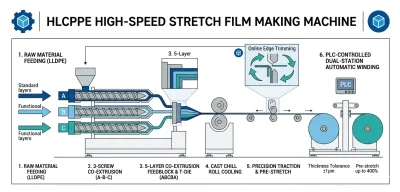
A five-layer stretch film extrusion machine represents a significant improvement over traditional film production equipment by combining advanced co-extrusion technology, precise process control, and intelligent automation. The typical five-layer structure uses an A-B-C-B-A configuration, where each layer performs a specific function to maximize film performance.
The outer A layers are designed to improve surface properties, including transparency, smoothness, and adhesion performance. These layers help achieve reliable wrapping results while maintaining excellent appearance. The B layers provide additional support and help optimize the overall mechanical structure of the film. The central C layer focuses on strength enhancement, allowing manufacturers to achieve higher puncture resistance and tear strength while reducing unnecessary material usage.
The independent feeding system of a five-layer stretch film extrusion machine allows different materials to be accurately distributed according to production requirements. By combining materials such as LLDPE, mLLDPE, recycled polymers, or functional additives, manufacturers can create customized film structures for different applications, including industrial pallet wrapping, food packaging, and heavy-load transportation.
Precision Extrusion Process with Advanced Temperature Control
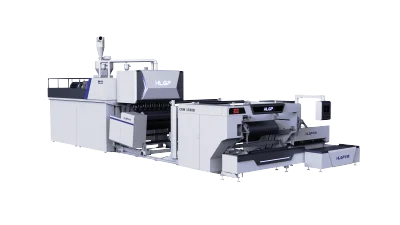
The extrusion process is one of the most important stages in stretch film manufacturing. Stable melting, mixing, and layer distribution directly determine the final film quality. Advanced stretch film extrusion machine systems use independent temperature control zones to maintain consistent processing conditions throughout the barrel, screw, adapter, and die areas.
During production, extrusion temperatures are typically controlled according to resin characteristics, with many LLDPE-based stretch film applications operating within approximately 180°C to 250°C depending on material formulation and process design. Precise temperature management helps ensure uniform polymer melting and reduces the possibility of defects such as fish eyes or unstable film surfaces.
After extrusion through the T-die, the molten film enters the high-efficiency casting section. A large-diameter chill roll rapidly cools and solidifies the film, locking in transparency, flatness, and dimensional stability. Compared with traditional cooling methods, advanced casting technology provides better thickness control and improved optical performance.
The precision-designed T-die and automatic thickness control system further enhance production accuracy. Through real-time monitoring and adjustment, manufacturers can maintain consistent film thickness distribution and reduce material waste caused by production fluctuations.
Intelligent Automation and Energy-Saving Production Features
Modern five-layer stretch film production lines integrate advanced PLC control systems to improve operational efficiency and production reliability. Operators can monitor key parameters such as extrusion temperature, pressure, speed, and winding tension through an intuitive interface, allowing faster adjustments and easier process management.
One important advantage of advanced equipment is optimized pre-stretch performance. High-quality stretch film produced by a modern stretch film extrusion machine can achieve excellent elastic memory and strong holding force, with some applications requiring pre-stretch ratios of up to 300% or higher depending on film design and packaging conditions. This allows users to reduce film consumption while maintaining secure pallet stability.
Automatic edge trimming and recycling systems also contribute to sustainable manufacturing. During the casting process, edge materials can be collected and recycled efficiently, minimizing production waste and improving raw material utilization.
For continuous industrial production, automatic winding systems provide significant advantages. Dual-station automatic roll changing technology enables stable 24-hour operation with reduced manual intervention. The system can complete roll replacement processes smoothly, improving productivity and reducing downtime.
Building Competitive Advantages Through Advanced Stretch Film Technology
For manufacturers seeking to improve production efficiency, reduce material consumption, and enhance stretch film quality, our 5-layer stretch film extrusion machine provides a reliable and advanced manufacturing solution. Designed with precision five-layer co-extrusion technology, intelligent PLC control, efficient casting systems, and optimized material distribution, our equipment helps customers achieve stable output and consistent film performance. We focus on providing customized stretch film production lines according to different production requirements, material choices, and application needs.
With professional engineering support and continuous technology improvement, our stretch film extrusion machine enables customers to build more efficient, cost-effective, and competitive packaging film production operations.