Equipment Features of 3-Layer Stretch Film Extrusion Machine
2026-08-28
In modern logistics, warehousing, manufacturing, and distribution, stretch film is widely used to secure palletized goods, protect products during transportation, and improve handling efficiency. As packaging lines become faster and more automated, manufacturers need stretch film with stable thickness, reliable stretchability, sufficient puncture resistance, and consistent cling. These requirements also place higher demands on the equipment used to produce the film.
A modern stretch film extrusion machine needs to do more than increase output. It must provide precise control over raw materials, layer structure, melt temperature, film thickness, cooling, and winding. A 3-layer configuration addresses these requirements by allowing different materials and functional properties to be distributed across the A/B/C layer structure.
Why Traditional Stretch Film Production Faces New Challenges
Traditional film production methods can make it difficult to balance strength, cling, transparency, and material consumption within a single film structure. Increasing film thickness may improve mechanical strength, but it also increases raw material consumption. Conversely, reducing thickness without improving the film structure can create weak points that are more likely to fail during stretching or transportation.
High-speed automated pallet wrapping creates another challenge. Stretch film must maintain stable elongation and tension while being continuously applied. Variations in film thickness or mechanical properties can contribute to film breaks, uneven wrapping, or production interruptions.
Heavy-duty packaging has different requirements. Metal products, construction materials, machinery components, and other industrial loads may have sharp edges or concentrated loads that place additional stress on the film. For these applications, a stronger core structure can provide a better balance between film thickness and mechanical performance.
These challenges have increased demand for a stretch film extrusion machine capable of controlling each layer according to its specific material and performance requirements.
How 3-Layer Stretch Film Supports Different Packaging Applications
A 3-layer stretch film uses an A/B/C structure to distribute different functions across the film. Instead of requiring one material to provide every desired property, manufacturers can design the outer and core layers according to the intended application.
The outer layers can be formulated for properties such as cling, surface characteristics, and optical appearance, while the core layer can contribute significantly to tensile strength and puncture resistance. The exact formulation and layer ratio depend on the target film specification, resin selection, and application requirements.
For pallet wrapping, stable cling and stretch behavior help keep loads consolidated during handling and transportation. For heavy-duty industrial packaging, a stronger core can help the film withstand localized stress. In logistics and warehouse applications, good transparency can also make packaged goods, labels, and identification marks easier to inspect.
This functional separation is one of the main reasons why three-layer structures are useful when manufacturers need to produce films for different packaging requirements.
Independent Triple-Screw Extrusion System
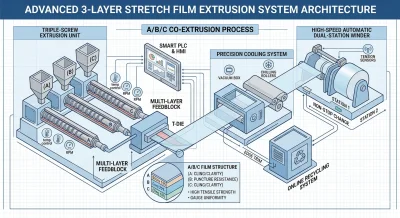
A key feature of an advanced 3-layer stretch film extrusion machine is its independent triple-screw extrusion system. Each extrusion unit can be controlled separately, giving manufacturers greater flexibility when processing different resin formulations.
Materials such as LLDPE and mLLDPE can be selected according to the required mechanical and stretching properties, while PIB may be incorporated where additional cling performance is required. Independent control of screw speed and processing temperature allows each extrusion unit to be adjusted according to the characteristics of the material being processed.
This configuration is particularly useful when producing thin-gauge stretch film. Instead of relying primarily on greater film thickness to obtain strength, manufacturers can optimize the layer structure and material distribution. This can support material-efficient film designs while maintaining the properties required for pallet wrapping and transportation protection.

Precision Multi-Layer Feedblock and T-Die
After individual extrusion, the polymer melts must be combined into a stable multi-layer structure. A precision co-extrusion feedblock helps control the distribution of the A, B, and C layers before the melt reaches the die.
Accurate layer-ratio control is important because excessively thick functional layers can increase material consumption, while insufficient layer thickness may prevent the film from achieving its intended surface properties. Stable melt flow also helps reduce interface disturbances between layers.
The T-die plays an equally important role in film formation. A precision T-die is designed to distribute the melt across the film width and support consistent thickness in both the transverse and machine directions. Better gauge uniformity is especially valuable for high-speed wrapping, where local thin areas can become weak points during stretching.
For manufacturers producing thin-gauge film, stable thickness distribution can therefore contribute to better material utilization and more consistent performance.
PLC and Smart HMI Control
A modern stretch film extrusion machine also requires coordinated process control. A PLC-based control system can monitor key operating conditions such as melt pressure, motor load, temperature, and line speed.
Through the HMI, operators can manage production parameters and store commonly used recipes for different film specifications. This makes it easier to switch between material formulations, layer ratios, and film thickness requirements while maintaining repeatable operating conditions.
Cooling control is another important part of the process. Proper cooling and solidification help stabilize the film after extrusion and can contribute to consistent optical properties and dimensional stability. These characteristics are useful for logistics and warehouse packaging, where transparent film allows operators to inspect packaged products and identify labels without removing the wrapping.
Automatic Dual-Station Winding for Continuous Production
The winding section directly affects production continuity and finished-roll quality. An automatic dual-station winder can perform roll changes with limited interruption to the extrusion process, making it suitable for high-volume stretch film production.
Constant tension control is important for maintaining consistent winding hardness. Excessive or unstable tension can contribute to roll deformation, while insufficient tension may result in loose or unstable rolls. Sensors and automated tension control help maintain more consistent winding conditions throughout production.
Online edge trimming can also remove uneven film edges during production, while the collected edge material can be directed toward an appropriate recycling or reprocessing process where the production formulation permits it. This helps manufacturers manage process waste more effectively.
From Equipment Features to Film Performance
The value of a 3-layer stretch film extrusion machine is ultimately reflected in the film it produces. Independent extrusion supports flexible material selection, while the multi-layer feedblock provides controlled layer distribution. Precision T-die technology contributes to thickness consistency, and PLC-based control helps maintain stable production conditions.
Together, these technologies can support stretch films with improved puncture resistance, reliable cling, consistent transparency, and stable stretching characteristics. These properties are valuable across automated pallet wrapping, logistics and warehousing, heavy-duty industrial packaging, and other load stabilization applications.
For manufacturers looking to reduce film thickness without unnecessarily compromising mechanical performance, a carefully engineered three-layer structure can also provide a practical route toward down-gauging and improved material efficiency.
3-Layer Stretch Film Extrusion Machine: Key Selection Factors
When selecting a 3-layer stretch film extrusion machine, manufacturers should look beyond nominal output and consider screw configuration, resin compatibility, layer-ratio control, T-die precision, cooling capacity, film thickness requirements, winding technology, automation, and maintenance. The right equipment should match the intended film structure and application, whether the goal is high-speed pallet wrapping, heavy-duty industrial packaging, or thin-gauge film production. Our stretch film extrusion machine combines independent triple-screw extrusion, precise multi-layer control, stable film forming, intelligent PLC management, and automatic winding to support consistent three-layer stretch film production. This integrated configuration provides manufacturers with greater flexibility in balancing strength, cling, transparency, stretchability, and material efficiency, making our machine a practical solution for producing stretch film for logistics, warehousing, pallet wrapping, and industrial packaging applications.