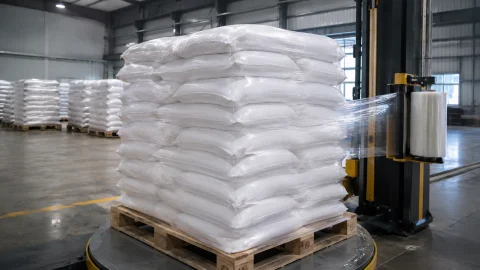
Palletized transport of fine materials like cement, flour, and chemical powders presents severe logistics challenges, including bag puncture, shifting loads, and moisture contamination. Implementing high-performance wrap produced by advanced stretch film manufacturing machines is critical to eliminating product loss, preventing workplace slip hazards, and ensuring load stability during transit.
Structural Integrity via Multi-Layer Co-Extrusion
Standard single-layer films often fail under the mechanical stress of heavy powder sacks. Utilizing a 2-5-layer stretch film machine allows for precise material engineering.
A classic three-layer ABA co-extrusion structure or an advanced 5-layer configuration creates a film with distinct functional layers:
- Inner Layer: Engineered with high-cling properties to lock individual powder bags into a cohesive unit.
- Middle Core Layer: Formulated for puncture resistance and tensile strength to withstand sharp bag corners.
- Outer Skin: Optimized with low-friction characteristics to prevent adjacent pallets from tearing each other during forklift handling.
- These multi-layer lines ensure consistent elongation rates of 250% to 300% without neck-down. This high pre-stretch capability maintains a continuous holding force, reducing product loss in powder logistics from average industry defect rates down to less than 0.2%.
Gauge Precision and Delamination Prevention
Film gauge uniformity directly dictates load containment reliability. In standard manufacturing, a gauge variation ±3 can lead to film delamination and premature snapping under load tension.
Advanced stretch film machine configurations resolve this by integrating independent temperature control zones and dedicated melt pumps. This maintains steady die pressure, tightening gauge tolerances to within ± 0.5 For powder applications requiring a standard 15 to 20-micron thickness, this precision eliminates thin spots, preventing bag burst and structural collapse during tight highway turns or sea transit.
Optimized Roll Quality through Precision Winding and Automated Shaft Changing
The winding phase dictates how the film rolls perform during downstream tension release. Investing in a fully automatic stretch film machine integrates an advanced, hands-free winding system equipped with automatic mechanical arms for seamless shaft and paper core changing. This continuous, high-speed automated cycle eliminates line stops, ensuring uniform tension profiles across the entire roll diameter and preventing telescoped or loose edges. Conversely, a semi-automatic stretch film machine offers the exact same extrusion and gauge control capabilities but utilizes manual shaft changing, providing a highly cost-effective entry point for operations with flexible production schedules. Regardless of the automation level at the winder, precise tension management ensures each roll deploys as a secure, puncture-resistant barrier capable of locking in fine powder aggregates.