Achieving Zero-Waste Production: How Stretch Film Extrusion Machine with Online Edge Trim Recycling Saves Raw Material Costs?
2026-09-07
Virgin LLDPE resin makes up more than 70% of the total cost of producing stretch film, so every percentage point of material lost to waste has an outsized effect on our margins and on our customers' margins. For decades, edge slitting has quietly eaten away at that resin budget: standard trimming during winding and rewinding generates somewhere between 5% and 8% waste on every roll produced. On a large production line, that adds up to tons of resin thrown away every month, not because the polymer is bad, but because the industry never found a clean way to bring it back into the process.
Why Trim Waste Has Always Been Harder to Solve Than It Looks
The obstacle isn't collecting the trim — it's what happens to it afterward. Edge trim cut from a stretch film web is thin, sticky, and highly cling-active, which is exactly what makes it useful as a film but difficult to recycle through conventional means. When trim is collected manually and reprocessed offline, it sits exposed to ambient air and moisture for extended periods, and it typically passes through an extra heating cycle before it ever gets close to an extruder again. Both factors degrade the polymer chain. The result is a regrind that has lost tensile strength and elongation, and that can no longer be blended into layers where cling performance or puncture resistance actually matters. In practice, most manufacturers using older lines simply stockpile trim, sell it off as low-grade scrap, or discard it — the material's value never makes it back into the finished product.
Where This Waste Actually Costs the Most
The financial and quality impact of unrecovered trim isn't evenly distributed — it shows up hardest in packaging applications where film consumption is high and margins are thin.
In metal wire and hardware packaging, coils and bundled products are wrapped at high frequency with fast roll changeovers, which means edge trim is generated constantly throughout a shift. Older machines have no way to process this trim as it's produced, so it accumulates on the shop floor and gets swept up as scrap rather than reused.
Fertilizer and agricultural input packaging places heavy demands on UV resistance and tear strength, since bags often sit outdoors before use. Offline-recycled regrind, already weakened by degradation, simply can't be blended back into these performance-critical layers, so producers end up buying more virgin resin than the trim loss alone should require.
Textile yarn roll packaging tends to involve irregular roll diameters, which means more frequent edge trimming than standard pallet wrap. On conventional lines, that translates into more manual trim handling, slower changeovers, and a recycling backlog that never quite gets processed before the next batch starts.
Recovering the Trim at the Exact Moment It's Created
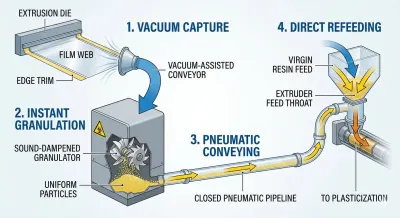
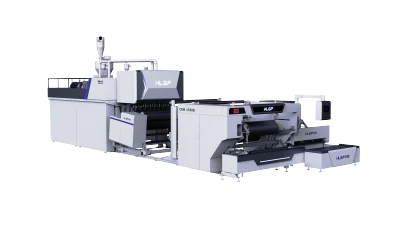
The technical answer to this problem is to stop treating trim recovery as a separate, offline process and instead build it into the extrusion line itself. Our stretch film extrusion machines integrate a continuous inline trim management module that operates automatically alongside the main line, working through four synchronized stages.
As the film web exits the die, vacuum-assisted conveyors capture the adhesive LLDPE edge trim immediately — there's no gap between generation and collection, which is what prevents the material from sitting exposed and degrading. A compact, sound-dampened granulator then pulverizes the trim into uniform particles right at the line, rather than sending it to a separate recycling station. From there, the particles move through a closed pneumatic pipeline that keeps them fully isolated from ambient oxygen and moisture during transport — the same exposure that causes offline regrind to lose its properties never happens here. Finally, the system feeds the recycled particles directly back into the extruder feed throat, where they blend with virgin resin immediately before plasticization.
Because the entire cycle happens within seconds of the trim being cut, the recycled content goes through essentially the same thermal history as fresh resin instead of an extra degrading pass. Field trials on our machines confirm the practical result: recycled content maintains tensile strength consistent with virgin polymer, retains the same maximum elongation and stretchability, and preserves the cling characteristics needed for self-adhesive film layers. That's the difference that actually matters for the industries described above — a fertilizer bag reinforced with recycled content that still holds its tear strength, or a wire coil wrap where the trim recovered from one roll strengthens the next one instead of being scrapped.
This module isn't limited to one configuration. It integrates with 2-layer, 3-layer, and 5-layer stretch film machines, and it works whether the line is running semi-automatic or fully automatic winding. On a 5-layer machine, the system can recapture 100% of generated edge trim online, which effectively eliminates post-industrial waste from the process entirely. For a production line turning out 2,000 metric tons of film annually, that level of recovery saves approximately 120 to 150 metric tons of LLDPE resin every year — resin that would otherwise need to be purchased new. None of this comes at the cost of output: the line holds its full winding speed and maximum throughput throughout, since the recycling module runs synchronously rather than interrupting production to process trim in batches.
What a Closed Loop Actually Changes
Once trim recovery is integrated directly into the extrusion process, stretch film production can become more efficient, consistent, and easier to manage. By returning suitable edge trim to the material stream during production, our stretch film extrusion machines are designed to help manufacturers reduce material waste while maintaining stable film quality. This integrated approach also reduces the need for separate trim handling and recycling steps, making the overall production workflow more streamlined.
For producers serving metal packaging, agricultural products, textiles, and other high-volume applications, our extrusion machines provide a practical approach to building a more resource-efficient stretch film production line. With trim recovery considered as part of the machine design rather than an added process, we help manufacturers turn material efficiency into a built-in part of everyday production.