Reducing Energy Consumption: 4 Ways to Make Your Stretch Film Extrusion Machines Energy-Efficient
2026-07-01
Maximizing production efficiency while minimizing operational costs is the defining challenge for modern plastics manufacturers. In the highly competitive flexible packaging sector, energy expenses constitute a massive portion of the Total Cost of Ownership (TCO) for manufacturing lines. As global sustainability regulations tighten and industrial electricity tariffs fluctuate, relying on legacy hardware is no longer a viable business strategy. Achieving true sustainability requires a deep technical overhaul of core machinery. By re-engineering critical driving, mechanical, and control systems, manufacturers can drastically lower their carbon footprint.
The Costly Burden of Legacy Extrusion Infrastructure
Traditional stretch film extrusion machinery operates on fragmented, uncoordinated hardware architectures that inherently waste massive amounts of electricity. Standard production lines frequently utilize outdated three-phase asynchronous motors paired with high-friction mechanical gearboxes. These systems suffer from severe power factor degradation during partial-load operations, resulting in substantial reactive power losses. Mechanically, older screw geometries fail to balance thermal energy input correctly. They rely excessively on external electrical resistance bands to melt linear low-density polyethylene (LLDPE) resins, rather than leveraging controlled mechanical shear.
Furthermore, legacy fluid dynamics within traditional die heads create immense flow resistance. This forcing main extruder motors to expend extra torque and energy just to overcome internal melt pressure drops. Managing these uncoordinated mechanical forces is further complicated by basic, decentralized temperature controllers and independent relays. Without a centralized command system, these components operate with severe thermal lag and inconsistent power cycles. The resulting system overshoots target temperatures, undergoes constant corrective cooling cycles, and wastes significant energy. This lack of synchronization ultimately compromises film gauge consistency and escalates scrap rates.
Centralized PLC Intelligence for Synchronized Energy Management
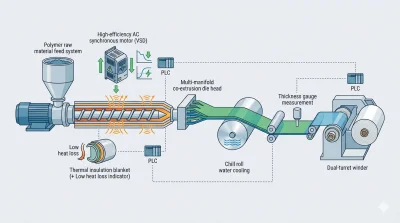
The foundation of a truly energy-efficient extrusion line lies in transition from localized control loops to a centralized intelligence hub. Integrating a high-performance Programmable Logic Controller (PLC) acts as the operational brain of the entire line, moving the system away from disjointed component operations. A centralized PLC system establishes an interconnected ecosystem by linking the primary extruder drive, melt pumps, casting roll systems, and winding stations into a unified closed-loop network.
Using advanced industrial protocols like EtherCAT or PROFINET, the central PLC continuously monitors real-time thermodynamic profiles, motor torque loads, and line speeds. Sophisticated internal algorithms dynamically calculate the exact power requirements across all heating zones and mechanical drives simultaneously. This predictive control eliminates the energy-wasting thermal overshoot and lag common in older systems. When the line changes speeds or processes different resin grades, the PLC instantly recalibrates the power distribution across the entire machine. By preventing idle power consumption and ensuring every watt of electricity matches real-time processing demands, the intelligent PLC reduces system-wide energy losses.
Advanced Permanent Magnet Synchronous Motors to Cut Power Losses
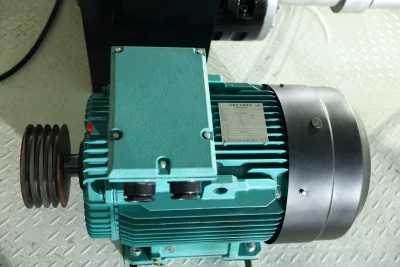
Replacing inefficient three-phase induction motors with Permanent Magnet Synchronous Motors (PMSM) represents a major leap forward in drivetrain efficiency. Traditional asynchronous motors suffer from high internal rotor copper losses and drop significantly in efficiency when operating outside their narrow peak design speeds. In contrast, PMSM technology utilizes high-coercivity rare-earth permanent magnets within the rotor. This design eliminates internal rotor current losses entirely and allows the motor to maintain an ultra-high power factor across its entire operational spectrum.
When managed by integrated digital variable frequency drives, a PMSM system delivers exceptional torque performance even at ultra-low operational frequencies. This precise torque control allows engineers to eliminate heavy, high-friction mechanical reduction gearboxes and implement a more direct drive configuration. Removing these mechanical transmission barriers directly cuts parasitic friction losses. As a result, the drivetrain achieves an immediate, measurable reduction in electricity consumption during continuous stretch film production.
Optimized Low-Friction Screws to Maximize Mechanical Shear Heating
The mechanical design of the extrusion screw dictates the fundamental thermodynamic efficiency of the entire polymer melting process. Standard screw profiles often treat the barrel's electrical heating bands as the primary source of thermal energy, which is highly inefficient for processing LLDPE. Modern energy-efficient stretch film extrusion machines utilize advanced, custom-engineered low-friction screws featuring optimized barrier flights and specialized dispersive mixing elements.
This advanced geometry relies on controlled, high-efficiency mechanical shear as the primary mechanism for melting the polymer. As the raw plastic pellets move through the barrier zones, the screw's precise mechanical action generates highly uniform frictional heat directly within the resin matrix. This optimized mechanical shear achieves a self-sustaining thermal balance, drastically reducing the run-time electricity required by external barrel heaters. Additionally, the specialized flight design minimizes internal stagnation zones and back-pressure spikes. This smooth flow profile allows the primary motor to process material with significantly less torque resistance, saving substantial energy at the main drive.
Precision Low-Resistance Die Heads to Eliminate Pressure Drops
The final mechanical hurdle in the extrusion process is the fluid dynamic resistance encountered within the feedblock and die system. Traditional co-extrusion die heads often feature restrictive internal flow channels that create severe pressure drops as the molten polymer flows through. To maintain a stable output and ensure consistent film thickness, the primary extruder and melt pumps are forced to operate at elevated pressures, which demands higher motor wattage.
Implementing precision-machined, low-resistance die heads with computer-optimized internal flow channels resolves this hidden energy drain. These advanced dies are developed using advanced computational fluid dynamics (CFD) to ensure the polymer melt flows smoothly with minimal internal friction. Reducing internal flow resistance lowers the overall backpressure throughout the entire barrel assembly. This pressure reduction allows the main drive motors and melt pumps to operate at lower torque levels while maintaining high output rates. The result is a highly stable, uniform melt distribution across all film layers that uses less energy and delivers exceptional mechanical film properties.
Measurable Enterprise Value and Sustained Bottom-Line Savings
Upgrading to an engineered, energy-efficient stretch film extrusion line delivers immediate operational and financial advantages for high-volume packaging manufacturers. Integrating a centralized PLC, high-efficiency PMSM drives, optimized screw profiles, and streamlined die systems creates a highly synchronized production process. This advanced engineering reduces total energy consumption per ton of finished stretch film by up to thirty percent compared to legacy systems.
Beyond direct electrical savings, these optimized components lower internal mechanical wear and extend routine maintenance intervals, significantly reducing unscheduled downtime. Maintaining precise thermal control and smooth polymer flow also reduces material degradation, leading to lower scrap rates and more consistent film quality. For global manufacturers facing rising energy costs and strict corporate sustainability targets, investing in modern energy-efficient stretch film extrusion machines provides a clear path to lower operational expenses, increased profitability, and a stronger competitive edge.