Stretch film production requires a balance among film structure, mechanical performance, surface properties, and material efficiency. Different packaging applications may require varied combinations of tensile strength, elongation, puncture resistance, cling, and transparency. Two-layer and three-layer co-extrusion technologies provide distinct ways to distribute these properties across the film profile. Understanding these structural differences can helps manufacturers select the appropriate stretch film making machines based on their film specifications, materials, and production requirements.
Challenges in Stretch Film Production
Stretch film manufacturers must maintain consistent stretch film quality while controlling resin consumption and production costs. The finished stretch film must deliver sufficient tensile strength and elongation for pallet wrapping, while maintaining adequate cling and handling characteristics.
In a 2-layer structure, fewer layers are available to distribute functional properties. Consequently, each layer must perform multiple functions simultaneously. While effective for specific A/B stretch film structures, formulation flexibility is inherently limited.
Material selection becomes critical when PCR-PE or cost-optimized resins are introduced. The impact of recycled resin on stretch film appearance and performance depends on its purity, cleanliness, color, contamination levels, filtration efficiency, and processing consistency. Manufacturers must evaluate these factors when determining optimal layer placement and PCR loading ratios.
Three-layer coextrusion offers greater structural flexibility. An added layer allows manufacturers to distribute materials and functions across the stretch film more precisely. This does not mean three-layer stretch film is universally superior to two-layer stretch film; rather, the two structures cater to different formulation strategies and production requirements.
Structural Difference Between 2-Layer and 3-Layer Stretch Film
The most direct difference between 2-layer and 3-layer stretch film is the number of material layers within the finished stretch film structure.
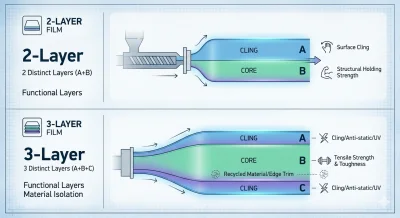
A 2-layer stretch film commonly uses an A/B structure. This allows manufacturers to combine selected properties within a straightforward profile. Because there are only two layers, each layer must fulfill more than one function depending on the formulation.
A 3-layer stretch film typically utilizes an A/B/C or A/B/A arrangement depending on machine configuration and target product. The additional layer provides greater versatility for distributing materials and functional properties.
It is important to distinguish stretch film structure from the mechanical configuration of the extrusion equipment. A 2-layer stretch film line can produce the required two-layer structure using a dedicated feedblock or coextrusion setup. The number of layers therefore describes the finished stretch film, while the extrusion configuration describes how the machine processes and distributes the material.
For three-layer production, the extrusion system is configured to independently control the materials feed for each layer. The exact equipment arrangement depends on machine design, target stretch film specification, and production requirements.
| Film Structure | A/B | A/B/C or other 3-layer configurations |
| Number of Film Layers | 2 layers | 3 layers |
| Material Distribution | Two material layers with different or combined functions | Three layers provide more options for material distribution |
| Functional Allocation | Each layer may perform multiple functions | Different layers can be assigned more specific functions |
| Extrusion Configuration | Single-screw extrusion system can be used | Extrusion system is configured according to the required 3-layer structure |
| Selection Considerations | Film formulation, thickness, width, output, and application | Film formulation, layer ratio, thickness, width, output, and application |
Material Distribution in 2-Layer Stretch Film
The A/B structure of a two-layer stretch film allows manufacturers to tailor each layer independently. One layer may contribute more to surface characteristics (such as cling or slip), while the other drives mechanical performance.
However, the actual role of each layer depends on the formulation. There is no universal rule that one layer must provide cling while the other provides strength.
A simplified extrusion system can process the selected resin formulation and form the required two-layer structure through the machine's material distribution system. This makes the configuration suitable for manufacturers whose product range relies on specific two-layer stretch film formulations.
Two-layer stretch film is suitable for many standard pallet wrapping and transportation packaging applications. When the material formulation and stretch film specification are properly matched, the structure delivers the required combination of elongation, strength, cling, and load stability.
Material Distribution in 3-Layer Stretch Film
A three-layer structure provides an additional layer for material distribution. An A/B/C arrangement, for example, allows the surface layers and central layer to be formulated for different functional requirements.
The outer layers can be optimized for surface properties such as cling, slip, friction, and clarity. The core layer drives properties such as tensile strength, toughness, elongation, and puncture resistance. The specific role of each layer depends on the resin formulation and target application.
This structure also offers more options when incorporating post-consumer recycled polyethylene (PCR-PE). If the recycled material meets the required quality and application conditions, manufacturers can encapsulate it within the core layer, preventing surface defects and preserving cling properties.
Comparing Film Performance and Production Requirements
The difference between two-layer and three-layer stretch film lies primarily in how materials and functions are distributed, rather than a disparity in overall quality.
A two-layer structure is suitable when required stretch film properties can be achieved with two material layers. Its straightforward structure suits manufacturers producing specific A/B formulations and standard stretch film products.
A three-layer structure provides an additional layer to isolate or combine material functions. This offers manufacturers greater control over surface characteristics, mechanical properties, recycled material placement, and resin combinations.
Both structures can produce stretch film with adequate tensile strength, elongation, puncture resistance, and cling when formulation and processing conditions are properly optimized. Ultimately, stretch film performance depends on resin selection, layer ratio, gauge, extrusion stability, casting conditions, cooling, and winding.
Stretch Film Making Machines for Different Production Requirements
Both 2-layer and 3-layer stretch film structures serve distinct operational needs. A 2-layer configuration offers a practical solution for manufacturers producing specific A/B stretch film structures, whereas a 3-layer configuration provides an additional layer to optimize resin distribution and functional segregation. The right choice depends on the target stretch film specification, resin formulation, production capacity, and application rather than the number of layers alone.
Our stretch film extrusion lines include both 2-layer and 3-layer configurations, accommodating diverse stretch film structures and manufacturing demands. Whether requiring a single-screw 2-layer solution for a specific formulation or a 3-layer system for flexible material distribution, our technical team evaluates the appropriate machine configuration based on stretch film gauge, width, resin selection, target output, and end-use requirements.