How Smart PLC Stretch Film Extrusion Machines Integrate into Automated Production Lines
2026-05-19
Traditional stretch film production lines often operate in isolation. Manual gauge adjustments, fixed temperature profiles, and standalone control cabinets cause persistent production bottlenecks. These isolated systems lead to film thickness variations, frequent downtime, and excessive material waste.
Modern fully automatic stretch film machines solve these challenges. By incorporating advanced smart PLC control systems, these machines transform from isolated equipment into interconnected nodes within automated production lines.
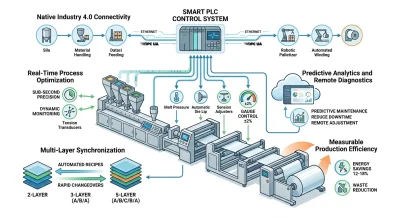
Native Industry 4.0 Connectivity
Smart PLC stretch film extrusion machines feature native integration capabilities for smart factories. They communicate seamlessly with upstream and downstream automation using industrial Ethernet and OPC UA protocols.
This connectivity allows the extrusion line to sync with raw material feeding systems, downstream automated winding, slitting units, and robotic packaging systems.
Real-Time Process Optimization
The integrated PLC system continuously processes data from across the production line to maintain optimal film quality:
- Sub-Second Precision: Automatically modulates extrusion speed and barrel temperature based on real-time sensor feedback.
- Dynamic Monitoring: Tracks live data from melt pressure sensors, automatic die lip adjusters, and winder tension transducers.
- Automated Gauge Control: Maintains strict film thickness tolerances within ±2%, drastically reducing variations.
Multi-Layer Synchronization
Whether configuring a 2-layer stretch film machine, a 3-layer stretch film machine, or a 5-layer stretch film machine, the smart PLC automates complex multi-layer cast film structures (such as A/B/A or A/B/C/B/A).
- Automated Recipes: Eliminates manual recipe adjustments for different film grades.
- Rapid Changeovers: Reduces line changeover times from hours to minutes.
- Targeted Performance: Synchronizes layer ratios to optimize puncture resistance, elongation, and clarity automatically.
Predictive Analytics and Remote Diagnostics
The core technological leap of the smart PLC backbone is its ability to perform predictive maintenance and analytics:
- Data Logging: Tracks historical process parameters, including resin viscosity fluctuations and chilling roll speed variance.
- Error Prevention: Identifies mechanical wear patterns before defects occur, reducing unplanned downtime by up to 40%.
- Remote Control: Allows plant engineers to adjust settings and troubleshoot via secure cloud dashboards without physical intervention.
Measurable Production Efficiency
Integrating PLC intelligence into continuous high-speed lines (producing 400–600 kg/h of 20–30 micron film) delivers clear operational improvements:
- Energy Savings: Reduces heating energy consumption by 12–18% through precise PID temperature loops.
- Waste Reduction: Minimizes resin scrap during start-ups and transitions via automated purge cycles.
- Robotic Readiness: Produces ultra-consistent film rolls optimized for high-speed robotic palletizers.