Stretch Film Extrusion Machine ROI: How to Achieve Fast Production & Profits
2026-07-03
In the global packaging industry, cost control and production efficiency have become the two most critical factors determining long-term competitiveness. For manufacturers working with stretch film, the performance of stretch film extrusion machines directly affects raw material consumption, output stability, and final product quality. As market demand continues to grow, traditional monolayer systems are increasingly unable to meet modern requirements for high efficiency, low waste, and consistent film performance. As a result, advanced co-extrusion systems with automation and recycling integration are becoming the preferred solution for achieving faster ROI and higher production profitability.
Industry Challenges in Traditional Stretch Film Production
Conventional stretch film production lines often struggle with a combination of technical and operational limitations. One of the most common issues is inconsistent film quality. Monolayer extrusion structures lack the ability to distribute material properties across multiple functional layers, which leads to variations in thickness, reduced puncture resistance, and unstable elongation performance. These defects directly increase scrap rates and reduce overall production efficiency.
Another major challenge is raw material inefficiency. Traditional systems do not allow flexible resin allocation, which forces manufacturers to rely on higher-cost materials throughout the entire film structure. This significantly increases production costs, especially in large-scale pallet wrapping applications where material consumption is high.
Operational downtime is also a critical issue. Many conventional stretch film extrusion machines rely heavily on manual adjustments, which increases the risk of human error and production interruptions. Frequent stopping for roll changes, tension corrections, and quality adjustments leads to reduced throughput and inconsistent output.
In addition, waste management and energy consumption remain significant concerns. Without integrated recycling systems, edge trim waste is often discarded, creating unnecessary material loss. At the same time, inefficient heating and driving systems result in higher electricity usage, increasing long-term operating costs.
Advanced Co-Extrusion Technology for Improved Performance
Modern stretch film extrusion machines equipped with multi-layer co-extrusion technology offer a substantial improvement over traditional systems. By combining different polymer layers within a single film structure, manufacturers can achieve a balance between mechanical strength, optical clarity, and cost efficiency.
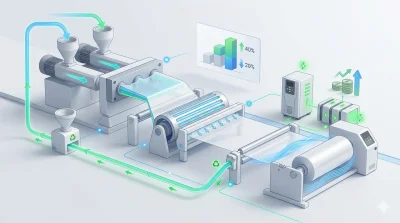
Three-layer and five-layer co-extrusion systems are particularly effective in optimizing resin utilization. These configurations allow each layer to serve a specific function. The outer layers typically provide strength and puncture resistance, while the inner layers can be engineered for cost efficiency using more economical resins. This strategic material distribution can reduce overall raw material costs by up to 15 percent while maintaining or even improving film performance.
Advanced LLDPE screw designs further enhance system stability by ensuring uniform melt homogeneity. Consistent thermal distribution and viscosity control reduce the occurrence of gels, unstable flow, and degradation, resulting in a smoother extrusion process and higher-quality final products.
Precise feedblock and die systems also play an important role in layer accuracy. By controlling the distribution of each polymer layer with high precision, these systems ensure consistent film gauge and improved structural integrity across the entire roll.
Automation Systems and High-Efficiency Winding Solutions
Automation is a key factor in maximizing the performance of modern stretch film extrusion machines. Fully automatic systems significantly reduce human intervention and enable continuous production with minimal interruptions.
One of the most important advancements is high-speed automatic rewinding and roll-changing technology. This feature eliminates the need for frequent manual stoppages, increasing monthly production output by up to 40 percent in optimized configurations. Continuous operation not only improves efficiency but also stabilizes product quality by maintaining consistent process conditions.
Closed-loop PLC tension control systems further enhance production stability. By continuously monitoring and adjusting winding torque, these systems prevent common defects such as wrinkles, telescoping, and uneven roll hardness. The result is a more uniform and commercially reliable final product.
For manufacturers with lower production volumes or frequent product changes, semi-automatic configurations provide a flexible alternative. These systems allow faster changeovers while maintaining stable operation, making them suitable for diversified production environments.
Inline Recycling and Energy Optimization for Sustainable Manufacturing
Sustainability and cost reduction are increasingly interconnected in modern extrusion technology. Integrated inline recycling systems represent one of the most effective methods for improving both environmental and economic performance.
Edge trim recovery systems collect waste material directly from the slitting process and reintroduce it into the extrusion line. This closed-loop approach eliminates the need for external waste handling and significantly reduces raw material loss. Over time, this contributes to a noticeable reduction in production costs and supports more sustainable manufacturing practices.
Energy efficiency is another important factor in improving ROI. Advanced cooling rollers and optimized air knife systems accelerate film solidification, allowing higher line speeds without compromising product quality. At the same time, variable frequency drives and energy-efficient heating zones reduce overall power consumption by approximately 20 percent compared to conventional equipment.
These improvements not only reduce operating expenses but also enhance the stability of long-term production cycles, making the entire system more cost-effective over its lifecycle.
Flexible Machine Configurations for Different Production Needs
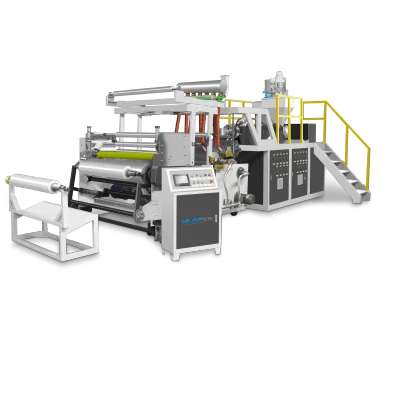
One of the key advantages of modern stretch film extrusion machines is their configurability. Manufacturers can select from different system architectures depending on their production scale, product requirements, and investment budget.
Two-layer systems are typically used for cost-sensitive applications where simplicity and operational efficiency are priorities. These systems offer stable performance with lower initial investment and are suitable for small to medium production facilities.
Three-layer and five-layer systems are designed for high-performance applications. These configurations provide superior film properties and greater flexibility in material selection. They are particularly suitable for high-demand packaging environments where strength, consistency, and cost optimization are essential. Although the initial investment is higher, the improved efficiency and reduced material costs result in a significantly shorter payback period.
Automation levels also play a key role in configuration decisions. Fully automatic systems are ideal for large-scale continuous production, while semi-automatic systems offer flexibility for smaller batches and diversified product lines. Selecting the right configuration allows manufacturers to align technical capability with business objectives, ensuring maximum return on investment.
Maximizing ROI Through Integrated Technology
The evolution of stretch film extrusion machines has shifted the focus from basic film production to integrated system optimization. Modern solutions combine multi-layer co-extrusion, intelligent automation, and energy-efficient recycling technologies to create a highly efficient production ecosystem.
By reducing raw material waste, improving production stability, and increasing automation levels, manufacturers can significantly lower operational costs while increasing output capacity. These improvements directly shorten equipment payback periods and enhance long-term profitability.
In today’s competitive packaging market, investing in advanced stretch film extrusion machines is no longer just a production upgrade but a strategic decision. The integration of precision engineering and smart automation provides manufacturers with a sustainable pathway to higher efficiency, lower costs, and faster ROI.