Rigid Quality Control: How We Test Every Stretch Film Extrusion Machine Before Shipment
2026-08-27
In today's competitive industrial packaging market, equipment reliability translates directly into market share. The operational stability of a stretch film extrusion machine determines not just daily throughput, but a manufacturer's reputation for consistency. A single unstable production line can mean missed delivery windows, wasted resin, and customers who quietly move their business elsewhere. To safeguard that investment and eliminate costly production interruptions, we put every production line through a rigorous Factory Acceptance Testing protocol before it ever leaves our floor, so equipment arrives not just ready for installation, but fully optimized for immediate, high-efficiency commercial production.
Why Pre-Shipment Verification Matters for Stretch Film Extrusion Machines
Too many stretch film lines still leave the factory without a systematic verification process behind them, which means stability problems only surface after installation, once a customer's production schedule is already on the line. Thermal control during long production runs is a common weak point: melt pressure drifts, screw speed accuracy slips, and barrel temperature zones fall out of equilibrium well before a shift is over. In multilayer co-extrusion configurations, imprecise layer ratio control is an even more expensive problem, since it can quietly cause delamination or bubble formation inside the stretch film long after the machine has already passed a basic functional check. Add loose thickness tolerance control, slow-responding winding tension systems that produce neck-in and uneven roll edges, and safety interlocks that were never fully verified under load, and it becomes clear why so many production interruptions trace back to gaps that should have been caught before shipment rather than after installation.
How Equipment Gaps Affect Different Stretch Film Applications
These gaps show up differently depending on where the stretch film ends up being used. In pallet wrapping and warehouse logistics, cost efficiency is the priority, but a standard 2-layer stretch film machine with unstable tension control still produces loosely wound rolls that translate into shifted loads and damaged goods in transit. In high-performance pre-stretch film applications feeding automated packaging lines, the demands shift toward elongation and puncture resistance, and any inconsistency in layer ratio control on a multilayer configuration introduces weak points that fail exactly where the film is stretched hardest. When recycled resin enters the process, the challenge changes again: bond strength between layers becomes harder to hold consistent, and stretch film produced on undertested equipment often loses puncture resistance and weathering performance precisely in the applications where durability matters most.
Built for Precision, Proven Under Load
Every stretch film extrusion machine we build is designed around the same principle that drives our testing protocol: performance has to be provable, not assumed. Intelligent PLC-driven supervisory control continuously monitors melt pressure, barrel temperature zones, and screw speed accuracy throughout production, keeping melt homogeneity within tight limits on lines that run continuously for extended shifts. For multilayer co-extrusion configurations, in-line capacitance sensors constantly verify layer ratio consistency, which is exactly what allows a 3-layer stretch film machine to hold the elongation and puncture resistance that high-performance pre-stretch applications demand. Precision gauge and tension control systems keep thickness deviation within a strict tolerance and roll edge alignment tight enough to unwind cleanly on both fully automatic and semi-automatic stretch film machine configurations, while optimized roll density control prevents the telescoping and jamming that slow down high-speed downstream unwinding. Together, these engineering choices are what let the same platform serve cost-sensitive pallet wrap production and premium pre-stretch film manufacturing without compromising either one.

The Testing Protocol Behind Every Shipment
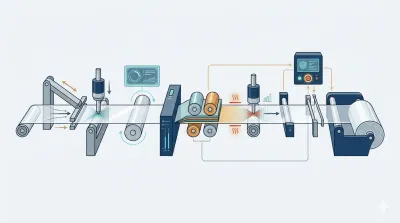
Before any stretch film extrusion machine is cleared for dispatch, it runs through a Factory Acceptance Testing sequence built to expose exactly the weaknesses that traditional equipment tends to hide. The extruder operates under full load for 72 continuous hours to prove mechanical endurance and thermal equilibrium, a step that eliminates early-stage component wear before it ever becomes the customer's problem. Throughout that run, PLC-driven monitoring tracks melt pressure, barrel temperature zones, and screw speed accuracy to confirm absolute melt homogeneity, while in-line capacitance sensors on multilayer configurations continuously verify layer ratio consistency to rule out delamination or bubble formation.
Thickness profile consistency is then measured across the full web width using a traversing beta gauge, with deviations restricted to a strict tolerance to guarantee flat, uniform stretch film with a premium appearance. The winding station undergoes its own stress testing to eliminate neck-in entirely, with servo-driven dancer rolls executing instant, micrometer-level torque adjustments to keep roll edge alignment within one millimeter. Finished roll density is validated separately to confirm compatibility with both fully automatic and semi-automatic stretch film machine configurations during high-speed downstream unwinding, preventing the telescoping and jamming issues that cost customers production time.
The protocol closes with real-time film performance analysis under simulated factory conditions. Technicians record elongation percentage, targeting a range of 250 to 350 percent for hand rolls, along with dual-side cling force and puncture resistance, all measured in strict compliance with ASTM D1709 standards. For multilayer machines processing eco-friendly recycled resins, puncture testing is repeated at elevated temperatures to confirm bond integrity holds under demanding conditions. Every emergency stop circuit and automated cutoff system is verified against IEC 60204 electrical safety standards before the machine is cleared to ship, regardless of whether it is configured as a semi-automatic or fully automatic stretch film machine.
Reliability You Can Measure
The outcome of this process is a finely tuned manufacturing system engineered to minimize time-to-market and maximize return on investment from the first day of operation. Whether the application calls for a cost-effective 2-layer stretch film machine, an advanced 3-layer configuration built for high-performance pre-stretch film, or a heavy-duty 5-layer stretch film machine designed for demanding recycled-resin processing, every unit passes through the same rigorous 72-hour stability testing, precision gauge and tension validation, and full compliance verification before it reaches the production floor. That is what rigid quality control means in practice: not a promise about how the equipment should perform, but a documented record of how it already has. For manufacturers evaluating a new stretch film extrusion machine, that difference is exactly what protects uptime, output consistency, and profitability for years after installation. Reach out to discuss which configuration, from standard 2-layer systems to custom multilayer lines, best fits your production goals.