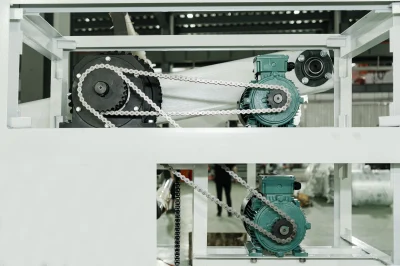
In modern extrusion equipment, particularly in bubble film production lines, mechanical drive stability plays a critical role in determining both product consistency and equipment lifespan. Among the available transmission technologies, worm gear drives are widely recognized for their durability advantages in high-load, continuous operation environments. Their performance benefits are primarily rooted in their unique mechanical contact structure and load distribution characteristics.
Unlike point-contact gear systems, worm gear drives operate through a sliding contact mechanism between the worm shaft and the worm wheel. This type of engagement increases the effective contact surface area during torque transmission. As a result, the applied load is distributed more evenly across the gear interface rather than being concentrated at localized contact points. This distribution significantly reduces peak stress levels, which in turn minimizes surface fatigue, pitting, and long-term wear of the gear teeth.
Another important factor contributing to the durability of worm gear systems is their inherent structural rigidity under load. In extrusion applications, screw drives are frequently subjected to fluctuating resistance due to variations in polymer viscosity, temperature gradients, and multilayer flow dynamics. Worm gear reducers help stabilize these fluctuations by maintaining consistent torque transmission, which reduces mechanical shock propagation through the drive system.
Additionally, worm gear configurations often exhibit a degree of self-locking behavior depending on lead angle and friction conditions. This characteristic helps resist back-driving forces generated during sudden load changes or machine stops. As a result, the system experiences reduced reverse impact stress, which is a common contributor to mechanical wear in less rigid transmission systems such as belt drives.
Compared to belt-driven systems, which rely on frictional engagement and are therefore subject to elastic deformation, tension variation, and potential micro-slip, worm gear drives provide a positive mechanical engagement. This eliminates slip-related energy losses and reduces irregular torque fluctuations, contributing to smoother screw rotation and improved process stability in extrusion lines.
Furthermore, the enclosed structure of worm gear reducers allows for more effective lubrication retention, which is essential for reducing friction heat and maintaining long-term efficiency. When properly maintained, this lubrication film also acts as a protective barrier that further reduces direct metal-to-metal wear, extending operational lifespan.
In extrusion environments where continuous operation, high torque demand, and process precision are required, these combined factors make worm gear drives a reliable solution for long-term performance. Their ability to reduce localized stress, absorb mechanical shocks, and maintain stable torque output directly contributes to improved equipment durability and reduced maintenance frequency.
Overall, worm gear drives are not simply an alternative to belt systems—they represent a mechanically robust solution engineered for stability, longevity, and precision in demanding industrial extrusion applications.