Essential Spare Parts You Should Always Have for Your Stretch Film Extrusion Machine
2026-09-15
Keeping a stretch film extrusion machine running reliably depends on more than skilled operators and a solid maintenance schedule. Even well-designed production lines rely on components that wear down through repeated thermal cycling and mechanical stress, and when one of these parts fails without a replacement on hand, production can remain interrupted while a replacement is sourced. Building a proactive spare parts inventory is one of the simplest ways to protect output, and it starts with understanding which components have the greatest impact on film quality and line uptime.
Where Unplanned Downtime Really Comes From
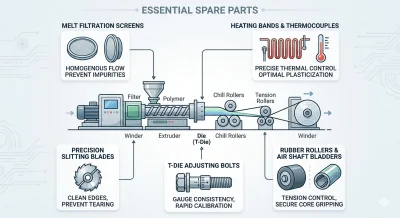
Many unplanned stoppages on a stretch film extrusion machine can be traced to a small set of wear parts rather than major mechanical failures. Melt filtration screens gradually collect contaminants and gel particles, increasing flow resistance and potentially affecting melt stability, film clarity, and overall film performance if replacement is delayed. Heating bands and thermocouples can degrade through repeated thermal cycling, and a failed sensor can cause temperature control in an individual zone to deviate, affecting polymer plasticization and potentially film consistency if the issue is not detected promptly. Precision slitting blades also become dull with use. Instead of producing a clean cut, a worn blade can create ragged edges and inconsistent roll geometry, increasing scrap and reducing finished-roll quality. Rubber rollers and air shaft bladders can gradually lose their grip and elasticity, which may result in slippage, core damage, or loose winding before the wear becomes visually obvious. These failures are often predictable, but without the right spares on the shelf, even a routine component replacement can become a source of unplanned downtime.
Why Component Reliability Matters Across Industries
The consequences of worn spare parts rarely stay contained to the machine room — they can show up in the finished roll and, from there, affect industries that depend on reliable stretch film performance. In building material and profile packaging, a dulled slitting blade can produce ragged edges and uneven roll geometry, increasing the risk of film damage during handling and transport. In chemical drum and industrial container packaging, a worn air shaft bladder can contribute to loose winding, reducing roll stability and making load securing less reliable during transit. In e-commerce and warehouse logistics, where pallets move through high-speed automated wrapping lines throughout the day, a malfunctioning heating band can destabilize temperature control and potentially affect melt processing and film consistency during automated wrapping cycles. In many such cases, the underlying issue may not be the film formulation itself, but a worn component that has been allowed to operate beyond its recommended service life.
Building a Spare Parts Strategy Around the Components That Matter Most
Reliable spare parts management starts with matching the right components to the demands of the production line. Melt filtration screens should be sized and rated according to the actual throughput and filtration requirements of the extrusion line. Production capacity can vary significantly with film width, thickness, resin formulation, screw configuration, and the number of extrusion layers, so filter components should be selected for the specific line rather than treated as generic consumables. Heating bands and thermocouples are especially important on multilayer lines, where each extruder typically operates with multiple independently controlled heating zones. Temperature settings should be matched to the resin and processing conditions, making it practical to keep replacement heating elements and sensors available for the zones used in production rather than only for components that have failed before.
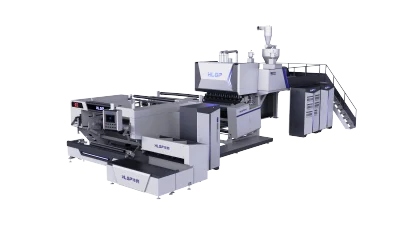
On high-speed fully automatic lines designed to operate at speeds of up to 250 m/min, precision slitting blades should be replaced according to actual wear and production requirements rather than only after cutting quality has visibly deteriorated. A blade that has started to tear the film may already be generating scrap before the problem becomes obvious during routine inspection. Rubber rollers and air shaft bladders should also be monitored and replaced when their surface condition, grip, or elasticity begins to affect winding stability. Keeping suitable replacement components available helps maintain balanced tension and reliable core gripping across the winding station instead of compensating for one worn component with excessive pressure elsewhere.
T-die adjusting bolts are easy to overlook, but they play an important role in making local die-gap adjustments when film thickness begins to drift from the target. On a line designed to maintain thickness variation of approximately ±3%, worn or damaged adjustment components can make fine die-gap correction more difficult and turn a routine adjustment into a more time-consuming maintenance task.
Turning Spare Parts Into a Planned Maintenance Advantage
The real value of a curated spare parts inventory is that it shifts maintenance from reactive to planned. Instead of waiting for a filter screen to become excessively restricted or a thermocouple to fail during a production run, operators can schedule replacements around production windows, maintain more consistent film quality, and reduce the risk of secondary wear caused by components operating outside their normal condition. Over time, this also helps protect the investment in the extrusion line itself. A nitrided alloy screw and cylinder, stable water-cooling system, and well-maintained die can operate more consistently and closer to their intended performance when the smaller wear parts around them are kept in good condition rather than pushed beyond their recommended service life.
We design every stretch film extrusion machine with this kind of long-term reliability in mind, from the layer configuration down to the components that keep the line running day to day. Our 2-layer, 3-layer, and 5-layer co-extrusion lines are built with heating zones, filtration systems, and die assemblies that are straightforward to service and maintain, so operators can plan ahead rather than react to unexpected component failures. If you are developing a spare parts strategy for your own line or evaluating a new stretch film extrusion machine with long-term maintenance in mind, we are glad to walk through the components that matter most for your specific production setup.