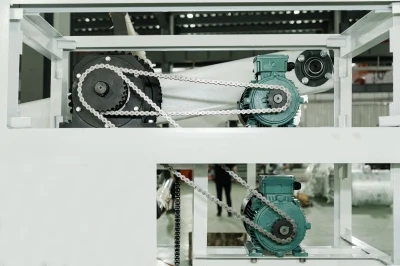
When sourcing machinery for bubble film production—ranging from 2-layer low-speed lines to 7-layer high-speed co-extrusion systems—the drive transmission architecture inside the extrusion unit plays a key role in determining torque stability, speed control accuracy, and long-term mechanical reliability. The comparison between belt-driven systems and worm gear reducers should therefore be understood from an engineering perspective rather than a purely conceptual one.
Belt drive systems are widely used in extrusion equipment due to their simple structure, low initial cost, and ease of maintenance. However, because torque is transmitted through frictional engagement, belt systems inherently exhibit elastic deformation and potential micro-slip under varying load conditions. In extrusion processes where screw speed stability directly affects melt pressure and output consistency, these small variations can contribute to fluctuations in gauge control, especially in multilayer film applications where flow balance is critical.
Worm gear reducers, in contrast, transmit torque through a meshing gear interface, providing a positive mechanical engagement between input and output shafts. This structure eliminates slip under normal operating conditions and improves rotational speed stability at the screw drive stage. As a result, melt delivery tends to be more consistent, particularly during load changes or start-stop transitions common in production cycles.
Another key characteristic of worm gear systems is their high reduction capability within a compact single-stage design. This allows efficient torque multiplication and stable low-speed output, which is beneficial for processing a wide range of polymer viscosities. Compared with belt systems that often require multi-stage pulley arrangements for similar reduction ratios, worm gear systems offer a more rigid and enclosed transmission path.
It should be noted that worm gear systems may exhibit limited back-driving capability depending on lead angle and lubrication conditions. In many extrusion applications, this characteristic can help maintain positional stability when the system is stopped. However, this behavior is not universally “self-locking” and should be evaluated based on specific gear geometry and operating conditions.
From a maintenance standpoint, belt systems require periodic tension adjustment and replacement due to wear and elongation, while worm gear systems require proper lubrication management to ensure efficiency and minimize heat generation. Each system therefore has distinct maintenance requirements rather than a one-sided advantage.
In summary, belt drives prioritize cost efficiency and structural simplicity, while worm gear reducers prioritize torque stability and rigid mechanical transmission. For bubble film extrusion lines where thickness consistency and process stability are critical, the selection of drive system should be based on production requirements, material characteristics, and control precision targets rather than a generalized assumption of superiority.