Custom Stretch Film Extrusion Machines for Niche Markets: Colored, Anti-Static & UV Resistant
2026-07-02
The race to the bottom in standard clear wrap manufacturing is driving producers to upgrade to custom stretch film extrusion machines to secure profit margins and dominate specialized, high-ticket packaging markets. These specialized production lines are designed to handle complex colorants, anti-static agents, and UV blockers for heavy-duty industrial applications.
The High Cost of Standard Extrusion in Niche Manufacturing
Traditional cast and blown film production lines are highly optimized for long, uninterrupted runs of standard clear linear low-density polyethylene (LLDPE) wraps. However, when these conventional systems are forced to process technical masterbatches or change specifications for specialty orders, deep-seated mechanical limitations quickly manifest as expensive operational bottlenecks.
A primary failure point of traditional systems involves color changeovers and severe material degradation. Standard extruders utilize general-purpose flow channels that lack streamlined geometries. When changing colors, the pigments lodge inside dead zones within the feedblock and die system. Operators must run the machine for hours just to clear out the residual color, generating vast amounts of purging waste and burning through expensive color masterbatches before achieving a clean blend.
Furthermore, integrating advanced functional additives like anti-static agents and ultraviolet inhibitors presents major thermal challenges. Conventional single or general-purpose barrier screws generate high localized shear heat. This intense thermal spike destroys the molecular structure of sensitive migrating or permanent anti-static agents, causing them to degrade before they ever reach the die lip. For UV inhibitors, poor distributive mixing in standard screws results in localized grouping, causing unplasticized gels and weak points that fail prematurely under sunlight. Standard machine configurations lack the mechanical flexibility to adjust layer-to-layer thickness ratios dynamically, meaning producers cannot strategically concentrate expensive additives in specific layers to optimize costs.
Precision-Engineered Core Components for Technical Additives
To solve these processing challenges, specialized stretch film extrusion machines leverage advanced metallurgical designs and fluid dynamics to handle highly sensitive, concentrated chemical masterbatches without compromising line throughput.
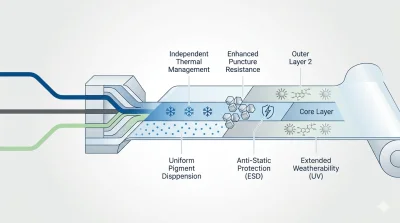
The foundation of this technology lies in proprietary high-mixing, low-shear screw geometries. These screws feature dedicated intensive mixing zones designed to homogenize pigments and functional additives perfectly at much lower processing temperatures. By reducing internal friction and shear stress, the screw preserves the chemical integrity of anti-static agents and ensures that UV stabilizers are distributed evenly across the polymer matrix without causing thermal degradation or micro-gels.
Downstream from the extruder, the co-extrusion feedblock and T-die assembly are engineered using computational fluid dynamics (CFD) software to ensure completely seamless flow paths. Every internal channel is highly polished and contoured to prevent stagnation zones, meaning that when a color changeover is initiated, the new resin instantly sweeps away the previous pigment. This streamlined internal architecture minimizes purging duration and drastically limits industrial material waste.
Accuracy is further guaranteed through the integration of continuous multi-component loss-in-weight gravimetric dosing systems. These feeders precisely measure and inject color masterbatches, anti-static agents, and UV stabilizers directly into the main extruder throat with an accuracy tolerance of within ±0.1 percent. This continuous closed-loop feedback loop guarantees absolute consistency across thousands of meters of film.
Finally, extra-large diameter primary chill rolls with high-efficiency internal spiral cooling channels rapidly quench the molten web. This immediate cooling traps the amorphous structure of the polymer, enhancing optical clarity, eliminating crystallization defects, and maximizing the physical properties of the specialty film.
Advanced Multilayer Solutions and Strategic Business Advantages
Transitioning to high-performance, customized extrusion lines equips manufacturers with the technical and commercial agility needed to capture premium industrial accounts and realize significant operational savings.
Rapid Color Transition and Raw Material Conservation
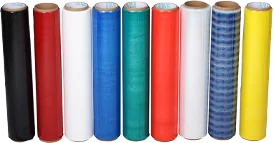
The optimized melt-flow channels allow manufacturers to execute complete color changeovers smoothly and rapidly. By reducing machine downtime and cutting purging scrap by more than half, film producers drastically lower the total cost of ownership (TCO) associated with small-batch custom color runs. This makes small-volume corporate-branding film orders highly profitable.
True Multifunctional Customization and Layer Engineering
These advanced co-extrusion lines deliver true multi-purpose manufacturing capabilities. With a single machine, a factory can produce high-opacity colored films in the morning, high-purity anti-static wraps in the afternoon, and heavy-duty UV-stabilized agricultural wraps the next day. Advanced feedblocks allow engineers to isolate expensive additives. For instance, rather than blending UV stabilizers throughout the entire film, the machine can concentrate the UV protection solely in the outermost 10 percent skin layers of an ABCBA structure, maintaining robust performance while lowering material costs.
Premium Performance Standards for Technical Applications
The resulting films satisfy the strict quality benchmarks of high-tech and industrial end-users. Colored stretch wraps achieve a flawless, uniform opacity without visual dark streaks or pinholes, ensuring absolute privacy for high-value cargo. Anti-static films maintain a reliable surface resistivity precisely between 10⁹ and 10¹¹ ohms, providing guaranteed protection against electrostatic discharge (ESD) for sensitive semiconductor and aerospace components during global transport. For outdoor storage, the UV-resistant films offer uninterrupted protection against degradation, remaining resilient under intense solar radiation without embrittlement or premature tearing for up to two years.
Intelligently Automated Production with Lower Energy Footprints
Modern control platforms integrate smart PLC systems capable of storing hundreds of complex recipe profiles. Operators can load specific parameter presets for any specialty film with a single touch, automatically calibrating screw speeds, zone temperatures, and dosing percentages. This reduces reliance on highly specialized mechanical technicians. Additionally, the optimized low-shear screw profiles require significantly less torque to process high-viscosity specialty resins, translating to a substantial reduction in overall factory power consumption.
Driving High-Margin Innovation in Specialty Packaging
Investing in a specialized stretch film extrusion line represents a profound strategic upgrade for modern film manufacturers. As international shipping standards tighten and industrial automation demands flawless packaging performance, the reliance on basic commodity wraps will continue to contract.
By resolving foundational processing flaws through intelligent component design, advanced mixing technologies, and precise layer distribution, these custom extrusion lines empower packaging companies to produce high-value technical films reliably. Moving into the production of specialized colored, anti-static, and UV-resistant stretch wraps is a highly effective pathway to bypass generic price wars, optimize manufacturing yields, and secure a dominant position in the global specialty packaging marketplace.