How to Choose the Right Raw Materials for Stretch Film Extrusion Machine
2026-08-13
Why Raw Material Strategy Now Decides Production Stability
As logistics, warehousing, and industrial protection standards continue to rise, the market is asking more of stretch film than ever before — greater stretch performance, stronger puncture resistance, more reliable cling, and better load retention. In traditional production, simply tweaking machine settings or thickening the film can no longer meet the twin demands of high efficiency and low cost. The resin type, density, and the ratio between functional layers must now be matched precisely to the structure of the stretch film extrusion machine itself before a line can run consistently at scale. This shift in emphasis — from equipment alone to equipment paired with the right material science — is what separates plants that hit their output targets from those that fight downtime and film-quality complaints every week.
The Limits of Single-Resin Formulas Across Different Packaging Scenarios
Different packaging applications place very different demands on the same roll of film. A standard pallet wrap only needs dependable cling and baseline stretch, while heavy industrial goods call for far greater tear and impact resistance, and automatic wrapping lines need rolls with tightly controlled thickness and tension from start to finish. A single linear low-density polyethylene (LLDPE) formula struggles to deliver high elongation, strong load-holding force, good optical clarity, and puncture resistance all at once, because these properties often pull resin design in opposing directions. Comonomer choice illustrates the trade-off well: hexene-based LLDPE tends to favor impact and tear strength, while octene-based grades typically deliver better puncture resistance and elastic recovery, so the comonomer selected for a formula meaningfully shapes which mechanical properties the finished film will excel at.
Single-layer production compounds this problem, since every required property has to be squeezed into one homogeneous film. The usual workaround — adding thickness — increases raw material consumption, drives up packaging cost, and slows overall line output. This is exactly the gap that multi-layer structures are designed to close, letting different resins each carry the specific function they are best suited for rather than compromising across the board.
The Role of Stretch Film in Modern Logistics and Industrial Packaging
Stretch film's core job is to stabilize palletized loads, using stretch-and-recovery force to hold goods firmly in place, resist shifting in transit, and shield cargo from dust and moisture. It shows up across e-commerce fulfillment, food and beverage distribution, industrial component packaging, and export container loading. As packaging operations push toward thinner films that hold loads just as securely, tighter gauge consistency for high-speed automatic wrapping equipment, and lower material consumption per pallet, the burden increasingly falls on the extrusion equipment itself to translate resin properties into a precisely controlled film — which is why raw material selection and machine design have to be solved together, not separately.
Matching Resin Selection to Extrusion Line Configuration
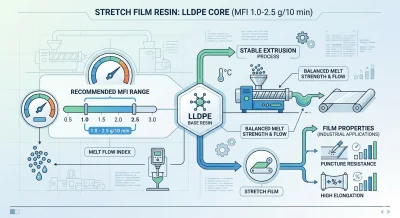
LLDPE remains the foundation resin for virtually all stretch film production, and selecting the right melt flow index (MFI) range is central to balancing melt stability, stretch performance, and puncture resistance. Higher melt-index skin-layer LLDPE grades containing hexane-extractable content generate meaningful cling force as low molecular weight components migrate to the film surface over the hours following extrusion, with cling typically continuing to build for one to three days after the film leaves the line. Getting this right on a production line depends on a stable screw plasticizing system, precise temperature control, and uniform melt delivery — capabilities that vary significantly between machine builders.
For two-layer stretch film extrusion machine configurations, common in general warehousing and standard pallet wrapping, LLDPE is typically paired with EVA or VLDPE in the surface layer to build in self-cling, flexibility, and stable processing — a practical, cost-efficient setup well suited to small and mid-sized producers. Three-layer and five-layer machines open up far more design freedom: the outer layer is optimized for abrasion and surface durability, the core layer carries tensile strength and load support, and the inner layer is tuned purely for cling performance. Combining LLDPE with metallocene LLDPE (mLLDPE) and VLDPE across these layers lets manufacturers hold mechanical strength steady while reducing overall material usage, since each resin only has to do the job its layer demands.
Meeting the Demands of High-Speed Automatic Wrapping Lines
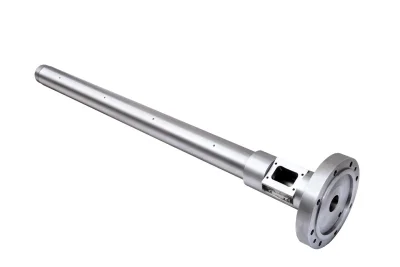
High-speed cast extrusion, which now dominates stretch film manufacturing for its gauge control and output speed, pushes melt through a flat die at roughly 200–260°C before rapid quenching on chilled casting rolls to lock in crystallization and mechanical properties. Modern cast lines commonly run production speeds well above 300 meters per minute, and film produced this way can reach tensile strength in the 20–40 MPa range along the machine direction with elongation at break exceeding 500 percent when the resin and process conditions are properly matched. At these speeds, even small fluctuations in melt flow translate into uneven film thickness or breaks in the film web, which is why precision screw geometry — typically an L/D ratio around 28:1 to 32:1 — automatic zoned temperature control, and stable haul-off and winding systems are non-negotiable on a serious automatic wrapping line.
The industry's broader shift is toward thinner, lighter film that still performs like a thicker one. Rather than adding material to gain strength, producers increasingly lean on mLLDPE and VLDPE formulations paired with five-layer co-extrusion, using functional layering to cut gauge without sacrificing load stability — lowering material cost per roll while improving overall production economics.
How Advanced Multi-Layer Stretch Film Extrusion Machines Maximize Material Value
Our well-engineered five-layer stretch film extrusion machine gives producers independent control over each resin layer's ratio, so premium, high-performance materials can be concentrated exactly where they matter — the cling surface or the load-bearing core — while more economical resin fills supporting layers. This kind of targeted allocation is one of the most direct ways to control raw material cost without compromising film performance. Layered onto this, automatic gauge control, precise line-speed regulation, stable traction systems, and high-precision winding reduce the need for manual adjustment, improve roll-to-roll consistency, and help manufacturers meet the volume and reliability expectations of large-scale packaging operations.
Achieving Better Film Performance Through Advanced Stretch Film Extrusion Technology
Ultimately, stretch film performance is never determined by resin selection alone — it depends equally on whether the extrusion equipment can effectively convert resin properties into consistent finished film quality. Selecting the right two-layer, three-layer, or five-layer stretch film extrusion machine according to specific product requirements enables more precise material distribution, better performance control, and improved production efficiency compared with conventional single-structure lines.
Our stretch film extrusion machines are equipped with advanced multi-layer co-extrusion technology, precise temperature control systems, stable melt extrusion structures, and intelligent automation features to deliver consistent film quality during continuous production. Designed with excellent resin compatibility, our machines can process various polymer combinations, including LLDPE, mLLDPE, and functional additives, enabling manufacturers to produce stretch film with superior stretchability, load retention, and puncture resistance while maintaining stable and efficient operation.