Technical Status of Global Biodegradable Stretch Film Extrusion Machine
2026-08-20
Growing restrictions on conventional plastics and increasing demand for sustainable packaging are encouraging manufacturers to explore biodegradable and bio-based alternatives to traditional polyethylene stretch film. Materials such as PLA, PBAT, starch-based blends, and bio-based polymers are attracting attention in sustainable packaging applications. However, these materials cannot always be processed in the same way as conventional LLDPE because their thermal sensitivity, melt strength, viscosity, and processing windows can be significantly different.
For manufacturers developing biodegradable stretch film, the performance of the extrusion equipment is therefore an important consideration. A modern stretch film extrusion machine combines controlled heating, optimized screw design, stable melt delivery, accurate thickness control, and reliable winding technology to create a more suitable processing environment for advanced film materials.
Processing Challenges of Biodegradable Materials
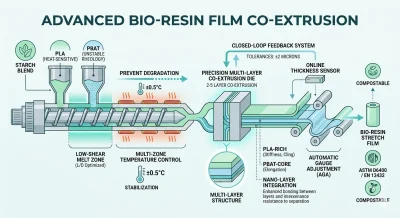
Biodegradable polymers can present several challenges during extrusion. PLA is relatively sensitive to excessive heat and moisture, while PBAT generally provides good flexibility but has different rheological characteristics from polyethylene. Starch-based and other biodegradable blends can also show changes in melt viscosity and processing stability depending on their formulation.
If the extrusion conditions are not properly matched to the material, excessive shear or heat can contribute to polymer degradation, unstable melt flow, film breakage, or inconsistent mechanical properties. These problems can become more noticeable when manufacturers attempt to produce thinner films or increase production speed.
For this reason, a stretch film extrusion machine for biodegradable materials should be configured according to the actual resin formulation. Screw geometry, temperature zones, extrusion speed, die design, cooling conditions, and winding tension all need to work together to establish a stable production process.
The Role of Stretch Film in Industrial Packaging
Stretch film is widely used for pallet wrapping, warehouse packaging, logistics, and transportation because it helps stabilize packaged loads during handling and distribution. For automated wrapping systems, film consistency is particularly important. Stable tensile properties, suitable elongation, puncture resistance, and controlled cling can help reduce film breaks and improve wrapping efficiency.
The development of biodegradable stretch film aims to introduce more sustainable material options without losing the functional characteristics required for industrial packaging. However, environmental performance should always be evaluated according to the actual material formulation and applicable certification requirements. Standards such as ASTM D6400 and EN 13432 relate to specific compostability requirements and should not be treated as universal certifications for every biodegradable stretch film.
Precision Temperature Control for Stable Extrusion
Temperature control is one of the most important factors when processing thermally sensitive polymers. A properly configured stretch film extrusion machine can use multiple independently controlled heating and cooling zones to maintain a stable temperature profile from feeding and melting through to die delivery.
Temperature control accuracy around ±0.5°C can be achievable under suitable machine and operating conditions, although actual stability depends on the heating system, cooling capacity, sensors, material throughput, and environmental conditions.
Precise thermal management helps reduce unnecessary thermal stress and provides a more consistent melt before the material reaches the T-die. This is especially useful for PLA- and PBAT-containing formulations, where excessive temperature or residence time may affect material properties.
Optimized Screw Design and Low-Shear Processing
Screw design has a direct influence on melting, mixing, residence time, and melt quality. Biodegradable polymers and their blends may require a gentler processing approach than conventional polyethylene. An excessively aggressive screw can introduce unnecessary shear and heat, while insufficient mixing can result in an uneven melt.
An optimized screw configuration can provide controlled conveying, progressive melting, and sufficient homogenization while limiting excessive mechanical stress. The length-to-diameter ratio, compression characteristics, mixing sections, and screw speed should be selected according to the material formulation and target output.
This material-oriented approach allows manufacturers to establish more stable extrusion conditions and develop repeatable production recipes for different biodegradable film grades.
Multilayer Coextrusion for Flexible Film Structures
Multilayer coextrusion can provide greater flexibility when balancing film performance, material cost, and sustainability objectives. Depending on the production requirements, a stretch film extrusion machine can be configured for two-layer, three-layer, or other multilayer structures.
Different materials can be assigned to specific layers according to their functional properties. For example, a PBAT-rich layer may contribute flexibility and elongation, while PLA or another compatible material can be used to modify stiffness and mechanical performance. The exact structure depends on resin compatibility and the required film characteristics.
Multilayer extrusion can also reduce the need to use the same high-cost material throughout the entire film thickness. However, the finished structure should be evaluated through practical testing, including tensile strength, elongation, puncture resistance, cling, and load retention.
Online Thickness Control and Material Efficiency
Thickness consistency is particularly important when processing higher-cost specialty or biodegradable resins. Over-gauging increases material consumption, while excessive thickness variation can affect wrapping performance.
Modern extrusion systems can integrate online thickness measurement and automatic gauge control. Sensors continuously monitor film thickness, while a closed-loop control system can adjust the process to maintain a more consistent gauge.
Advanced systems may achieve very tight thickness tolerances under suitable production conditions, but actual results depend on film width, thickness, die configuration, resin properties, measurement technology, and machine stability. Rather than focusing only on a specific tolerance value, manufacturers should evaluate the complete thickness-control system and its ability to maintain consistent production.
Developing a Flexible Biodegradable Film Production Line
The biodegradable stretch film market is still developing, with material costs, resin availability, application requirements, and regional environmental regulations influencing equipment decisions. A practical production line should therefore provide enough flexibility to accommodate different formulations and future product development.
A stretch film extrusion machine can be configured around the selected resin, film thickness, width, output target, layer structure, and winding requirements. Stable extrusion, accurate temperature control, suitable T-die technology, efficient cooling, and controlled winding work together to provide a reliable foundation for cast film production.
Manufacturers should evaluate the complete production system rather than focusing only on maximum extrusion speed. Matching the machine configuration to the actual material and application can improve production stability, material utilization, and long-term operating efficiency.
Supporting the Next Generation of Sustainable Film Production
As sustainable packaging continues to develop, biodegradable stretch film production will require equipment that can adapt to new materials and changing film specifications. Precise thermal management, optimized screw technology, multilayer extrusion, online thickness control, and stable winding provide the technical foundation for this transition.
Our stretch film extrusion machine solutions are designed for manufacturers seeking flexible cast film production with advanced material compatibility and stable processing performance. By matching the extrusion configuration to resin characteristics, film structure, output requirements, and application needs, manufacturers can build a production line suited to both current products and future sustainable packaging development.
Welcome to choose our stretch film extrusion machine to build a more flexible and efficient biodegradable film production line tailored to your material requirements, film specifications, production capacity, and long-term manufacturing goals.