How to Produce Black & Colored Film on a Stretch Film Extrusion Machine
2026-05-22
The production of high-quality colored and black stretch film requires precise control over mechanical properties and visual consistency. Integrating color masterbatch into the Linear Low-Density Polyethylene (LLDPE) matrix introduces specific extrusion challenges, such as color streaking, poor pigment dispersion, and potential loss of essential film cling or tensile strength. Resolving these issues depends heavily on multi-layer co-extrusion technology, specialized screw design, and strict temperature management.
Technical Challenges in Colored Stretch Film Extrusion
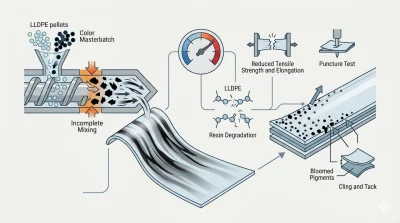
When producing black or colored stretch film on a stretch film extrusion machine, color masterbatch (typically 1% to 5% by weight) must be thoroughly homogenized. Inadequate mixing or improper temperature profiles lead to major quality defects:
- Visual Streaks and Inconsistent Opacity: Caused by incomplete melting and poor distributive mixing of pigment particles.
- Resin Degradation: Excessive shear or overheating degrades the LLDPE base resin, significantly reducing film elongation, tear resistance, and puncture resistance.
- Cling Interference: Migrating pigments can bloom to the film surface, compromising the tack and interlocking performance of the final product.
Multi-Layer Co-Extrusion Solutions
Modern multi-layer stretch film extrusion machines resolve these technical hurdles by isolating layers and optimizing melt flow dynamics.
5-Layer Stretch Film Extrusion Machine: Maximum Layer Flexibility
A 5-layer configuration provides the highest level of process control for premium colored film production:
- Pigment Isolation: Dedicated internal layers encapsulate the color masterbatch, isolating the pigments from the high-clinging outer layers to prevent migration.
- Advanced Screw Design: Specialized mixing screws and distributive mixing sections ensure thorough colorant dispersion without generating excessive shear heat.
- Thermal Precision: PID-controlled heating zones maintain a stable processing window between 180°C and 220°C, ensuring full color development while preventing LLDPE degradation.
3-Layer Stretch Film Extrusion Machine: Core Layer Encapsulation
The A/B/C sandwich structure of a 3-layer machine offers an efficient, high-performance method for manufacturing colored stretch wrap:
- Core Coloring: The color masterbatch is restricted entirely to the core layer (B), while layers A and C remain clear and enriched with pure cling additives to preserve surface tack.
- Homogeneous Melt Flow: High-performance barrier screws maintain a consistent compression ratio, enabling stable output and reducing gauge variation even at a 5% black masterbatch loading.
2-Layer Stretch Film Extrusion Machine: Enhanced Shear Mixing
For solid tinted films or simpler color runs, 2-layer extrusion systems utilize modified screw profiles:
- High-Shear Profiles: Incorporation of high-shear mixing sections within the screw allows both layers to carry pigment uniformly.
- Configurable Temperature Curves: Semi-automatic adjustments allow precise fine-tuning of the temperature curve and screw speed to guarantee batch-to-batch repeatability.
Automation and Process Control
The integration of automation systems directly impacts the efficiency and quality consistency of colored film extrusion lines.
Fully Automatic Extrusion Lines
- Closed-Loop Dosing: Real-time sensors automatically synchronize the masterbatch feeder speed with the main line speed, maintaining exact color density during throughput fluctuations.
- Automated Parameter Logging: The control system logs melt temperature, pressure, and film thickness, allowing rapid, low-scrap changeovers between clear and colored film runs.
Semi-Automatic Extrusion Lines
- Precision Metering: Manually adjustable, calibrated metering units allow precise recipe management for smaller production batches.
- MFI Matching: Maintaining a masterbatch concentration under 5% with a carrier resin that matches the Melt Flow Index (MFI) of the base LLDPE ensures optimal stretchability.
Through advanced multi-layer extrusion technology and rigorous process controls, a stretch film extrusion machine can successfully deliver black and colored films that meet strict visual and functional industrial specifications.