Why Precise Temperature Control Matters in Stretch Film Extrusion Machine
2026-09-17
Temperature control is a critical part of stable stretch film extrusion. During production, resin must be heated to the appropriate processing range so it can melt and flow consistently through the extrusion system. When temperatures vary between heating zones, melt viscosity can change, affecting film thickness, surface quality, and the consistency of the finished roll.
For manufacturers producing LLDPE, mLLDPE, EVA, or multi-layer stretch film, maintaining a stable thermal profile is therefore an important part of controlling product quality and material efficiency.
The Problems Caused by Uneven Heating
Traditional extrusion lines may rely heavily on manual temperature settings and operator adjustments. If individual barrel zones cannot be controlled independently, temperature differences can develop along the extrusion path and remain unnoticed until they begin affecting the melt.
Uneven heating can contribute to unstable melt flow, gauge variation, surface defects, and inconsistent processing conditions. In multi-layer extrusion, changes in melt behavior can also make it more difficult to maintain consistent layer distribution and interlayer bonding.
These problems become more significant as production speed increases. A line running continuously at higher output has less tolerance for unstable processing conditions because even a small variation can affect a larger volume of material before the operator has an opportunity to correct it.
How Temperature Control Affects Film Quality
The effect of temperature control can be seen in several important aspects of stretch film production.
Film thickness: Stable melt flow helps the extrusion system maintain more consistent gauge across the film web. This is particularly important when manufacturers are trying to reduce unnecessary resin consumption without compromising film performance.
Surface quality: Fluctuations in melt conditions can contribute to surface irregularities and other extrusion defects. A more stable thermal profile supports smoother and more predictable processing through the die.
Layer consistency: In co-extruded stretch film, different layers may use different resin grades or formulations. Keeping each extrusion section within its intended processing range helps maintain more stable melt conditions before the layers are combined.
Mechanical performance: Film strength, stretchability, and puncture resistance depend on resin selection, formulation, layer structure, thickness, and processing conditions. Temperature control does not determine these properties by itself, but stable extrusion conditions help manufacturers reproduce the intended film structure more consistently.
This distinction is important for production planning. Precise temperature control should be viewed as one part of the overall extrusion process rather than a standalone guarantee of film performance.
Independent Heating Zones for More Stable Processing
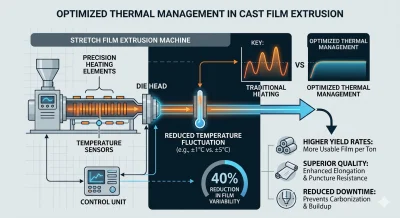
Our stretch film extrusion machine uses independently regulated heating zones along the barrel, allowing operators to establish different temperature settings according to the requirements of each extrusion section.
Closed-loop PID temperature control continuously compares the measured temperature with the set value and adjusts heating output accordingly. This provides more responsive control than relying on fixed manual settings alone.
The heating system is designed to maintain temperature tolerance within ±1°C under specified operating conditions. This helps create a more stable thermal environment for processing materials such as LLDPE, mLLDPE, and EVA.
Stable heating also provides a more consistent foundation for downstream processes. When melt conditions remain within the intended range, operators can make process adjustments based on more predictable material behavior rather than constantly compensating for temperature fluctuations.
Supporting Consistent Multi-Layer Film Production
Temperature control becomes particularly important when a stretch film extrusion machine is configured for co-extrusion.
Different layers can serve different functions within the finished film. One layer may contribute to stretchability, another may provide puncture resistance, while another can be formulated to support cling or material efficiency. These properties depend on the selected resin and formulation, but the extrusion process must still maintain suitable conditions for each material.
Independent heating control allows the extrusion sections to be adjusted according to their respective processing requirements. This helps reduce unnecessary thermal variation before the individual melts enter the feedblock or die system.
For manufacturers producing multi-layer stretch film, this level of control makes process repeatability easier to manage, particularly when production involves different resin combinations or film specifications.
Reducing Waste Through Process Stability
Temperature control also has a direct connection with material efficiency.
When unstable melt conditions cause gauge variation or visible defects, part of the production run may need to be downgraded or discarded. More stable processing can reduce the frequency of these quality-related losses and help manufacturers maintain a more consistent usable output.
This is especially relevant for stretch film because resin represents a major portion of production cost. Maintaining the intended film thickness and avoiding unnecessary scrap can therefore have a meaningful effect on material utilization.
Stable thermal conditions can also make start-up and process adjustment more predictable. Instead of repeatedly correcting temperature deviations during production, operators can work from a more controlled baseline.
Temperature Control and Automated Extrusion
Precise temperature control also provides a more stable operating environment for automated functions on the extrusion line.
Automatic thickness control, winding tension control, and other process-monitoring systems depend on consistent production conditions. If the melt itself is changing because of thermal instability, downstream control systems may have to compensate for variations that originate earlier in the process.
A stable thermal profile does not replace these control systems, but it gives them more consistent process conditions to work with. This can help manufacturers maintain repeatable film quality while reducing unnecessary manual intervention.
Built Around Repeatable Extrusion Conditions
For a stretch film extrusion machine, temperature control is not simply about reaching a target temperature. The more important objective is maintaining appropriate and repeatable thermal conditions throughout the extrusion process.
Our stretch film extrusion machine combines independently regulated heating zones with closed-loop PID control and temperature tolerance within ±1°C under specified conditions. These features are designed to provide stable melt processing for LLDPE, mLLDPE, EVA, and other compatible materials.
By controlling temperature more precisely at each extrusion section, manufacturers can establish a more consistent foundation for film thickness, surface quality, layer distribution, and material utilization. Combined with the appropriate resin formulation, die configuration, and downstream controls, precise thermal management helps make stretch film production more repeatable from one run to the next.