Technical Advantages of High Performance 7 Layer Bubble Film Extrusion Machine
2026-04-27
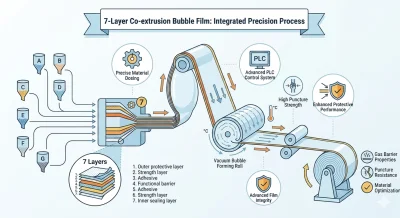
The 7-layer bubble film extrusion machine represents a major leap in functional packaging. While traditional films are limited by their material layers, this system utilizes a precision co-extrusion process to integrate up to seven distinct functional polymers into a single structure. This allows manufacturers to combine specific properties—such as gas barriers (EVOH), moisture resistance, and high tensile strength—without the need for secondary lamination.
Once-Through Shaping and Precision Engineering
A core innovation of this equipment is the once-through shaping technique. This integrated approach ensures consistent film morphology and mechanical integrity. Key technical components include:
- Precision Co-Extrusion System: Enables independent metering and layering of specialized resins, ensuring micron-level accuracy in thickness distribution.
- Vacuum Forming Roller: Stabilizes the bubble structure and manages the cooling gradient to optimize optical clarity and puncture resistance.
- PLC-Controlled Electromechanical Integration: Advanced automation governs thermal management and line speed, ensuring stable production and repeatable film quality.
Enhanced Functional Protection
The 7 layer bubble film machine is engineered to overcome the most demanding technical bottlenecks in industrial logistics:
- Superior Barrier Properties: Provides critical protection for pharmaceuticals and electronics by blocking moisture and volatile organic compounds (VOCs).
- High Mechanical Strength: The engineered layer design delivers exceptional tensile strength and puncture resistance, preventing packaging failure during high-stress automated palletizing.
- Material Optimization: By precisely controlling layer thickness, the machine achieves superior performance with less total resin, optimizing the weight-to-protection ratio.
High-Speed Production and Efficiency
Designed for high-output environments, our high-speed extrusion lines minimize downtime and material waste. The seamless integration of raw material feeding, extrusion, and final winding ensures a fully automated workflow. This technology allows for the production of differentiated, high-value packaging that meets stringent global supply chain standards and evolving environmental regulations.