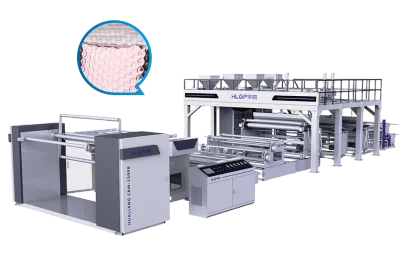
Precautions for Using a 7-Layer High-Speed Bubble Film Machine
2026-08-28
Investing in a state-of-the-art 7-layer high-speed bubble film machine is a strategic move for any manufacturer looking to strengthen its position in the protective packaging industry. But the same co-extrusion complexity and high-output operation that make this equipment so productive also mean it demands precise handling. Getting that handling right is not just a maintenance concern, it is what determines whether the machine delivers stable performance and a strong return on investment or becomes a source of recurring downtime and rejected rolls.
Raw Material Discipline Comes Before Anything Else
Multi-layer co-extrusion only works as well as the materials feeding into it, which makes raw material quality the first place operational discipline needs to start. Resins going into a 7-layer system should consistently meet specified requirements for melt flow index, moisture content, and purity, since even a modest deviation in any one of those properties can ripple across all seven layers at once. Contaminated pellets or an inconsistent resin lot tend to show up downstream as unstable layer bonding, bubble formation defects, or nozzle blockages that stop production entirely until the die is cleared.
A strict quality control process before material ever reaches the hopper is the most effective way to prevent these issues rather than troubleshoot them after the fact. That means checking incoming resin against specification rather than assuming supplier certificates tell the whole story, and keeping different material lots properly separated and labeled so a mix-up at the hopper does not turn into an hours-long cleanup at the die head. It is also worth paying close attention to resin moisture content specifically, since even trace moisture can flash into steam inside the barrel and create voids or surface defects that only become visible once the film has cooled and wound onto the roll. Establishing a short pre-production check, rather than relying on memory or habit, gives operators a consistent way to catch a bad lot before it ever reaches the extruder.
Managing Heat With a Steady Hand
Thermal management is where a surprising number of avoidable problems originate, particularly during startup and shutdown when the extrusion barrels and die head are most vulnerable to thermal shock. Rapid heating during startup puts uneven thermal stress on mechanical components before the system has had a chance to reach equilibrium, and that stress accumulates over repeated cycles even if no single startup causes a visible failure. A gradual, staged temperature ramp-up gives the polymer time to melt evenly and lets mechanical components expand at a controlled rate, which keeps the whole system stable as it comes up to operating temperature.
The same caution applies in reverse during shutdown. Cooling the extrusion barrels and die head too quickly risks shifting die head alignment, since uneven contraction can nudge components out of the precise positioning that multi-layer co-extrusion depends on. A controlled, staged cooling procedure protects that alignment and helps ensure the machine starts up just as reliably the next time, rather than requiring realignment before the next production run can begin.
Preventive Maintenance Keeps High Speed Sustainable
Running at high speed magnifies the consequences of deferred maintenance, which is exactly why a proactive maintenance routine matters more on a 7-layer high-speed line than it would on slower equipment. The bubble forming and air distribution system should be inspected regularly to confirm stable bubble formation and uniform film structure, since even a partially restricted air path can translate into inconsistent bubble height across the width of the film.
Nip roller alignment, surface condition, and winding tension control deserve equally close attention, because problems in any of these areas tend to surface as wrinkles, uneven rolls, or tension instability that only becomes obvious once a customer unrolls the finished product. Mechanical transmission components, including chain drives and gearboxes, should be lubricated on the schedule and with the lubricant type the manufacturer recommends, since the wrong lubricant or an extended interval between services accelerates wear in components that are far more expensive to replace than they are to maintain properly. Keeping a simple maintenance log for each inspection point also makes it far easier to spot a developing trend, such as gradually increasing tension variance, before it turns into a full stoppage.

Training Operators to Catch Problems Early
Even the best-maintained machine depends on operators who understand it well enough to catch small issues before they become big ones. Every operator working with a 7-layer high-speed bubble film machine should be fully trained on the human-machine interface, emergency stop procedures, and lockout-tagout safety protocols, particularly given the high-temperature zones and moving mechanical parts involved in day-to-day operation.
Training should go beyond safety procedures alone. Operators who understand what stable bubble formation, consistent film thickness, and clean surface quality look like are far more likely to notice a process deviation while it is still a minor adjustment rather than after it has produced an entire roll of scrap. Building that kind of routine visual and process monitoring into standard operating procedure turns operators into an early warning system rather than passive machine minders, and pairing newer operators with experienced staff during their first weeks on a high-speed line helps that judgment develop faster than reading a manual alone ever could.
Where Careful Operation Matters Most
These precautions carry the most weight in the specific industries that depend on a 7-layer high-speed line's output rather than a slower, lower-volume machine. Automotive and industrial component packaging is one clear example, since parts with sharp edges, irregular shapes, or significant weight need consistent multi-layer strength across every roll, and a batch with unstable layer bonding or thin spots caused by a temperature ramp-up problem can mean a damaged component reaching an assembly line rather than a warehouse shelf. Buyers in this space tend to specify film performance tightly, and a machine that drifts out of its operating parameters even briefly can produce rolls that fail those specifications without any obvious visual sign until the film is put under load.
High-volume e-commerce fulfillment operations present a related but distinct challenge. These customers order bubble film by the truckload rather than the pallet, so a preventable disruption, whether from a maintenance oversight or an operator missing an early warning sign, does not just create scrap, it threatens a delivery schedule that a fulfillment center is counting on to keep its own operations running. The cost of that disruption scales directly with how much volume the line was capable of producing before something went wrong, which is exactly why the precautions above matter more on high-speed equipment than they would on a smaller machine running at a fraction of the output.
Turning Discipline Into Long-Term Return
A 7-layer high-speed bubble film machine represents a genuinely advanced production system, but its performance is never separate from how carefully it is operated day to day. Manufacturers who commit to strict material handling standards, disciplined thermal control during startup and shutdown, a consistent preventive maintenance schedule, and thorough operator training put themselves in a position to see fewer disruptions, more stable output, and a longer working life from their equipment. Proper operation is ultimately what transforms an advanced bubble film extrusion machine from a large capital purchase into a dependable, high-return production asset that keeps paying off year after year.