Why Sourcing Bubble Film Extrusion Machine from China Manufacturers Is Secure and Profitable
2026-09-03
Global packaging producers often face a difficult balance between equipment performance and upfront capital costs. Investing in more capacity than actual production needs can tie up capital that could otherwise support business growth, while choosing equipment with insufficient performance may lead to inconsistent quality, higher scrap rates, and customer complaints over time. Advanced bubble film extrusion machines from experienced Chinese manufacturers are helping narrow this gap by combining competitive equipment costs with the production stability and engineering capabilities required for long-term operation.
Bubble Film's Role in a Cost-Conscious Global Supply Chain
Bubble film remains a foundational cushioning material across global packaging supply chains, supporting applications from high-volume e-commerce fulfillment to electronics protection and industrial goods export. As these use cases diversify, international buyers are no longer comparing equipment on purchase price alone—they're weighing whether a machine can reliably meet the specific tolerances their application demands, alongside total cost of ownership factors like energy consumption and scrap rates. Compliance with standards such as CE and ISO has also become a baseline expectation for manufacturers selling into regulated export markets. Equipment that delivers strong technical performance across this range of applications without an inflated price tag has become a genuine competitive differentiator for Chinese-built extrusion lines in the global market.
Bubble Film's Role in a Cost-Conscious Global Supply Chain
Bubble film remains a foundational cushioning material across global packaging supply chains, from e-commerce fulfillment to electronics and industrial goods protection. But as international buyers evaluate where to source their production equipment, the calculation has shifted beyond simply comparing purchase price. Buyers increasingly weigh total cost of ownership—energy consumption, material efficiency, scrap rates, and equipment longevity—against the initial capital outlay. At the same time, compliance with recognized standards such as CE and ISO has become a baseline expectation for manufacturers selling into regulated export markets, since certification directly affects a buyer's ability to integrate equipment into audited, quality-controlled production environments. Equipment that can deliver strong technical performance without an inflated price tag has therefore become a genuine competitive differentiator for Chinese-built extrusion lines competing in the global market.
Engineering Features That Drive Both Performance and Value
Achieving melt-viscosity stability at a competitive price point depends on proprietary screw geometry paired with automated PLC touch-screen control, which together allow multi-layer co-extrusion to run with precise, repeatable layer distribution rather than depending on manual fine-tuning. This combination is what allows different machine tiers to serve distinctly different production needs without sacrificing quality at any level.
| Machine Type | Key Technical Features | Production Advantage |
|---|---|---|
| 2-Layer Low-Speed | Digital PID controllers, precise barrel temperature regulation | Repeatable bubble stability, well suited to startup-scale operations |
| 2-Layer Medium-Speed | Dual-resin co-extrusion (virgin + recycled) | Maintains film strength while reducing raw material costs |
| 2-Layer High-Speed | Dual servo-driven winders, automatic tension sensors | Prevents film wrinkling at higher take-off speeds |
| 3-5 Layer Medium-Speed | Modular die stack design | Faster material and specification changeovers |
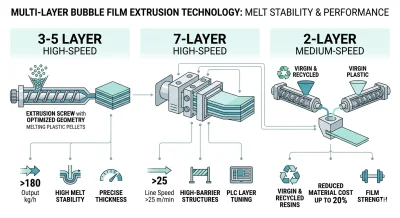
| 3-5 Layer High-Speed | Optimized screw profiles, energy-efficient servo systems | Stable melt viscosity and precise thickness control at high output |
| 7-Layer High-Speed | PLC-driven layer ratio tuning, automated diagnostics | Precise barrier structures at high line speeds |
A 3 to 5 layer high-speed bubble film machine illustrates this balance well, using optimized screw profiles and energy-efficient servo systems to maintain high melt stability and precise thickness control even at substantial output levels. That combination of throughput and consistency is what allows mid-tier converters to scale production without the melt instability that often accompanies faster line speeds on less refined equipment.
At the upper end of the range, a 7-layer high-speed machine is built for high-barrier specialty applications such as e-commerce mailers, where integrated PLC control allows real-time tuning of layer ratios and temperature profiles during production rather than requiring a full stop for adjustment. This level of responsiveness matters most for converters producing complex, multi-functional film structures where even small deviations in layer ratio can affect barrier performance.
On the more cost-focused end of the spectrum, a 2-layer medium-speed machine specializes in co-extruding virgin and recycled resins together, allowing manufacturers to meaningfully reduce raw material costs while maintaining the structural strength the finished film needs. For converters under pressure to lower per-unit costs without compromising on quality, this configuration offers a practical path to doing both at once.
Energy Efficiency and Operational Reliability as Long-Term Value Drivers
Capital cost is only part of the total ownership equation—energy consumption and scrap reduction compound significantly over years of continuous operation. The combination of advanced screw geometry and PLC-driven diagnostics helps reduce specific energy consumption meaningfully compared to conventional equipment, an advantage that becomes increasingly significant as energy costs rise and sustainability reporting becomes a standard part of supplier evaluation.
Automated tension control adds a further layer of operational security. High-speed lines equipped with dual servo winders and tension sensors automatically adjust nip-roll pressure in response to real-time conditions, preventing the film wrinkling that would otherwise generate scrap and interrupt continuous production. For manufacturers running extended shifts or 24-hour operations, this kind of automated correction reduces the need for constant manual oversight while protecting yield consistency across every batch.
Together, precise multi-layer co-extrusion, digital PID temperature regulation, and robust PLC diagnostics combine to make these systems a secure, profitable, and high-yield asset rather than simply a lower-cost alternative to premium equipment. The value proposition isn't cutting corners on engineering to hit a lower price—it's applying focused, well-tested technology across the specific systems that matter most for consistent output and long-term reliability.
A Practical Path to Balancing Performance and Investment
For manufacturers weighing where to source their next production line, the choice no longer needs to come down to a tradeoff between capital cost and technical capability. A well-engineered bubble film extrusion machine built around proven screw geometry, integrated PLC control, and automated tension management can deliver the melt stability, energy efficiency, and production flexibility that competitive packaging operations require, at a capital investment that keeps growth plans realistic. Manufacturers evaluating new equipment are well served by comparing these technical fundamentals directly against total cost of ownership, rather than purchase price alone, when selecting a production partner suited to their scale and application needs.