How Importing a Bubble Film Extrusion Machine Boosts Margins for Packaging Wholesalers
2026-09-02
Packaging wholesalers face constant pressure from changing resin prices, supplier lead times, transportation costs, and increasingly customized customer requirements. When finished bubble film is purchased entirely from external manufacturers, wholesalers have limited control over production costs and supply schedules.
Importing a bubble film extrusion machine can provide another option: bringing bubble film production in-house. For wholesalers with stable demand and sufficient production volume, this approach can improve control over material costs, product specifications, inventory, and delivery times while creating an opportunity to capture manufacturing value.
The Challenges of Relying on External Bubble Film Suppliers
Limited control over material costs
The price of finished bubble film reflects more than polyethylene resin. Processing, labor, energy, packaging, storage, transportation, and supplier margins all contribute to the final purchase price.
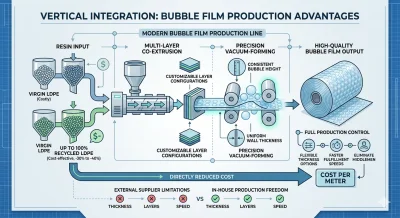
When resin prices fluctuate, wholesalers purchasing finished film have limited opportunities to optimize the material structure themselves. An in-house bubble film extrusion machine gives manufacturers greater flexibility to evaluate virgin LDPE, recycled LDPE, or blended materials according to the required product performance.
The appropriate recycled material ratio depends on resin quality, melt flow characteristics, contamination levels, film thickness, and application requirements. Proper formulation and testing can therefore provide additional opportunities for material cost optimization without relying entirely on the finished-film market.
Restricted specifications and longer response times
Packaging customers increasingly require different film widths, thicknesses, bubble sizes, colors, and functional properties. Standard bubble film may be sufficient for general e-commerce packaging, while electronics, appliances, glassware, and agricultural products may require more specific solutions.
When film is sourced externally, every specification depends on the supplier's available equipment and production schedule. This can make urgent orders, small batches, and customized products more difficult to manage.
With in-house production, wholesalers can adjust production according to their own order schedule and equipment configuration, providing greater flexibility for different customer requirements.
Pressure on distribution margins
Wholesalers traditionally earn mainly from the difference between purchasing and selling prices. However, the finished-film price already includes upstream manufacturing and logistics costs.
Producing bubble film internally changes this structure. A wholesaler can manage both manufacturing and distribution, potentially retaining part of the value that previously remained with the upstream producer. At the same time, better control over inventory and production scheduling can reduce dependence on external supply during periods of high demand.
Why Bubble Film Remains Important in Packaging
Bubble film is widely used for cushioning and surface protection because it combines low weight with practical impact protection. It is commonly used in e-commerce fulfillment, appliance packaging, furniture components, glass and ceramic products, electronics, and general industrial packaging.
Different applications place different requirements on the material. E-commerce operations often prioritize lightweight film and cost efficiency, while fragile products require consistent cushioning and surface protection. Electronics packaging may require antistatic properties, while outdoor applications can benefit from UV-resistant formulations.
These changing requirements make production flexibility increasingly valuable. For some packaging wholesalers, owning production capacity can become a strategic supply-chain decision rather than simply an equipment investment.
How a Bubble Film Extrusion Machine Can Improve Production Economics

Multi-layer co-extrusion and stable bubble forming
A multi-layer bubble film extrusion machine can combine different polyethylene materials within one film structure. This provides greater flexibility when balancing mechanical properties, material consumption, and product requirements.
Controlled extrusion and forming systems help maintain consistent film thickness and bubble dimensions during continuous production. Stable bubble formation is particularly important for wholesalers supplying appliances, precision products, glassware, and other applications where packaging consistency matters.
Improved process stability can also help reduce material waste caused by excessive thickness variation or unstable bubble formation.
Recycled LDPE compatibility
Material efficiency is an important part of bubble film production economics. Depending on the required quality and application, manufacturers may use virgin LDPE, recycled LDPE, or a combination of different materials.
A suitable extrusion system can provide the processing flexibility needed for different formulations. Instead of simply maximizing recycled content, manufacturers can determine an appropriate ratio through material testing and production trials.
For high-volume packaging orders, optimizing resin selection and material consumption can have a meaningful effect on overall production costs.
Capacity matched to actual demand
Not every wholesaler requires the same production capacity. A lower-speed bubble film extrusion machine can be suitable for standard products and businesses transitioning from finished-film purchasing to in-house production.
Medium-capacity systems can provide a balance between output and flexibility, making them suitable for wholesalers handling multiple specifications and frequent order changes.
For businesses with consistently high demand, higher-output and multi-layer configurations can provide greater production capacity. However, machine selection should consider film width, thickness, bubble size, layer structure, material formulation, and expected utilization rather than focusing only on maximum output.
A machine operating at a suitable utilization rate will generally provide a more practical production economy than an oversized line that remains underused.
Functional additives and customized products
In-house production also creates opportunities to manufacture differentiated bubble film products.
Antistatic additives can be considered for electronics and sensitive components. UV stabilizers can be used for applications involving outdoor exposure, while masterbatch can provide customized colors for product identification, packaging classification, or branding.
This flexibility allows wholesalers to move beyond standard commodity film and provide packaging materials tailored to specific customer requirements.
Build Greater Control with In-House Bubble Film Production
For packaging wholesalers with consistent demand, importing a bubble film extrusion machine can provide a path from simple film distribution toward integrated manufacturing and supply.
Our bubble film extrusion machines are designed for manufacturers and packaging businesses that need stable production, flexible material options, and different capacity configurations. Multi-layer extrusion, controlled bubble forming, and adaptable production setups provide the flexibility needed for standard and customized bubble film applications.
By selecting the appropriate machine configuration according to film width, thickness, layer structure, target output, and material requirements, wholesalers can build an in-house production system focused on practical capacity, material efficiency, consistent quality, and long-term operating value.