How to Reduce Waste in Bubble Film Extrusion Machine
2026-08-19
Material waste directly affects production costs, material utilization, and overall efficiency in protective packaging manufacturing. In bubble film production, unstable temperatures, inconsistent airflow, poor thickness control, and inefficient material changes can all increase scrap. For manufacturers seeking thinner, stronger, and more sustainable packaging, precise process control is becoming increasingly important.
A well-designed bubble film extrusion machine can help reduce unnecessary waste by improving melt stability, bubble formation, thickness consistency, and production automation. The goal is not simply to increase output, but to produce more qualified film from the same amount of raw material.
Common Causes of Waste in Bubble Film Production
Waste can occur at almost every stage of bubble film production. One common problem is fluctuating melt temperature. If the polymer is not heated consistently, melt viscosity can change, affecting extrusion stability and film uniformity. Excessive temperatures may also increase the risk of material degradation.
Unstable airflow can create another source of waste. Bubble formation depends on consistent air pressure and cooling conditions. Variations may cause uneven bubble dimensions, wrinkles, unstable edges, or thickness fluctuations.
Material changes and product transitions can also generate significant scrap. Switching between LDPE, LLDPE, masterbatch formulations, or suitable recycled materials requires adjustments to extrusion and cooling conditions. Without controlled transitions, more film may need to be discarded before stable production is restored.
These problems are often interconnected. Improving only one parameter may not deliver a significant reduction in total waste. Effective waste control requires coordinated management of extrusion, temperature, airflow, cooling, and winding.
Why Bubble Film Requires Precise Process Control
Bubble film is widely used for protecting furniture, glass, electronics, household products, industrial components, and e-commerce shipments. Its air-filled structure provides cushioning against impact and vibration while helping prevent surface damage.
At the same time, packaging manufacturers are increasingly looking for thinner films that maintain adequate protective performance. Using less material requires better thickness control because excessive thickness increases consumption, while localized thin areas can affect film performance.
This makes extrusion precision particularly important. A stable bubble film extrusion machine can help manufacturers achieve more consistent film structures while improving material utilization.
Precision Melt Temperature Control
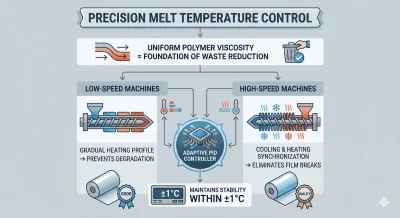
Stable melt temperature is one of the foundations of efficient extrusion. A controlled heating and cooling system helps maintain more consistent polymer processing conditions and supports stable melt viscosity.
PID temperature control can continuously compare actual and target temperatures and adjust heating output accordingly. The actual stability depends on the resin, machine configuration, ambient conditions, and operating parameters, but accurate control helps reduce unnecessary temperature fluctuations.
For lower-speed production, progressive heating can reduce temperature overshoot and unnecessary heat input. For high-output production, coordinated heating and cooling become increasingly important because the extrusion system operates under higher thermal loads.
The objective is to establish an appropriate temperature profile for each material and production condition rather than simply maintaining one fixed temperature throughout the process.
Stable Airflow for Better Bubble Formation
Consistent airflow is essential for stable bubble formation. The air ring and cooling system need to provide uniform conditions around the bubble structure to minimize variations in bubble size and film geometry.
This becomes more important with three-layer, five-layer, and seven-layer bubble film production. Multilayer structures offer greater flexibility in material distribution, but they also require coordinated extrusion rates, air pressure, cooling, and line speed.
A properly configured airflow and cooling system can help reduce bubble instability, edge variation, wrinkles, and other defects that may result in rejected film or additional trimming.
Efficient Material and Product Transitions
Startup and material changes are common sources of production waste. When switching between different resin grades, thicknesses, widths, or bubble specifications, the extrusion system needs time to reach stable conditions.
A controlled transition process can reduce unnecessary scrap. Screw speed, feeding rate, melt temperature, cooling conditions, and winding speed should be adjusted in coordination rather than independently.
PLC automation can further improve repeatability by storing production recipes and allowing operators to recall suitable settings for different products. While the actual amount of transition waste depends on the materials and production conditions, automated parameter management can reduce manual adjustment errors and shorten the stabilization process.
PLC Automation and Thickness Control
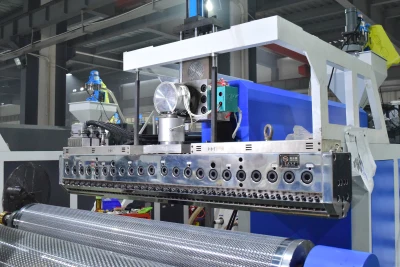
Modern extrusion lines can use PLC systems and online monitoring to improve process consistency. Key parameters such as temperature, extrusion speed, cooling conditions, and winding speed can be monitored and managed through a centralized control system.
Online thickness measurement is particularly useful for thin bubble film. It allows operators to identify thickness deviations during production instead of discovering problems only after a complete roll has been produced.
Automation does not replace operator experience. Resin properties, equipment condition, ambient temperature, and product specifications still influence production results. Instead, automation provides faster feedback and more repeatable control, helping operators maintain the process within the desired production range.
Optimize the Machine Configuration for Material Efficiency
Waste reduction should begin when selecting the machine configuration. The production line should match the required film width, thickness, structure, output, and material combination.
Two-layer and three-layer systems can provide practical solutions for standard protective packaging, while five-layer and seven-layer configurations offer greater flexibility for demanding applications.
Multilayer extrusion can also help manufacturers distribute materials more efficiently. Where specifications permit, selected layers can incorporate suitable recycled materials while maintaining the required performance in functional layers. This approach can improve material efficiency without simply increasing overall film thickness.
Practical Ways to Reduce Scrap
Manufacturers can improve material utilization by maintaining stable extrusion temperatures, monitoring airflow and cooling conditions, optimizing die and bubble settings, and keeping extrusion and winding speeds synchronized.
Preventive maintenance is equally important. Worn components, unstable sensors, contamination, and poor cooling performance can gradually increase process variation. Regular inspection helps keep the equipment operating within its intended range.
Production data should also be reviewed regularly. Tracking startup scrap, transition waste, edge trim, rejected rolls, and material consumption can reveal where the largest losses occur. This allows process adjustments to be based on actual production data rather than assumptions.
Build a More Efficient Bubble Film Production Line
Reducing waste in bubble film production is not achieved through one single component. It requires coordinated control of extrusion, temperature, airflow, cooling, material feeding, thickness, automation, and winding.
Our bubble film extrusion machine solutions are designed to provide stable production and efficient material utilization across different film structures and output requirements. From practical two-layer and three-layer lines to advanced five-layer and seven-layer configurations, the equipment can be configured according to film specifications, materials, production capacity, and factory requirements.
With controlled extrusion, stable bubble formation, efficient cooling, and automated process management, our bubble film extrusion machine provides a reliable foundation for reducing unnecessary waste while maintaining consistent film quality.
Explore our bubble film extrusion machine solutions to improve production stability, reduce unnecessary material waste, and build a more efficient packaging film production line.Our technical team can help you select a suitable machine configuration based on your film specifications, production capacity, material requirements, and long-term production goals.