The Importance of Regular Calibration for Your Extrusion Machine
2026-08-28
Bubble film casting is a high-precision process, and precision is exactly where small problems hide the longest. A parameter drift too subtle to notice on the control panel can still show up downstream as thickness variation, weakened barrier properties, and material that never should have left the die. Whether the line in question is a 2-layer medium-speed bubble film machine or an advanced 7-layer high-speed configuration, keeping every sensor and control loop calibrated is one of the simplest ways to protect output quality before it ever becomes a customer complaint.
When Sensor Drift Becomes the Real Root Cause
Most instability traced back through a production line eventually lands on the same culprit: sensor drift. Thermocouples and pressure transducers are built to hold tight tolerances, but months of continuous operation gradually wear at that precision, and the shift is often too gradual for operators to catch by feel alone.
On the thermal side, a thermocouple reading off by just two degrees Celsius is enough to create a localized hot spot inside the extruder barrel. That hot spot accelerates polymer degradation in a small pocket of material, and the result surfaces later as gels or black specks scattered through an otherwise clean roll of film. On the pressure side, even a small amount of hysteresis in a pressure transducer, on the order of half a percent, is enough to destabilize melt pump output and die head pressure. That instability is one of the most common causes of periodic gauge bands and inconsistent bubble formation, defects that tend to repeat in a rhythmic pattern rather than appearing randomly, which makes them especially frustrating to diagnose without checking the sensors first.
Keeping Multiple Layers in Rheological Agreement
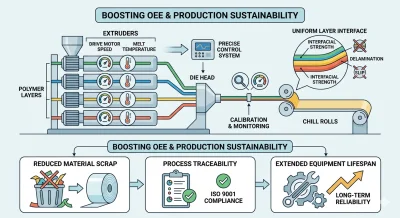
For manufacturers running 3-layer, 5-layer, or 7-layer high-speed bubble film machines, calibration carries even more weight, because interlayer compatibility depends on it directly. Each polymer layer in a co-extrusion process can behave differently under heat and shear, and if drive motor speeds and melt temperatures are not kept in close synchronization, those differences start to show at the interface between layers rather than staying contained within each one.
Systematically calibrating motor speed against melt temperature keeps viscosity and elastic recovery consistent across every layer, which is what allows the layers to bond and move together as the film is drawn and cooled. Without that consistency, interlayer slip and delamination become far more likely, and a multi-layer structure that was designed for a specific balance of strength, clarity, and barrier performance ends up falling short of the industrial standards it was supposed to meet. Calibration in this context is less about any single measurement being accurate and more about every layer agreeing with every other layer at the same moment in the process.
Turning Precision Into Measurable Production Gains
The payoff from staying ahead of sensor drift shows up directly in Overall Equipment Effectiveness, and it does so in ways that compound over a full production run rather than showing up as a one-time improvement.
A properly calibrated machine holds melt pressure at its optimal point, which noticeably reduces both edge trim and start-up waste, two categories of scrap that quietly erode margin even when a line looks like it is running well. Regular calibration also generates the kind of documented measurement traceability that quality systems like ISO 9001 expect to see, which matters increasingly to export customers who audit suppliers before placing large orders rather than after receiving a damaged shipment. Preventing motor overload and heater fluctuation through consistent calibration further reduces mechanical wear across the line, extending the working life of components that are far more expensive to replace than they are to maintain.
Why This Matters Most Where Tolerances Are Tightest
Calibration tolerances that seem minor on a data sheet become significant the moment a roll of film ships to a customer with strict quality requirements. Food-contact and personal care packaging is a clear example, since buyers in this space routinely reject rolls that show even minor cosmetic defects like gels or black specks, regardless of whether the film's mechanical performance is otherwise unaffected. A hot spot caused by a two-degree thermocouple error is invisible on the production floor but immediately obvious to a quality inspector holding the finished roll up to the light.
Export-focused manufacturers face a related but distinct challenge during supplier audits. International buyers increasingly expect calibration records and measurement traceability documentation as part of their qualification process, not as an afterthought requested after a quality issue arises. A facility that can produce clean calibration logs on request moves through supplier audits faster and with fewer follow-up questions, while one that cannot risks losing qualification entirely regardless of how the film itself performs. In both cases, the underlying issue traces back to the same root cause: sensors and control loops that were never given the routine attention needed to keep them within spec.
Building Calibration Into the Machine Itself
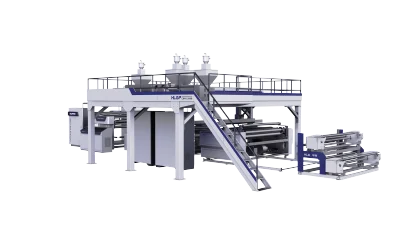
Our bubble film extrusion machine platforms are engineered with this reality in mind, pairing high-precision thermocouples and pressure transducers with control systems built for long-term measurement stability rather than accuracy that degrades quietly over time. Thermal zones are monitored closely enough to catch the kind of two-degree drift that creates hot spots before it ever reaches the film, and pressure control is tuned to hold melt pump and die head stability well within the range that prevents gauge banding.
For manufacturers running multi-layer co-extrusion, motor speed and melt temperature calibration are treated as a single coordinated system rather than separate adjustments, which keeps every layer's viscosity and elastic recovery working in agreement rather than drifting apart. That coordination is what allows our 2-layer, 3-layer, 5-layer, and 7-layer bubble film machines to hold structural integrity across a wide range of production speeds without sacrificing the layer bonding that determines final film strength.
Secure Your Competitive Edge Through Consistency
Regular calibration is easy to treat as routine maintenance, but it functions as something closer to a strategic investment in production reliability and market reputation. Eliminating the variables that lead to downtime, rejected rolls, and failed audits means every shipment leaves the facility meeting the specifications a customer expects, rather than the specifications the machine happened to deliver on a given day.
If your extrusion line is due for a closer look at its sensing and control systems, our team works with manufacturers running everything from 2-layer medium-speed bubble film machines to advanced 7-layer high-speed platforms, and we are glad to walk through what a calibration review would look like for your specific setup. Reach out for a technical consultation or a quote on our high-speed multi-layer bubble film extrusion machine solutions, and let's build a more efficient, zero-defect production future together.