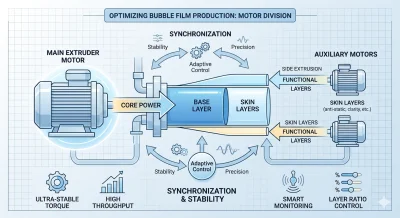
The drive system is one of the key factors determining the production stability and film quality of a modern bubble film making machine. In multi-layer co-extrusion production, different components within the extrusion system work together to control material melting, conveying, layer distribution, and bubble formation. Among these components, the main extruder motor plays a central role because it provides the primary power source for plasticizing and transporting polymer materials through the extrusion process.
In bubble film production, the performance of the main extruder motor plays an important role in melt stability, production efficiency, and final film consistency. A properly designed drive system helps maintain stable extrusion conditions and supports reliable long-term operation of the machine.
The Role of the Main Extruder Motor in Co-Extrusion Production
In a co-extrusion bubble film making machine, the main extruder is usually responsible for processing the primary resin layer, which forms the structural foundation of the bubble film. Compared with auxiliary extruders that add functional layers such as anti-static, color, or barrier properties, the main extruder typically handles a larger material volume and requires higher torque capability.
During extrusion, polymer materials must pass through several stages, including feeding, melting, mixing, and conveying. Any instability in screw rotation speed or torque output can influence the pressure inside the extrusion system. Since extrusion pressure affects melt flow through the die head, fluctuations may lead to uneven film thickness, inconsistent bubble formation, and variations in product performance.
A stable main extruder motor helps maintain consistent screw speed and provides continuous power output under changing production conditions. This stability is especially important when processing materials with different viscosities or when operating the machine at higher production speeds.
Challenges Affecting Extrusion Stability
One of the major challenges in bubble film production is maintaining uniform melt flow during continuous operation. Polymer materials such as LLDPE, LDPE, and modified resin blends may have different flow characteristics depending on their formulation and processing temperature. Without sufficient motor torque and accurate speed control, the extrusion process may experience unstable material conveying.
For multi-layer bubble film production, synchronization between the main extruder and auxiliary extruders is also essential. Each extruder contributes a specific layer thickness and material function. If the rotation speed of the main drive changes unexpectedly, the layer distribution ratio may be affected, reducing the consistency of the final film structure.
For example, a bubble film designed with a stronger core layer and functional surface layers requires precise coordination between multiple extrusion units. Stable motor performance helps each extruder maintain its designed output ratio, supporting better layer bonding and reducing the possibility of uneven material distribution.
Another important consideration is the processing of recycled materials or specialty additives. Modern bubble film manufacturers increasingly use recycled content and functional masterbatches to meet different market requirements. These materials may create additional load variations during extrusion. A high-performance main extruder motor with accurate control capability can respond more effectively to these changes and maintain stable operation.
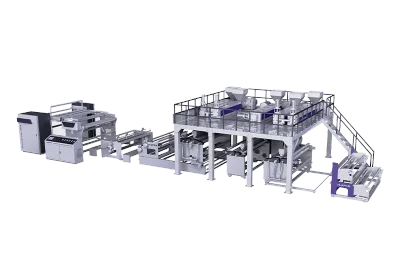
Engineering Features of an Advanced Main Extruder Motor
The performance of a main extruder motor depends not only on rated power but also on torque characteristics, speed control accuracy, energy efficiency, and integration with the machine control system.
High-torque capability is one of the most important requirements for extrusion applications. During plasticization, the screw must overcome material resistance inside the barrel. A motor with stable torque output can maintain consistent screw rotation even when processing materials with higher viscosity or when production conditions change.
Modern bubble film making machines commonly combine efficient AC motors or permanent magnet synchronous motors with variable frequency drive (VFD) systems. The VFD allows precise adjustment of motor speed according to production requirements and provides better coordination between the main extruder and auxiliary units.
Through digital control, operators can adjust extrusion parameters more accurately, helping maintain stable output during different production stages. This is particularly valuable for manufacturers producing different film specifications, where rapid adjustment and repeatable processing conditions are required.
Thermal management is another important aspect of motor reliability. Because the main extruder motor operates continuously under significant mechanical load, effective heat control helps maintain long-term performance. Advanced systems may integrate monitoring functions that allow operators to observe operating conditions such as current load and temperature status through the machine control interface.
Improving Film Quality Through Drive System Optimization
The quality of bubble film depends on the cooperation of multiple systems, including extrusion units, die heads, cooling systems, and winding mechanisms. The main extruder motor provides the foundation for stable material processing, which directly supports consistent film production.
When the motor maintains stable screw speed and torque output, the extrusion process becomes more predictable. This helps manufacturers achieve more uniform bubble structures, stable film thickness, and consistent mechanical properties.
For industrial packaging applications, these advantages are important because bubble film must provide reliable cushioning and protection during transportation. Products such as electronic components, precision instruments, furniture, and export goods often require packaging materials with stable impact resistance and dimensional consistency.
A reliable main drive system also helps reduce material waste. During startup, speed changes, or product changeovers, accurate motor control allows the extrusion process to reach stable conditions more quickly. This can reduce the amount of off-specification film and improve overall production efficiency.
Energy Efficiency and Long-Term Production Reliability
Energy consumption is an important consideration for modern film manufacturers. Since the main extruder motor operates continuously during production, its efficiency has a direct influence on operating costs.
High-efficiency motors combined with optimized drive control can improve energy utilization by adjusting power output according to actual extrusion requirements. Instead of operating at unnecessary power levels, the system can provide the required torque and speed more efficiently.
In addition, stable motor operation reduces mechanical stress on related components such as the gearbox, screw, and transmission system. This contributes to longer service intervals and helps manufacturers maintain continuous production with fewer interruptions.
Advanced Drive Systems for High-Performance Bubble Film Making Machines
The main extruder motor is a critical component that supports the overall performance of a co-extrusion bubble film making machine. Through stable torque output, accurate speed control, and efficient operation, it helps maintain consistent extrusion conditions and improve the reliability of film production.
Our bubble film making machines are designed with advanced extrusion drive systems to provide stable material processing, precise control, and reliable production performance. By optimizing the main extruder motor configuration and integrating intelligent control technology, our machines help manufacturers produce high-quality multi-layer bubble films with improved efficiency and consistent output.
Whether for standard protective packaging or customized industrial applications, our equipment provides a dependable solution for companies seeking stable operation, flexible production capability, and long-term value from their bubble film production lines.